Why Fast Guitar Playing Feels So Much Harder Than It Should - And How To Fix It In 30 Days
Something is wrong - and it's not what you think.
You've been practicing for years. You can play. You have real ability in both hands. But every time you push the tempo past a certain point, everything turns to mud. Clean notes become a blur. Timing drifts. Passages that sound fine at 80% speed collapse into noise at full tempo.
And it feels much harder than it should.
Not "challenging" in the way learning something new feels challenging. Harder. Like you're fighting your own hands. Like something invisible is working against you - turning every fast passage into a struggle that players at your level shouldn't be having.
You're right. Something is working against you. And until you fix it, playing fast will always feel like a battle you're losing.
The Biggest Secret To Building Speed Has Nothing To Do With Your Hands
Here's something almost no speed course will ever tell you:
What you think about during practice matters more than what your hands do.
Your mental focus during each repetition determines whether your brain builds the right neural pathways or reinforces the same broken patterns that have kept you stuck. Most guitarists practice with their hands while their brain drifts somewhere else entirely. They focus on the wrong things, at the wrong times, in the wrong sequence.
The result? Years of practice that produce almost nothing. Not because they're lazy. Not because they lack talent. Because the alignment between focus and action was never there.
This course tells you exactly what to think about during every practice session. Not vague advice like "focus on accuracy" - specific mental processes that change what your nervous system builds as you play. This is one of the most powerful elements in the entire system ... and it's the one thing no other course addresses.
The Problem Isn't Your Hands. It's The Connection Between Them.
Most guitarists believe their speed problem lives in their fingers. One hand is "slower" than the other. So they train that hand harder. They grind through exercises. Nothing changes.
Because the problem was never about either hand being too slow. The problem is that your two hands are out of sync - and that problem doesn't live in your hands at all. It lives in your brain.
95% of guitar speed is neurological - built in the brain, not in the muscles. The neural pathways that coordinate your two hands are what determine how fast you can play cleanly. Those pathways don't develop through general practice, don't develop by working each hand separately, and definitely don't develop by playing the same exercises faster and hoping something clicks.
Imagine your real potential is 200 BPM. That's the speed your nervous system could produce if both hands were perfectly coordinated. But because they arrive at slightly different microsecond intervals - your pick strikes a fraction too early, your fretting finger lands a fraction too late - your usable speed drops to 140 BPM. Maybe less.
That gap isn't talent. It isn't genetics. It's synchronization - a specific, trainable skill you've never trained directly. And it's the reason playing feels so much harder than it should.
Your Ears Can't Keep Up With Your Hands - And That Changes Everything
This is something almost nobody talks about:
At slower speeds, your ears can hear every detail. You can catch mistakes, feel when something is off, and correct it. Your brain has enough processing time to monitor what both hands are doing.
But when you push the tempo up, your ears lose the ability to track what's happening. Flaws that only exist at higher speeds - tiny synchronization errors, timing drift, tension spikes - become invisible to you. You can sense that something is wrong, but you can't identify what it is, why it's happening, or how many things are breaking down at once.
Here's why this traps you: when you slow back down to "practice carefully," those specific flaws disappear. They only exist at speed. So you're left in a cycle - unable to hear the problems at tempo, unable to find them at slow speeds, unable to fix what you can't detect.
This course includes specific perceptual training that teaches your ears to process what's actually happening at speeds where they currently can't. This isn't a minor detail. It's the difference between practicing blind and practicing with total awareness of exactly what needs to change.
Why Nothing You've Tried Has Fixed This
Speed courses exist. Some have decent ideas. But they're incomplete - they address pieces of the problem while missing the combinations that actually produce results. Having 4 of 7 ingredients for a recipe means you have real ingredients, but you'll never get the dish.
There's another problem: most speed training was created by players who never struggled with speed. It came naturally to them. They can demonstrate fast playing. They can show exercises. But they've never taken ordinary players - people stuck at the same speed for years - and systematically broken them through every barrier to clean, effortless speed. That's a completely different skill.
If You Already Own The Picking Or Fretting Hand Course, Read This Carefully
Training your picking hand makes your picking hand faster. Training your fretting hand makes your fretting hand faster. But having two fast hands doesn't mean they work together.
Synchronization is a completely different neurological skill. Your brain coordinates your two hands through separate neural pathways than the ones controlling each hand individually. Training each hand to move faster does absolutely nothing to train those coordination pathways. Nothing.
This is why players with fast hands still produce sloppy playing at speed. The individual hand speed is there. The coordination between them is not.
This course trains a skill the other two courses were never designed to address - because synchronization requires fundamentally different training methods, different mental focus, and a different sequence of neurological development. If you've already built individual hand speed, this is the piece that makes all of it usable.
What This Course Actually Does
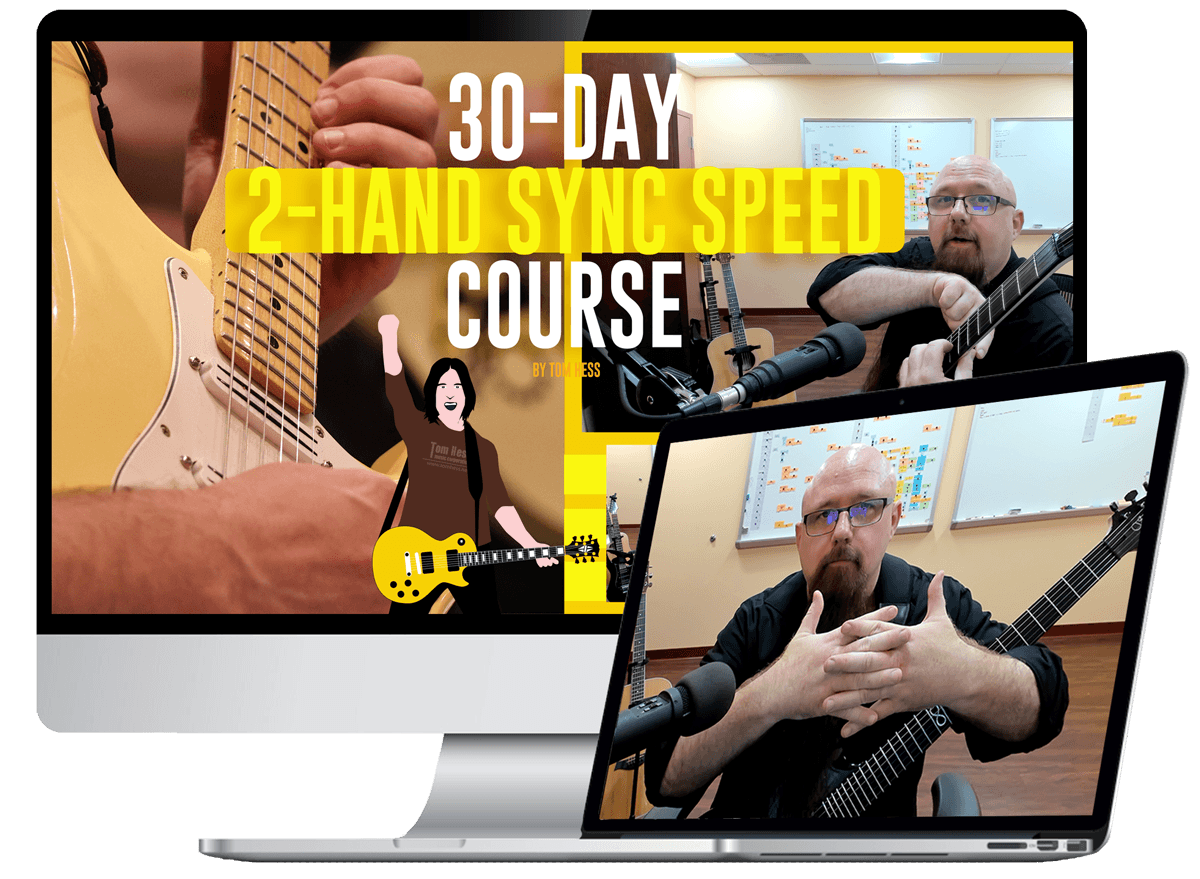
The 30-Day 2-Hand Synchronization Speed Course doesn't train your hands to move faster. It trains your brain to coordinate them with precision - so the speed you already have becomes clean and usable.
It combines multiple proprietary training methods - hand alternation protocols, synchronization diagnostics, threshold identification, neural pathway integration, tension optimization, targeted high-speed correction, and the perceptual training described above - into a specific 30-day sequence where each element builds on what came before.
The individual methods are powerful on their own. The real breakthrough comes from how they're combined, alternated, and integrated. That integration is what no other course offers - because no other course creator has developed it.
This is why some of the largest groups of buyers for this course are other guitar teachers. They invest in this training to learn what they can't figure out on their own - and to get results for their students that no other approach has produced. When professional guitar teachers pay to learn a methodology, that tells you where it sits relative to everything else available.
15 Minutes A Day. Three 5-Minute Sessions.
This course uses three 5-minute practice sessions spread throughout your day. Not back-to-back. Separated by hours.
Your nervous system builds speed between sessions - during rest - not during practice. The neural pathways controlling hand coordination develop when you're NOT playing. Short focused sessions with gaps between them produce dramatically faster results than grinding through one long block.
Five minutes with your morning coffee. Five minutes at lunch. Five minutes before bed. You're not adding to your schedule. You're using time you're currently wasting.
What You're Getting
30 daily video lessons. Day 1 unlocks immediately. Each following day, the next video unlocks automatically. One per day - because this kind of neurological training requires discipline, not binge-watching.
Each video shows you exactly what to practice, exactly how to do it, exactly what to think about and listen for. No guesswork. No figuring it out on your own. No wondering if you're doing it right.
You get the specific practice sequences, the mental focus protocols, the self-diagnostic tools to identify your exact breakdown points, the perceptual training for your ears, and the day-by-day progression that builds each element in the right order. Everything is structured so that each day's training builds on what your nervous system encoded the day before.
What Happens Over 30 Days
Days 1-10: You'll discover how disconnected your hands actually are - and begin retraining the neural pathways that link them. You'll develop awareness you've never had: where exactly the sync breaks down, what your brain is doing wrong during fast passages, and why your previous approaches reinforced the problem.
Days 11-20: Your hands start arriving together. Passages that fell apart begin holding at higher tempos. Something unexpected happens: playing starts feeling easier. Not because you're working harder - because you've eliminated the internal friction that was making everything unnecessarily difficult. The coordination becomes automatic.
Days 21-30: Everything you built in the first 20 days unlocks tempos your nervous system couldn't access before. Students reach this phase and realize they're playing passages that felt impossible a month earlier - with less effort than they used to spend at slower speeds.
"My clean speed ceiling was stuck at about 140 BPM for over two years. I'd done exercises, watched videos, practiced scales for hours - nothing moved it. After 30 days with this course, I tested at 185 BPM clean. Not sloppy-fast. Clean. The difference was that I finally understood what was actually breaking down at speed - and it wasn't what I thought."
- Mark Rivera, USA
"I'm a guitar teacher with over 200 students. I bought this course expecting to pick up a few tips. Instead, it completely changed how I understand speed development. I've been teaching for 12 years and had never addressed synchronization as its own skill - because I didn't know it was one. My own playing got faster, and now my students are breaking through plateaus I couldn't help them with before."
- David Engström, Sweden
This Training Is Based On My $2,000 - $3,500 Live Events
Students who attend my intensive live training events pay $2,000 to $3,500 for several days of in-person instruction. At these events, students routinely achieve speed gains that sound impossible until you watch them happen in real time.
The synchronization methodology in this course is based on what I teach at those events - structured into a focused 30-day home study program for a fraction of the cost.
"I not only increased my solo speed, I can now play my solos with accuracy and a confidence I have never had! It has opened up a world of the way dreams are made of. Thank you Tom Hess!"
- Andy Thacker, USA
Who This Is For
This course is for intermediate through highly advanced players whose playing falls apart at speed - even though each hand can move.
You might be self-taught. You might already train with me. You might have played for 5 years or 25. If your hands stop cooperating above a certain tempo - if clean, fast playing still feels unreliable - this course will break you through.
This is NOT for complete beginners. If you're still learning basic chords, you're not ready for this.
This is NOT for people who won't follow instructions. If you're going to skip days, combine your three sessions into one block, or modify the exercises - don't buy this. You'll waste your money and blame the course for results you sabotaged.
The Investment
You get the complete course for $297.
To put that in perspective: students pay $2,000 to $3,500 to attend my live events where I teach this methodology in person. Private instruction to cover what this course teaches would cost $1,000+ over 30 sessions. You're getting a complete, structured system based on that same methodology for less than the cost of two private lessons with most qualified teachers.
Guitar players spend more than this on gear that doesn't improve their playing. They spend more than this on lessons that never address synchronization directly. They spend years grinding through methods that were never designed to solve this problem.
$297 to fix the invisible bottleneck that's been holding your speed back for years. That's less than $10 per day for 30 days of targeted neurological training that permanently changes how your hands work together.
No Refunds
There are no refunds. Not because the course doesn't work - you've seen what my students achieve. But because this course is designed for players committed enough to follow through without an escape hatch.
If you need a guarantee before you'll commit to 15 minutes a day for 30 days, this isn't for you. If you're serious - if you'll follow the system exactly - you will be playing faster and cleaner in 30 days. That's not a promise. That's what happens when students do the work.
Imagine This
Thirty days from now, you pick up your guitar and play a passage that always fell apart at speed.
But this time, both hands lock together. The notes ring clean. The timing is tight. You push the tempo higher ... and it holds. Higher still ... and it's still there. Clean. Controlled. Your hands working as one unit instead of fighting each other.
That feeling of never knowing when it's all going to collapse? Gone. Replaced by something you may have stopped believing was possible: total confidence in your playing at any speed you choose.
That’s what happens when you stop training your hands separately and start training them to work together.
Or you could keep fighting the same invisible battle you’ve been losing for years.
How Long Has Playing Felt Harder Than It Should?
Six months? A year? Your entire playing life?
Every time you fight through a lick that should be flowing ... every time you hold back because you don't trust your hands to stay together ... every time you slow down a lick because you know it will fall apart at tempo - that's synchronization. A specific problem with a specific solution.

|
Tom Hess |
 |

P.S. - Already own the 30-Day Picking Hand Speed Course or the 30-Day Fretting Hand Speed Course? Those courses trained each hand to move faster individually. This course trains your brain to coordinate them. Without synchronization, two fast hands still produce sloppy playing. With it, the speed you built in those courses becomes fully usable. You trained your hands - now make them work together.
Frequently Asked Questions:
Do I lose access to the course after 30 days? What if I can't start right away?
No, you don't lose access. The course is available for you in your student account and will remain available for as long as your account is active. So you can start the course today, or you can start it two weeks from now, or 2 years from now - it' always there for you.
What if I can't practice on a specific day throughout the 30 days?
If you can't practice on a specific day once you start the training, no problem. Let's say you miss day 6 on a Tuesday, then simply do day 6 on Thursday. If for example you can't do all three 5-minute sessions on a specific day, let's say day 13, then repeat day 13 the next day. You don't have to finish the course in exactly 30 days... and you don't have to start immediately.
I'm 78 years old and took up the guitar again after a hiatus. I do have some physical issues in my hands - I'd like to know whether this course is for me.
A huge portion of my students are senior citizens, so when I created the course, I natually had this group in mind. So yes, I honestly believe this course can and will help you. The course is designed for very focused but short practice sessions 3x per day. Once your hands are warmed up, you'll only be training with the course for 5 minutes per practice session. That's it. I won’t bore you here with why the science behind this works but I’ll simply say that when we practice guitar, the highest quality of repetitions when practicing something happen in the beginning. The law of diminishing returns kicks in with repetitions happening 15, 30 or 60 minutes later.