Why Everything Feels Hard Beyond A Certain Tempo - And How To Fix It In 30 Days
Your fretting hand is stuck.
Maybe it's been stuck for months. Maybe years.
Below a certain speed, everything works fine. Notes ring clean. Fingers land where they should.
Push the tempo higher - and it falls apart.
Your fingers trip over each other. Your pinky won't cooperate. Your ring finger and pinky move like they're glued together. Legato passages that should flow turn into a tense, exhausting mess.
Everything that felt easy at 80 BPM becomes a battle at 120.
So you practice harder. Push more. Grind through (pointless) spider exercises until your hand aches. Squeeze tighter. Try to force your fingers to move faster.
Nothing changes.
You start wondering if it's your hands. Too small. Too big. Wrong genetics. You wonder if you're just not built for speed - if other players have something you don't.
Some guitarists eventually accept this. They settle for less than they're capable of. They give up on becoming the player they once believed they could be.
That's a tragedy. Because the limitation isn't real.
The problem isn't that you're not trying hard enough. The problem is that trying harder makes it worse.
You're not lacking potential. You're not limited by genetics, hand size, or age.
You're using too much tension.
Every guitarist who plateaus makes this mistake. They squeeze harder than necessary. They press the strings with far more force than the notes require. They carry tension in their fingers, hand, wrist, forearm - sometimes up to their shoulder - without realizing it.
That excess tension is usually the biggest culprit - though it's often not the only thing holding you back.
Either way, excess tension is a speed killer. It's like trying to sprint while clenching every muscle in your body. You can push harder. You can try more. But you'll never move fast until you stop fighting yourself.
Here's why this is so hard to fix on your own:
Some players don't even realize how much tension they carry - it feels normal because it's how they've always played. Others know they're too tense but have no idea how to actually fix it. "Relax" and "play lighter" sound simple ... until you try to do it consistently at speed and realize you have no idea what that actually means in practice.
There's a specific process for eliminating this tension. And it's the opposite of what most players try. The typical approach - start where you are and try to "reduce" tension - fails almost every time.
The real solution requires retraining your nervous system from the ground up. A completely different method that works WITH your biology instead of against it.
Get The Full 30-Day Course - $197
"But I Practice An Hour A Day And I'm Still Stuck"
If an hour of daily practice was going to fix your fretting hand speed, it would have worked by now.
Here's what most guitarists don't understand: your nervous system doesn't build speed during practice. It builds speed between sessions - during rest. That's when the neural pathways controlling your fingers actually develop and strengthen.
Grinding for an hour straight never gives your nervous system the gaps it needs to adapt. You're practicing, but you're not improving - because the adaptation happens after you stop.
This is why three short sessions spread throughout the day produce dramatically faster results than one long session. Five minutes in the morning. Five minutes midday (or early evening). Five minutes before bed. With breaks between them.
But here's what matters even more:
An hour of wrong practice just reinforces bad habits faster. You're not undertrained. You're mistrained. More volume of the wrong approach digs the hole deeper.
Fifteen minutes of the right training - structured correctly, spaced correctly, focused on the specific mechanisms that actually build speed - does what years of grinding never could.
The issue was never how much you practiced. It was what you practiced and how.
What Happens Over 30 Days
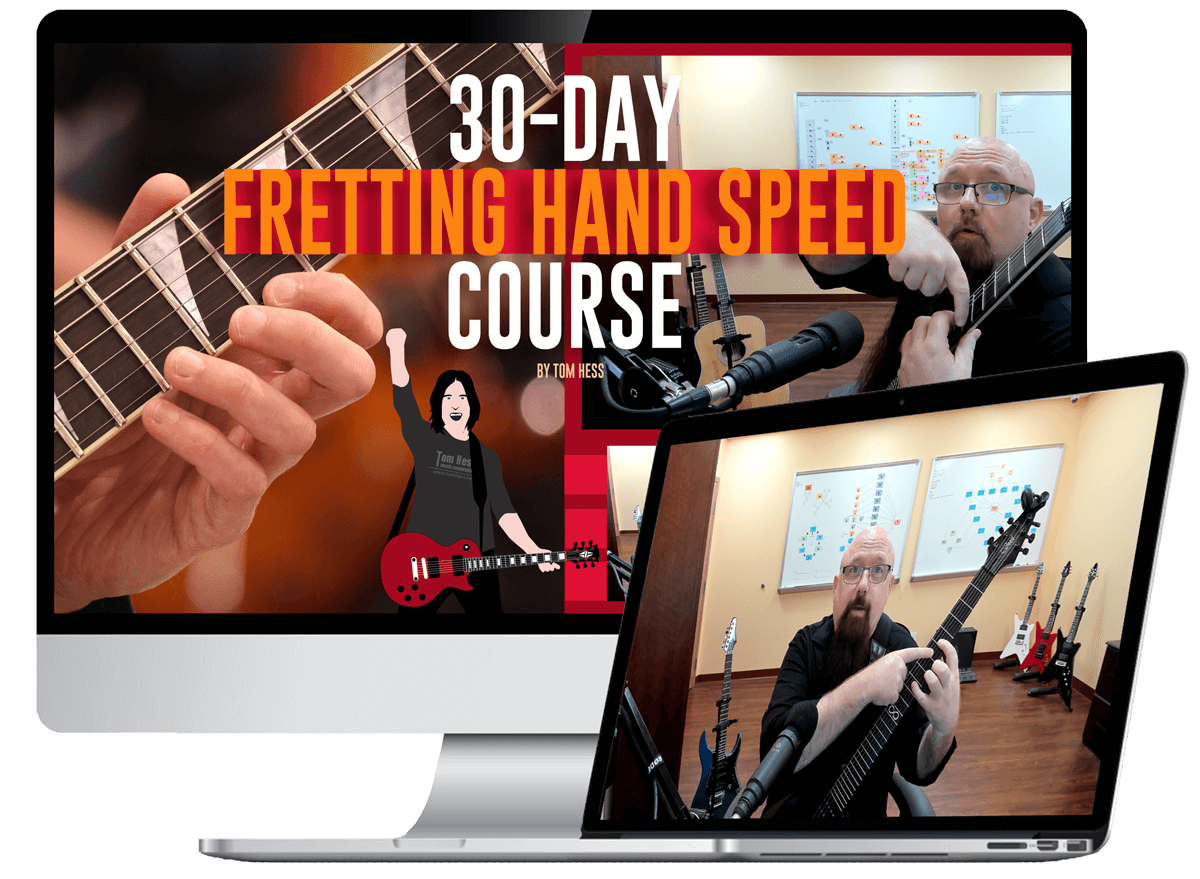
The 30-Day Fretting Hand Speed Course retrains how your fingers, hand, and nervous system work together. Tension elimination, finger independence, economy of motion, legato efficiency, neural pathway development - working in parallel throughout the program.
Days 1-10: You'll discover how much unnecessary tension you've been carrying - and begin eliminating it through a method that's the opposite of what you've tried before.
You'll develop awareness you've never had: micro-tensions you didn't know existed, inefficient movements bleeding speed from every note, habits that feel normal but silently hold you back.
You'll begin building real finger independence - especially between your third and fourth fingers, where most guitarists are weakest.
Days 11-20: The foundation compounds.
Your fingers start moving with less effort.
Legato passages that used to exhaust your hand become sustainable.
The tension patterns you've carried for years begin dissolving.
You'll feel the shift before you measure it - that sense of "everything is hard beyond a certain tempo" starts fading.
Days 21-30: This is where speed explodes.
Everything you built in the first 20 days unlocks tempos your nervous system couldn't access before.
Students reach this phase and realize they're playing passages that felt impossible a month earlier - with less effort than they used to spend playing slower.
The sequence matters.
Each phase builds on what came before.
The specific details - what to practice, exactly how to do it, what to listen for, how to self-correct - are what separate this system from random exercises that produce nothing.
"I've been playing for 22 years and spent the last 10 convinced I'd maxed out my speed. By day 25, I was playing legato runs I couldn't touch before - and my hand felt like it could go all day. I didn't know this was possible for me."
— Michael Torres, USA
"My pinky went from my weakest finger to almost as strong as the others. The independence between my ring finger and pinky completely transformed. This should be required training for every guitarist."
— Andreas Böhm, Germany
Get The Full 30-Day Course - $197
"I've Tried Speed Courses Before"
So have many of my students. Those courses didn't work.
They didn't work because exercises alone are worthless. YouTube has thousands of fretting hand exercises - (useless) spider crawls, finger independence drills, legato patterns. They don't build speed. Because exercises without the right sequence, the right spacing, the right awareness training, and the right error correction are just movements. Activity without adaptation.
This course isn't a collection of exercises. It's a 30-day system where every element works together - the training methods, the spacing between sessions, the sequencing of concepts, the diagnostics, the specific instructions on what to feel and hear and fix.
That's why it works when other approaches haven't.
"I Don't Have Time"
You have time.
Five minutes with your morning coffee. Five minutes at lunch or before dinner. Five minutes before bed.
You're not taking time from your other practice. You're using time you're currently wasting - scrolling your phone, watching videos, doing nothing productive.
This course doesn't compete with your other guitar development. It uses time you weren't spending on guitar anyway.
Fifteen minutes a day. Spread across three windows. That's all it takes.
What You're Getting
30 daily video lessons. Day 1 unlocks immediately. Each following day, the next video unlocks automatically. One per day - because speed training requires discipline, not binge-watching.
Each video shows you exactly what to practice, how to do it, and what to pay attention to. No guesswork. No figuring it out yourself.
This Training Is Based On My $2,000-$3,500 Live Events
Students who attend my intensive live training events pay $2,000 to $3,500 for several days of in-person instruction. At these events, students routinely achieve speed gains that sound impossible until you watch them happen in real time.
The fretting hand methodology in this course is based on what I teach at those events - structured into a focused 30-day home study program.
"After the first three days at Tom Hess's live event, my fretting hand speed increased more than it had in the previous five years of practicing on my own. The tension elimination work alone was worth the entire trip."
— David Lindqvist, Sweden
Who This Is For
This course is for intermediate through highly advanced players whose fretting hand speed has plateaued.
You might be self-taught. You might already train with me. You might have played for 5 years or 25 years. If your fretting hand has stalled - if everything feels hard beyond a certain tempo - this course will break you through.
This is NOT for complete beginners. If you're still learning basic chords and can't play single-note lines cleanly, you're not ready for this.
This is NOT for people who won't follow instructions. If you're going to skip days, combine your three sessions into one block, or modify the exercises because you think you know better - don't buy this. You'll waste your money and blame the course for results you sabotaged yourself.
The students who follow this system get faster. Every single time.
The Investment
A single private lesson with a qualified teacher costs $75-150. One lesson. Not a complete 30-day system designed around how your nervous system actually builds speed.
Guitar players spend hundreds on gear that doesn't improve their playing. Thousands on lessons over the years that never addressed the real problem. Endless hours grinding through methods that were never going to break them through.
$197 to solve a problem you've been fighting for years. Less than most pedals. Less than new pickups. Less than the random gear purchase you'll make next month that won't improve your playing at all.
Except this actually makes you faster.
Get The Full 30-Day Course - $197
No Refunds
There are no refunds.
Not because the course doesn't work - you've seen what my students achieve. But because I only want students committed enough to follow through without an escape hatch.
If you need a guarantee before you'll commit to 15 minutes a day for 30 days, don't buy this. I'd rather you stay stuck than buy with one foot out the door.
If you want real fretting hand speed - and you'll follow the system exactly - you will be faster in 30 days. That's not a promise. That's just what happens when students do the work.
Imagine This:
Thirty days from now, you pick up your guitar.
You play that legato run that always exhausted your hand after a few seconds ... but now it flows. Effortlessly. Your hand doesn't tire.
You play the fast passage where your pinky always fumbled ... but now it's clean. Controlled.
You push the tempo higher. Still there.
That feeling of "everything is hard" - gone. Replaced by something you maybe stopped believing was possible: your fingers doing what you want them to do, when you want them to do it, at speeds you couldn't reach before.
That's not fantasy. That's what happens when you stop fighting your own body and start training speed correctly.
How Long Have You Been Stuck?
Six months? A year? Five years?
How many more months will you grind through the same approach, hoping something magically changes?
Some guitarists have already given up. They've accepted a ceiling that shouldn't exist. They've settled for less than they're capable of - and they'll spend the rest of their playing lives wondering what might have been.
You don't have to be one of them.
You're not limited by genetics. You're not limited by hand size or age. You've been limited by training that worked against your own biology instead of with it.
Thirty days from now, you could be playing things your fingers can't do today - with less effort than you currently spend playing slower.
Or you could still be exactly where you are right now.
Get The Full 30-Day Course - $197

|
Tom Hess |
 |

P.S. - Already own the 30-Day Picking Hand Speed Course? Your picking hand can only move as fast as your fretting hand can keep up. If you trained your picking hand but not your fretting hand, you've got one fast hand and one that's holding it back. The two courses work together - training both unlocks speed potential that neither course alone can produce. You already know this methodology works. Now complete the system.