Simple 2-Hand Synchronization Tips For Lead Guitar Players
10% faster in one day

EMAIL TO GET ACCESS
By submitting your info, you agree to send it to Tom Hess Music Corporation who will process and use it according to their privacy policy.
If your hands get out of sync every time you try to play guitar fast - and you've been trying to fix it for years - the problem probably isn't what you think.
You don’t need more speed. (Because speeding up out-of-sync guitar playing just makes you sound worse.)
The exercises you've tried aren't broken either - they only expose 2-hand synchronization flaws to make them easier to spot.
And practicing more won't get you there - you need to practice smarter, the way I'm about to show you.
To prove this, let me introduce you to ...
... a guitar player who almost gave up because of "lack of talent".
Right now, somewhere in Australia, my student - 49-year-old guitar player named Michael - is playing the fast runs from Yngwie Malmsteen's Rising Force album cleanly and at full speed.
His comfortable top speed with clean 2-hand synchronization is 195 bpm sixteenth notes ... and he can do medium-length bursts up to 220 bpm.
But three years ago, his hands got out of sync at 120 bpm.
When Michael first reached out to me, he was far from a beginner.
He had a good ear, solid vibrato, and more music theory knowledge than most guitar players I work with. His guitar technique was strong in almost every area ... except one: his picking hand and fretting hand refused to stay in sync the moment he pushed past medium speed.
10% faster in one day
EMAIL TO GET ACCESS
By submitting your info, you agree to send it to Tom Hess Music Corporation who will process and use it according to their privacy policy.
He tried to fix that by increasing his practice time from 60 to 90 minutes per day.
(👆Which is more than most of my guitar students practice.)
And he'd been seriously trying to boost his speed for over a decade. He'd tried every speed-building course he could find from other guitar teachers online - each one giving him 2-hand synchronization exercises that felt like they should work.
Except ... they didn't.
He told me: "I don't know what else to try. I've been at this forever, I practice every day, and my hands just won't do what I want them to. I'm starting to wonder if I'm just not built for this.”
I'll show you exactly why his hands wouldn't sync up - and why it had nothing to do with talent - as you keep reading.
What Every Synchronization Course Got Wrong
Here's what I found when I started working with Michael:
Every one of those other courses gave him exercises (guitar lick patterns and scale sequences) and metronome routines.
And those exercises aren't bad - some of them are quite good. But they all assumed something about Michael that wasn't true.
They assumed he already had the physical motions (needed for tight 2-hand synchronization) in place - or that he'd develop them naturally by practicing the exercises through talent alone.
👆 That assumption is one of the BIG reasons why some guitar technique courses work for some players but not for most.
They depend on you having enough natural talent to figure out what's missing in how your hands move on your own.
If you happen to have that talent, you get results. If you don't (and most people don't) - you practice the exercises ... but nothing actually changes.
It was obvious to me that Michael didn't need more exercises. He needed the basics of how his hands move to be solid first - so the exercises could actually build on something.
And here's what those motions actually look like:
The Lead Guitar Mechanics Almost Nobody Teaches (Correctly)
Two-hand synchronization isn't one skill.
It's a result of several elements coming together to help you play guitar fast and clean. These elements include:
Picking hand mechanics - the motions that let you articulate notes cleanly and keep both hands locked in together.
Watch this video to see what these motions are:
Sometimes bad picking hand habits need to be unlearned (like, for example, moving the pick with the thumb and index finger - which is a mistake that quietly limits everything).
Fretting hand mechanics - this includes not just how you fret notes, but how you release them as well. Most guitar players release notes with more tension than needed, which creates tiny delays that throw your timing off the moment you speed up ... as well as create noises that make your playing sound sloppy. (This alone was a revelation for Michael.)
Getting the fretting hand right is crucial - especially learning to use the open hand position, which allows you to play (and sync up your hands) cleanly, without excess tension.
Watch this video that shows you how:
Pick attack - being able to accent the first note of each beat with either an upstroke or a downstroke, so your hands sync up no matter what the accents demand.
This element is often lacking in guitar players who are used to alternate picking everything and are not as comfortable accenting notes with upstrokes as guitar players who use directional picking.
 How To Increase Speed On Guitar
Discover the most effective ways
to increase speed in your playing.
 14 Day Guitar Speed Mini Course
Discover the most effective ways
to quickly build your guitar speed.
 Strengthen Your Guitar Technique
Discover how to play with cleaner,
more accurate guitar technique.
String changes - keeping your picking motion clean even as your pick moves from string to string. (Either while doing sweep picking motions when changing strings in the same direction, or transitioning from a downstroke on a higher string to an upstroke on a lower string (or vice versa).)
String skipping - doing the same picking motion on non-adjacent strings.
None of these are "exercises" in the traditional sense. They're the raw building blocks that make it possible for exercises to improve your playing.
This was an eye-opener for Michael ... because he had been skipping these basics entirely for over a decade.
And none of those courses he bought from other teachers could give him what he actually needed - someone watching him play and pointing out exactly which element was breaking down at faster speeds. (They couldn’t. Because they were courses - not coaching.)
As I walked him through each element and he started drilling them in isolation, he suddenly understood WHY syncing his hands had been so hard.
He didn't lack talent.
He'd simply never had someone watch him play.
But I didn't ask Michael to master all of these 👆 elements before moving on. That would have been the obvious approach (and the wrong one).
Because as soon as you become familiar with the elements of 2-hand synchronization, you need to immediately start working on ...
Drills Built For YOUR Weak Points
Once Michael had basic awareness of how his hands needed to move, I started designing drills that targeted his specific weak points in 2-hand synchronization - not generic exercises from a course, but patterns built around the exact lead guitar challenges that were holding HIM back.
Designing those drills wasn't the hard part. The hard part was everything around them - diagnosing what was actually breaking down in Michael's playing, building drills targeted at HIS specific issues, and adjusting the approach as his hands changed. Once I had all of that, the drills themselves came together in minutes. They did one of three things:
Isolate - I build a short note pattern around the one element causing the student the most trouble - just that element, almost nothing else.
For Michael, one of his biggest challenges was keeping his hands in sync when using his ring finger and pinkie on a string change. (Yes, a somewhat unusual challenge ... all the more reason why a one-size-fits-all course didn't work for him.) So I built guitar lick patterns that drilled exactly that.
Emphasize - I take that same element and put it inside a longer phrase, so it shows up more often than it would in a normal guitar lick.
In a real lick, the troublesome notes might only come up once every 12 notes. In a drill I build for the student, the same notes show up every 4 notes - still in a musical context, but with way more repetitions on the part that matters.
Exaggerate - I make the element harder than it needs to be in real music. If the student's challenge is syncing fingers 3 and 4 on adjacent frets at the 12th fret area, I'll have them work the same pattern lower on the neck - around the 5th fret, where the frets are further apart but the same fingers still have to stay in sync. When they go back to normal playing, it feels easy by comparison.
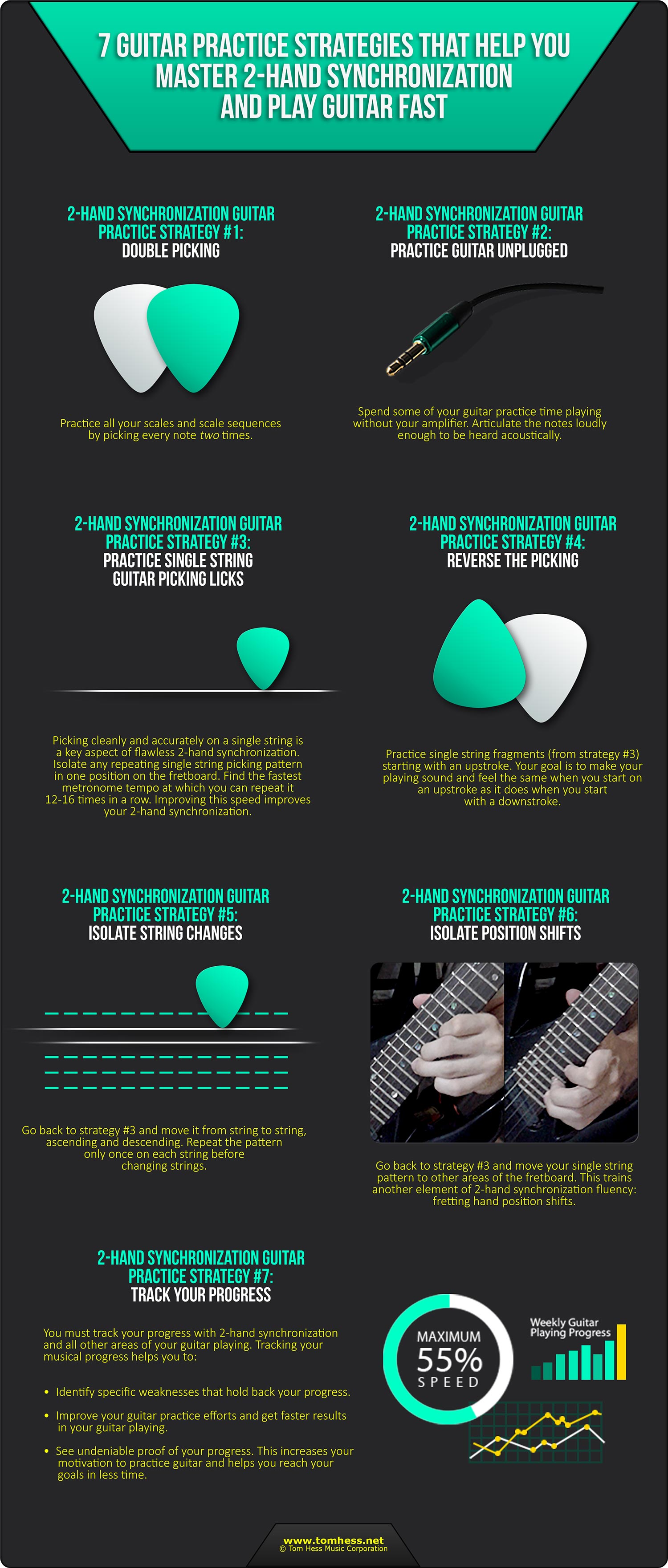
This is where the neoclassical pivot licks in the video below came in for Michael. They're in the style of guitar players he loves (Yngwie Malmsteen, Vinnie Moore), AND they emphasize exactly the 2-hand synchronization challenges he was working on - pinkie and ring finger on string changes.
This particular example is neoclassical because that's what Michael plays. The same drill-building approach works whether you play blues, classic rock, prog, metal or indie.
When the drills are built around YOUR music (the way the ones I built for Michael were built around his), you practice them harder. That matters more than most people think.
What you just read - isolate, emphasize, exaggerate - is the simple part. Once you know what to drill, the rest is logical pattern-building. Anyone can understand it.
The hard part is everything before that.
Most guitar players have been guessing at their weakest link for years. They think it's their fretting hand when it's actually pick attack. They might think it's shoulder tension when it's a release issue on a specific finger. Or they may think it's a string-change problem when it's actually their picking motion getting sloppy half a beat earlier.
When you can't see what your hands are doing - and nobody who can see you is telling you - you can't build the right drill no matter how good the method is.
Which Of These Is YOUR Weakest Link?
So here's a question worth thinking about: do you actually know which of those elements is the weakest link in YOUR 2-hand synchronization?
And are your current exercises targeting that specific element - or are they generic patterns that assume you'll figure out the guitar technique on your own?
(If you don't know the answer - that's a huge part of the problem.)
The good news is: even if you struggle with 2-hand synchronization right now, there is still a way to squeeze (more) clean speed out of your hands and prove to yourself that you have way more potential to play guitar fast than you realized.
I show you how in my free guide Speed Blitz: How To Play Guitar 10% Faster In One Day. It gives you a very specific practice routine you can do in one day (yes, just one day!) that can make you (at least) 10% faster by this time tomorrow.

Now here's the part of Michael's story that surprised even him:
What Traditional 2-Hand Synchronization Advice Usually Gets Wrong
I told him to start mixing both - the underlying hand motions AND the targeted drills - in the same practice session, before he'd mastered either one.
A few minutes on the basic motions, then a few minutes on the isolate/emphasize/exaggerate drills, then back to the basic motions.

When I said that to him - he didn’t buy it at first.
It felt wrong - like trying to run before you can walk. (Most guitar players feel this way, and they're not wrong to.)
But here's what most people miss: part of getting those motions right comes from the feedback you get when you try to apply them - imperfectly - while you're actually playing real music.
You see where they break down. Then you go back to the basics with your brain far more aware of what needs to happen. Going back and forth like that makes both stronger - the basic motions get tighter, and the drills get more useful.
Here's what that looked like in practice:
Michael would attempt a neoclassical drill, notice his ring finger release was creating tension right at the string change, go back to working on his fretting hand release in isolation, then return to the drill. Each round sharpened both - the drill showed him what was breaking, and the isolation gave him the tool to fix it.
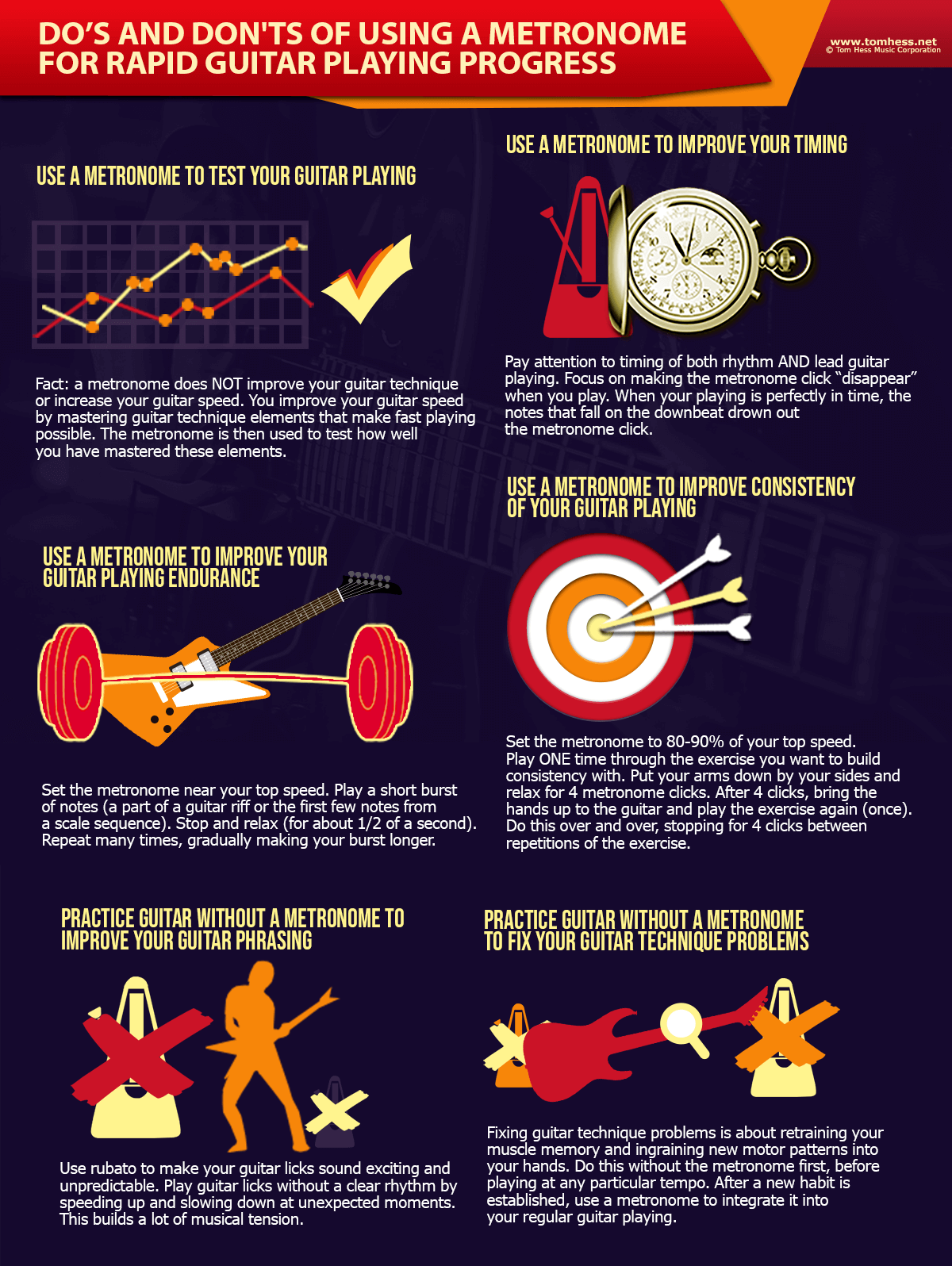
The key was finding Michael's threshold of control - the fastest speed where he could play the drills with his hands still in sync.
Michael had been practicing these drills too slowly - staying in a comfortable zone where his 2-hand synchronization wasn't being challenged.
That 👆 is a common mistake. I pushed him UP to his metronome threshold - the tempo where he could still maintain control, but had to stay fully focused to do it. Practicing right at that edge is where the real gains happen.
When he played through those first integrated sessions and heard his hands actually locking in - at a speed he controlled - he finally stopped wondering if he was limited by talent. He could feel the answer in his own hands.
Three years later: he is at 195 bpm, clean sixteenth notes, playing the fast Yngwie runs he could never get through before.
(And the good news is: whether you're 46 like Michael was when he started, or 75 - your hands work the same way.)
The Part Nobody Can Solve For You In An Article
I know this sounds self-serving, but I'll say it anyway: what changed for Michael wasn't more information. What changed was having someone watch him play, tell him exactly which elements were breaking down in his specific playing, and build the right drills around those specific issues.
But:
- Which of those elements are YOUR weakest links?
- Which drills should YOU be practicing?
- What tempo is YOUR threshold of control?
- When should you go back to the basics instead of pushing forward with harder drills?
Those answers are different for every guitar player. And they're exactly what I work out with you in Breakthrough Guitar Lessons. I watch you play, diagnose YOUR specific 2-hand synchronization issues, give you direct feedback on what's actually breaking down, and build the right drills for YOUR situation. From there, I keep correcting and adjusting as your hands get tighter. This is not a one-size-fits-all course - and it's much more than a plan. It's me working with you directly, until your hands lock in.
Where Will You Be A Year From Now?
Michael spent over a decade practicing 90 minutes a day, buying courses, doing everything "right" - and his hands still got out of sync at 120 bpm. He was starting to believe the problem was talent.
It wasn't. He'd been practicing exercises that assumed his hands already moved the way they needed to - and they didn't.
A year from now, you could still be sitting with your guitar at the same tempo, hearing your hands come apart in the same place they always do, wondering why playing fast and clean seems so easy for others, while it’s so hard for you.
Or you could be hearing your hands lock in at speeds you didn't think were possible for you - playing the licks you've wanted to play for years ... and cleanly.
If you're not ready to work with me directly yet, here's one small step in that direction.
My free Speed Blitz guide gives you a one-day routine built on the same understanding of how speed actually works - the understanding behind everything I do with my students.
It won't tell you which 2-hand synchronization elements are YOUR weakest links (only working with me directly can do that). But it will give you a measurable speed gain you can hear in your own playing within 24 hours - and a real taste of how I think about this.