How To Build Speed On Guitar: Why One Guitar Player Got Fast And The Other Stayed Stuck
Technique Much Faster
EMAIL TO GET ACCESS
By submitting your info, you agree to send it to Tom Hess Music Corporation who will process and use it according to their privacy policy.
Want to know what really builds guitar speed? Then let me tell you about two guitar players who wanted the same thing ... because the difference between them will teach you more about playing fast than any exercise ever could.
Brandon, from Aspen, Colorado, now plays fast guitar solos in the styles of Vinnie Moore and John Petrucci. He picks 16th notes at 172 beats per minute - cleanly and relaxed. It took him 2 years.
Daniel, from Wrexham, Wales, wanted the exact same thing. After 5 years of working on his speed, he was stuck at 128 beats per minute ... and sick about all the time he'd wasted.
They had the same goal, practiced about the same amount (around an hour a day) and started at nearly the same speed. Both even found their way to my free videos and articles around the same time. Brandon applied for lessons with me ... Daniel emailed me to say he'd rather build his speed his own way, and then went and did exactly that.
So why did Brandon build so much more speed than Daniel?
It came down to several choices.
And at the time he made them, every one of Daniel's choices felt completely reasonable to him.
(If you've been stuck at the same top speed for a while, some of YOUR practice beliefs probably feel just as reasonable.)
I'll walk you through the three biggest ones - and what each one cost Daniel.
Technique Much Faster
EMAIL TO GET ACCESS
By submitting your info, you agree to send it to Tom Hess Music Corporation who will process and use it according to their privacy policy.
First, so you know this is a fair-enough comparison: Daniel had been playing for 11 years when he first emailed me. He was 44 and picked 16th notes at 108 bpm. Brandon had been playing for 7 years, was 39, and started at 116 bpm.
Different ages, different countries, different lives ... but the same situation where it counts: adult players with an hour a day and a strong desire to play fast.
(And if shred isn't your thing, don't worry - everything below applies whether you want faster metal solos or just want your blues and classic rock licks to flow with zero effort.)
Guitar Speed Choice #1: Building Guitar Technique One Skill At A Time (Or Not)
I've been telling guitar players for years to combine their picking licks with legato (hammer-ons and pull-offs) as part of their guitar technique training.
Here is why:
Combining picking and legato makes it easier to play fast for longer without tension building up, it trains your 2-hand synchronization as you switch between picked notes and legato notes, and it turns separate techniques into cool licks you'd never come up with otherwise.
You can see this in action in this video:
Brandon loved the idea and embraced it totally ... while Daniel didn't.
He wanted to focus ONLY on picking until he reached at least 150 bpm - to avoid (in his words) "distracting himself" with other techniques.
On the surface, that thinking made sense: you master one thing at a time, then move on.
This belief holds back more guitar players than almost any other.
Here's the problem with it: guitar skills don't develop in a straight line, one after another. They develop together. And you cannot fully master any skill until you integrate it with other skills.
Think about what "learning one skill at a time" really means with an hour of practice time per day. You'd spend years on picking alone before starting to practice anything else. And each time you finally started a new skill, you'd feel like a complete beginner ... again and again. That's linear learning, and it's painfully slow.
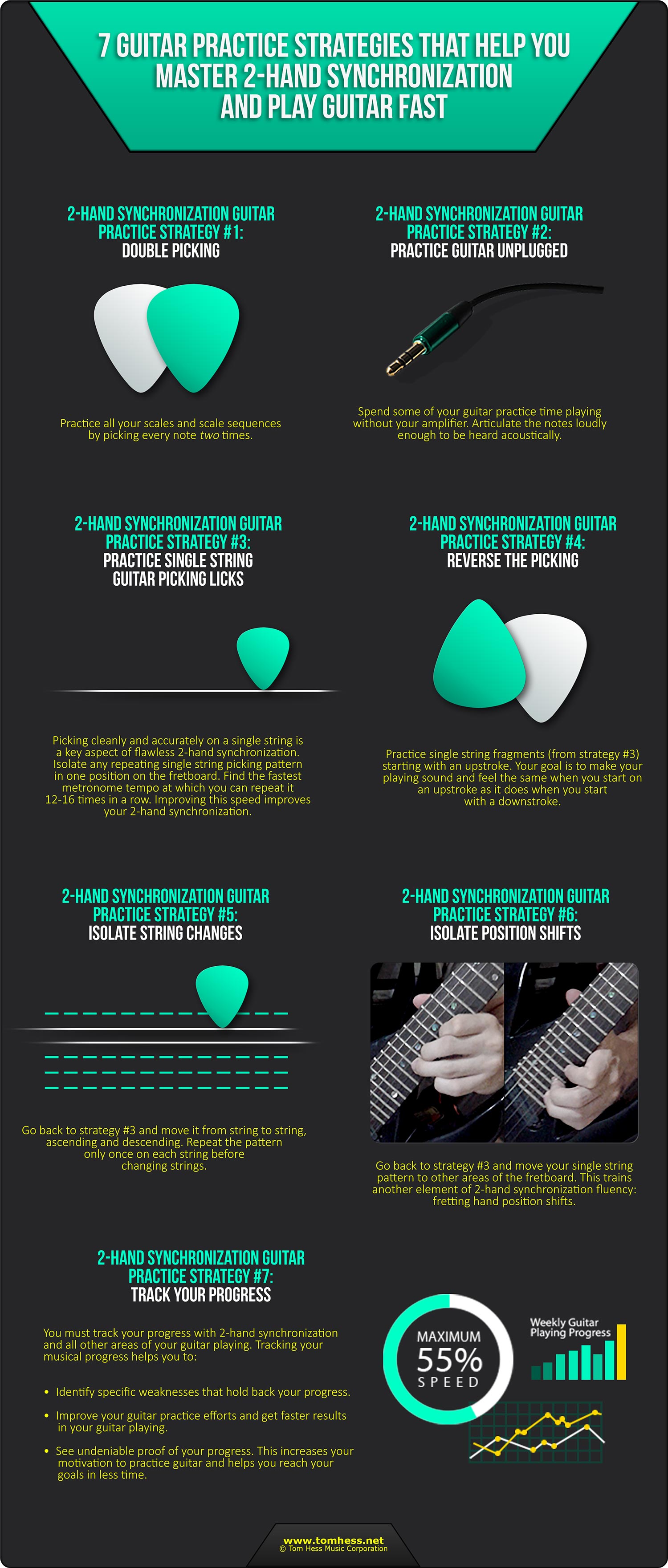
Geometric learning works the opposite way: you build several skills at the same time, and each one helps you use the other skills you have … getting closer to mastery with all of them. The legato Brandon practiced helped relax his picking hand. The synchronization practice cleaned up everything he played. Thus, he built speed faster.
That was the first difference between them. The next one mattered even more ... because it was about how Daniel believed speed gets built in the first place.
Guitar Speed Choice #2: How You Practice To Play Guitar Fast
Daniel was skeptical of slow practice, and he told me so in that first email. He'd heard that practicing slowly trains your hands to use different motions than the ones you need to play guitar fast. So he called slow practice "outdated" and preferred to ONLY practice small fragments at tempos beyond his top speed. His plan was to clean up his sloppy playing later … after he built the speed.
I hear variations on this idea from new students all the time. And speed bursts DO have their place ... for players who are ready for them.
But those who aren’t - like Daniel - generally play with a LOT of excess tension. And forcing the top speed higher over and over only makes that tension worse - killing their speed potential. Daniel had no way of knowing that, and nobody was watching his playing closely enough to tell him.
Brandon took the opposite approach. He told me: "You have a lot of students who rip it up and down on guitar! I'll do whatever you tell me - just get me faster!"
So here's what Brandon came to understand that Daniel never accepted: slow practice by itself doesn't train the wrong motions into your hands ... UNLESS you practice motions at slow speeds that don't work for fast playing. I show you what those motions look like (and what to do instead) in this video:
Avoid those mistakes 👆 and slow practice becomes one of the most powerful guitar speed tools you have. For example, it makes it possible to undo bad habits and reprogram your muscle memory. Here's a video that shows how:
The challenge is knowing which motions (in BOTH hands) make fast playing possible ... and then using those motions at EVERY speed, not just fast ones.
And there's one more powerful benefit of slow practice: it teaches you to stay relaxed when you play, so your fast playing feels just as easy as your slow playing.
There's no way to learn this if you never experience what truly effortless playing feels like at slow speeds. (You will have no way to tell whether you're relaxed enough at faster tempos.)
Which raises a question: when you play fast, are you actually relaxed ... or do you just think you are?
Daniel was sure he was fine. Only he wasn't. So which one are you right now: Brandon, or Daniel? From the inside, both feel exactly the same.
And excess tension limits your speed no matter how many hours you practice. I made a free training class that helps you identify the tension in your own playing (including tension you don't feel yet) and start removing it:
That was the second choice that separated the two players. The last one cost Daniel the most ... and it's the one where his reasoning sounded the most admirable of all.
Guitar Speed Choice #3: The Way You Pick Fast On Guitar
If you want to pick fast on guitar, the picking technique you use matters a lot.
Both of them had watched me demonstrate directional picking - the technique I teach every student who wants serious speed.
Brandon went all in from day one.
Daniel didn’t want to learn it.
His reason made sense to him: his favorite guitarists used alternate picking, so that's what he wanted to master. To him, directional picking felt like "cheating" - making things easier for himself instead of earning his speed the way his heroes earned theirs.
 4 Myths That Wreck Guitar Speed
See if any of these common beliefs are keeping your speed stuck.
 How To Play Guitar Faster Without Tension
Learn to stay relaxed as you play, so fast playing feels as easy as slow playing.
 How To Combine Your Guitar Skills Together
Possibly the fastest way to sound more pro with the skills you already have.
I've watched this exact split happen hundreds of times. Two players hear the same thing about directional picking, one starts using it that week and the other defends the technique his heroes used.
I understand why Daniel felt that way.
But here's the problem most people miss:
Your guitar heroes got fast DESPITE alternate picking, not because of it. Nobody taught them a better way when they were learning, so they worked much harder and much longer than they had to.
Guitar players today don't have the excuse of not knowing a better way. And the evidence in favor of directional picking is pretty clear.
So, copying their technique doesn't make you more like them. It just makes you work harder than you have to … for no reason.
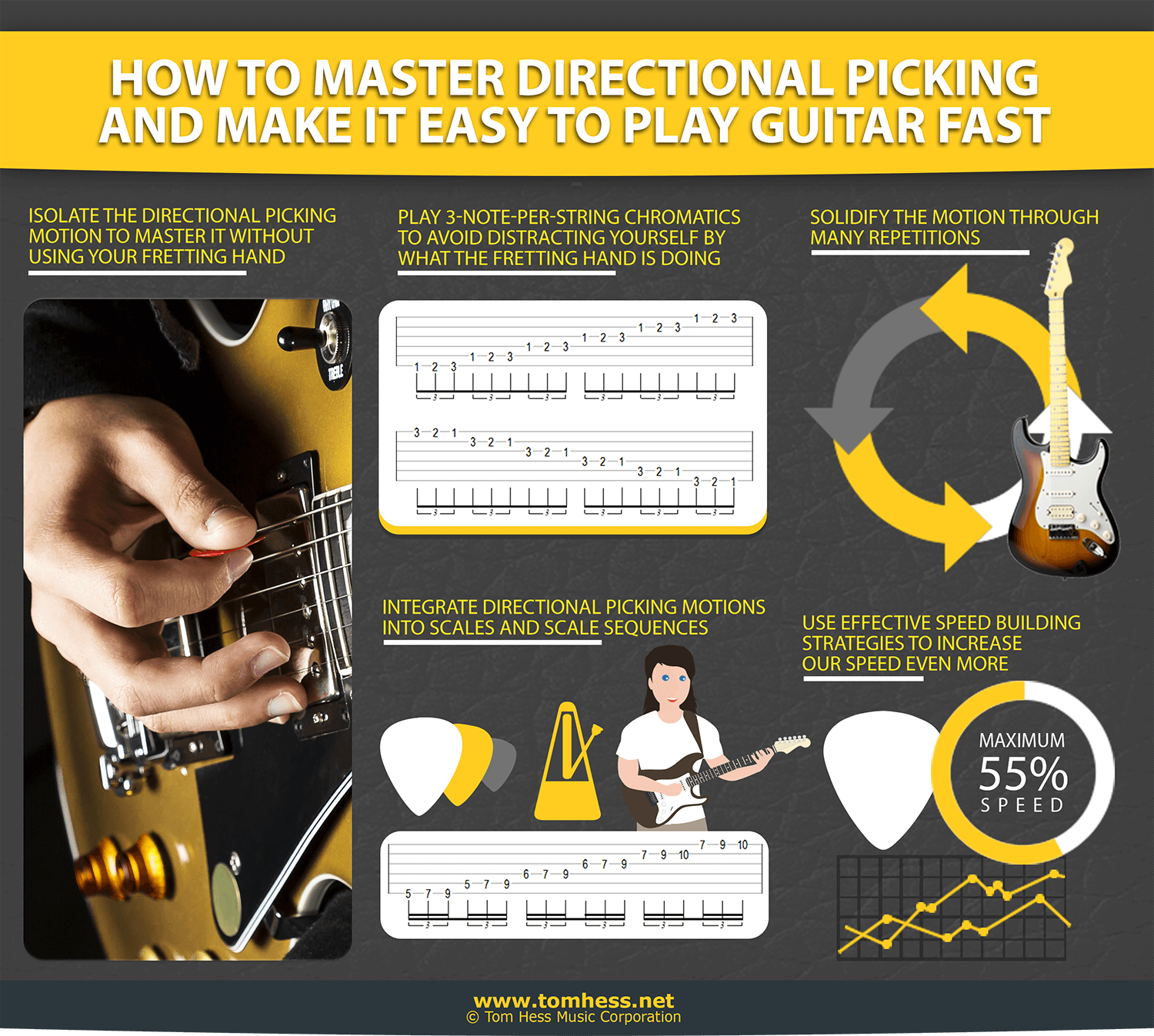
Directional picking works on one principle: move the pick the shortest possible way to the next note. When you're on a single string, you alternate pick each note.
When you're changing strings and moving to the higher (thinner) string, you always start it on a downstroke.
When you're changing strings and moving to the lower (thicker) string, you always start on an upstroke.
Sometimes that means you're alternating your pick strokes. But sometimes it means you're able to sweep pick through a string change (by going directly to the next note).
With directional picking, your picking hand doesn't make unnecessary jumps over a string or stops mid-motion ... which allows you to pick faster, with less effort.
That rule takes ten seconds to read. But doing the technique correctly - with all the motions done perfectly - is a different thing, because once you're playing at speed you can't watch your own picking hand closely enough to know whether you're really picking the right way or your technique is full of flaws that are invisible to you.
That's why players who commit to it build their guitar speed in a fraction of the time. Brandon proved it. Daniel spent 5 years making pick strokes he never needed to make.
Here is where these three choices - with each one feeling completely reasonable to Daniel at the time - took him.
The Guitar Speed Plateau Daniel Never Broke Through
So that's where Daniel stood 5 years ago: he'd read and watched all three of these things from me ... and decided he didn't need any of them. He never applied for lessons with me. And for the next 5 years, he worked on his speed alone ... keeping legato "for later," forcing his top speed higher with bursts (before he was ready) and sticking with alternate picking.
Then, 5 years after that email, an application with a familiar name showed up in my inbox. It was Daniel. He was now 49, and his top speed after all those years of hard work: 128 bpm ... a guitar speed plateau that 5 years of effort couldn't break.
When we talked, he walked me through everything he'd tried in those 5 years ... and every single thing he tried traced back to one of the three choices above.
Then he said: “I feel sick thinking of the time I've wasted and I don't want to screw around anymore.”
Brandon reached 172 bpm 16th notes in 2 years. Today he plays the fast solos he always wanted - in the styles of the same heroes Daniel had. They admired the same players but ended up in completely different places.
The real difference between these two players isn't measured in bpm. Brandon spent 2 years getting better ... Daniel spent 5 years getting older, playing almost the same licks at almost the same speed.
How To Play Guitar Fast Instead Of Staying Stuck
Now, here's the part that matters most for YOUR playing: at each step on his quest to build guitar speed, Daniel's choice FELT like the right thing to do.
Loyalty to his heroes … skepticism of easy shortcuts … discipline and focus. From the inside, the wrong path felt exactly like the right one.
So the real question isn't whether you're working hard. Daniel worked hard for 5 years. The question is which of the practice beliefs you trust most are Brandon-choices ... and which are Daniel-choices. That's the one thing you can't judge from the inside. (Daniel couldn't either … even though he was certain he could.)
The solution is to have someone on the outside look at your playing ... someone who's watched thousands of players make these exact choices and knows how each one ends. That's what my students get in Breakthrough Guitar Lessons. I look at YOUR playing, your goals and the specific things holding your speed back.
Then I build your lessons specifically for you and tailor what you practice to your progress and needs as a player.
You send me recordings, ask me questions any time, and get my feedback at every step - so a wrong assumption never gets 5 years to do its damage.
A year from now, you'll be somewhere with your guitar speed. You can get there the way Daniel did: certain, disciplined and stuck. Or the way Brandon did, with me watching your playing and guiding every step.
To get started, click the green "Get Started" button on the banner below: