How To Control Lead Guitar String Noise In Your Guitar Solos

EMAIL TO GET ACCESS
By submitting your info, you agree to send it to Tom Hess Music Corporation who will process and use it according to their privacy policy.
In this article, I'll show you little-known (but simple) lead guitar technique secrets that enable you to:
1. make your guitar licks and guitar solos free of string noise
2. make your guitar playing more expressive
3. achieve more sustain and fire in your guitar licks and solos
This has nothing to do with what licks you play or how advanced your technique is.
It has everything to do with eliminating string noise from the strings you are not playing.
When you can do that, you sound pro, even if you're playing very simple and slow guitar licks… and you build the foundation for making your faster licks sound great too.
These are some of the secrets that separate the pros from the amateurs… and yet most guitar tutorials either gloss over them or leave them out entirely.
I've taught these techniques to countless guitar students of mine (who once struggled to play guitar clean, but – after doing what I teach – have since become awesome players)
Today is your turn.
EMAIL TO GET ACCESS
By submitting your info, you agree to send it to Tom Hess Music Corporation who will process and use it according to their privacy policy.
To begin…
Watch this video that shows you how to control excess string noise in your guitar playing:
Now that you know the basics, here are 5 more elements of clean guitar playing to focus on that make your guitar licks sound better:
Guitar String Noise Control Tip #1: Hold The Pick In A Way That Makes Thumb Muting Possible.
First, what is thumb muting? It is a way to mute the lower (thicker) strings from ringing out as you play on the higher (thinner) strings.
This way you can keep your playing clean of guitar string noise when playing fast lead guitar techniques (like scale sequences, sweep picking arpeggios and bent-note vibrato).
(Simply slide the thumb up and down the strings as you ascend and descend your guitar licks.)
But keep in mind one thing:
To do thumb muting correctly, you need to hold your guitar pick in such a way that it doesn't hang over the edge of the pick. Here is how I recommend holding the guitar pick for maximum control over string noise in your guitar playing:
If you're unsure whether you're holding the guitar pick correctly (or doing thumb muting the right way), the best thing to do is to get feedback on your technique from an expert guitar teacher who can:
– look at your playing
– point out fast-acting tweaks you can make to your hand positions to sound much better right away.
This feedback is one of many things I provide to guitar players in my personalized Breakthrough Guitar Lessons.
 Create Awesome Rock Guitar Licks
Learn how to make any guitar lick you play sound absolutely amazing.
 How To Quickly Build Guitar Speed
Learn the secrets to building guitar speed by watching this free video.
 How To Fix Sloppy Guitar Playing
Use this muting technique to clean up your guitar playing right away.
Question: “Tom Hess, but there are many guitar players who don’t mute string noise the way you show! Most guitar players mute with the side of their palm on the strings! Isn’t this just as good as (or better than) thumb muting?”
Answer: No. Thumb muting has a few big advantages over palm muting:
1. Your thumb is forward of your picking hand’s palm... which makes your string noise control muting more immediate than palm muting could be. This means there is virtually no chance for open string noise to happen in your guitar lick with your picking hand’s thumb locking down the thicker strings as you’re playing lead guitar.
2. Thumb muting makes your lead guitar picking technique more efficient, because the pick’s point of rest is inside the trench of the strings (space between strings). This means, you’re able to make the size of your picking motion much smaller... and thus – play faster (without guitar string noise muddying up your guitar licks).
3. Thumb muting prevents you from accidentally muting the strings you’re playing (when you don’t want to mute them).
Question: “But Tom Hess, what about muting the strings your pick is striking (to create the palm muted effect in rhythm guitar playing)?”
Answer: When playing rhythm guitar riffs, you can (and should) mute the strings with the side of the palm.
This allows you to mute the strings you’re playing (which is a different guitar playing skill altogether) and is key for achieving a tight rhythm guitar sound.
Watch this video to see how to do palm muting in rhythm guitar riffs.
But even with flawless thumb muting, you may still notice some string noise issues in your playing, if you ignore the next guitar sting noise control tip, which is:
Guitar String Noise Control Tip #2: Work On Your 2-Hand Synchronization
One of the challenges to making your lead guitar playing sound clean is lack of 2-hand synchronization.
This means your hands aren’t picking and fretting notes at the exact same time. Lack of 2-hand sync makes your playing sound sloppy.
Here are 7 ways to get your hands in sync and make your guitar playing very clean:
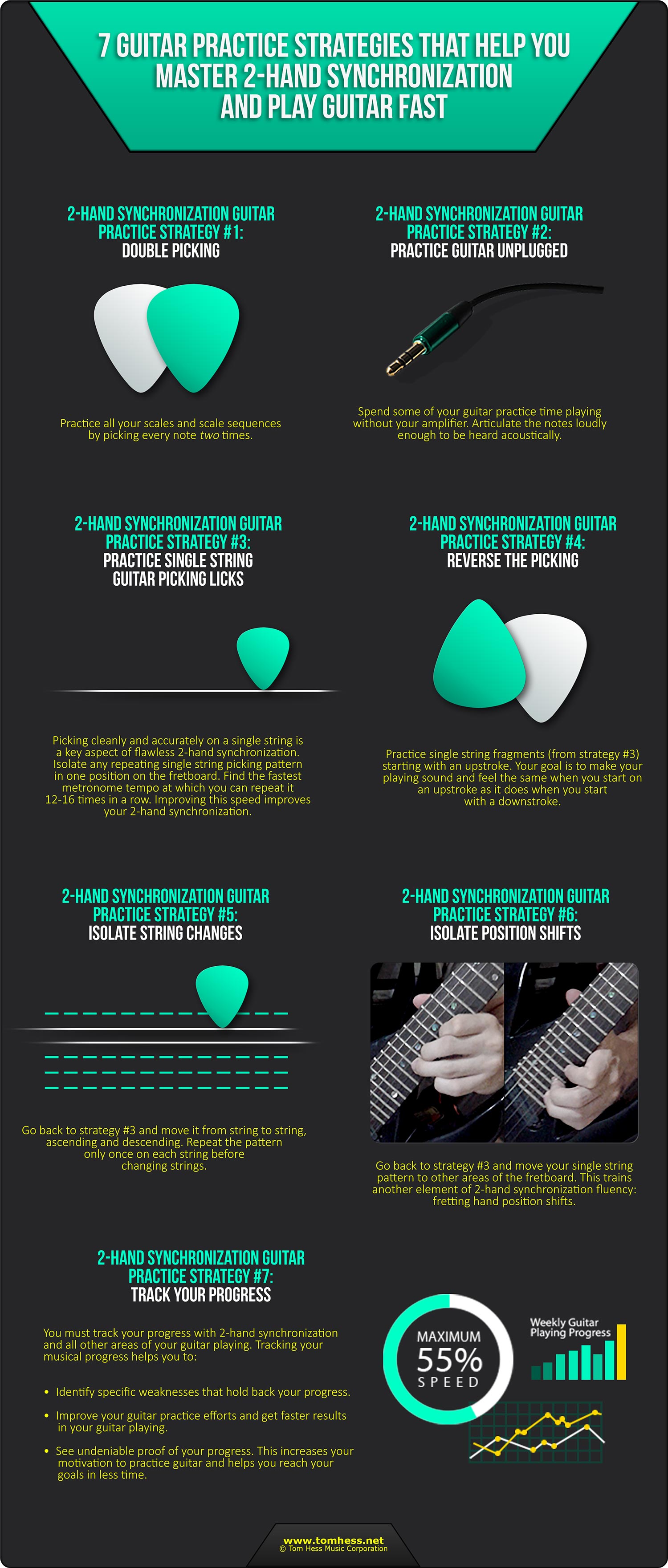
There are two ways to incorporate these lead guitar practice techniques for getting your hands in sync and cleaning up your lead guitar playing:
1. Set aside part of your practice time to practice one of the drills in the graphic above. For example: practice your guitar lick using double picking on Monday and unplugged on Wednesday.
2. Rotate focus between the different 2-hand synchronization training drills in the same practice session. For example: Set aside 20 minutes per day to work on your 2-hand synchronization and – every minute (or so) – shift focus between:
– double picking
– playing the lick unplugged
– practicing any guitar lick on a single string
– practicing the same guitar lick on a single string with its picking reversed (starting on an upstroke).
– practicing a guitar lick where your synchronization breaks down on string changes by isolating the string changes.
– practicing a guitar lick where your synchronization breaks down on position shifts by isolating the position shifts.
Focus rotation is a very effective way to improve many areas of your guitar playing (e.g. controlling guitar string noise and getting your hands in sync) in a single practice session.
As you practice your 2-hand synchronization, avoid these common mistakes that make it harder to get your hands in sync:
1. Trying to get your hands in sync at your maximum speed. Your 2-hand synchronization threshold is its own top speed that’s likely to be much lower than the top speed at which your hands move.
So, find this 2-hand synchronization top speed and practice at or near it.
Watch this video that shows you how:
2. Using very light gauge strings for playing lead guitar. Lighter (thinner) guitar strings have a bit of a delayed response to your hands. This means, there is a bit of a delay between your pick touching the string (after fretting a note) and striking through the string. This doesn't mean you cannot keep your hands in sync when playing fast guitar licks with thin strings (many guitarists do)... it’s simply harder to do so. And the lighter the string gauge you use – the harder it becomes.
Check out this guitar video guide on how to choose the right guitar string gauge for more info on this.

3. Using a very thin pick. This creates the same problem as using ultra-thin guitar strings. A thin guitar pick creates a bit of a delay between the pick touching the string and pushing through the string... and then, there is a second delay for the pick to reset after finally pushing through the string. For this reason, I recommend using a guitar pick that doesn't flex when you’re playing guitar.
Your grip should also be firm enough to keep the guitar pick from moving in your hand during your guitar playing.
4. Focusing on exercises instead of mechanics. Pro tip: there aren’t any special 2-hand synchronization exercises... there are just ways to practice 2-hand synchronization that you can apply to any guitar lick or exercise in your guitar playing.
5. Using a wimpy pick attack that makes your acoustic picking sounds almost inaudible. (This tends to happen more if you’re using a thinner guitar pick and lighter guitar strings.) This is why it’s so important to spend some of your guitar playing time practicing unplugged. The better you become at playing guitar cleanly (using a strong pick attack) without an amp... the easier it will be to play guitar (with your hands in sync) when you play with your regular tone.
(Just be careful and don't assume that everyone who gives advice on the internet is a pro. Most aren't. A pro guitar teacher had better have a long list of guitar players whom they had helped to become really good players… similar to this list of my guitar students from Breakthrough Guitar Lessons.)
And after you've learned thumb muting and tightened up your 2-hand synchronization, the next tip will truly elevate your playing to the pro level and make you sound awesome. Check it out:
Guitar String Noise Control Tip #3: Eliminate Bleeding Between Notes In Your Guitar Playing
“Bleeding” of notes happens when two (or more) notes are ringing together. This makes your guitar playing sound very sloppy... and it’s a different type of guitar string noise that takes specialized practice to fully control.
Bleeding tends to occur when you change strings, and you let the last note on the previous string to continue ringing as you play the first note on the new string.
This can happen either:
1. When you change strings with two different fingers (and don't release the one that was playing the previous string as you begin playing on the new string).
2. You do finger rolling and don’t correctly release the string you were rolling from when playing the string you were rolling the finger too.
Watch this video to see how to correctly do finger rolling:
A few tips for eliminating the bleeding of notes:
Tip #1: Practice relaxing each finger off the string (instead of yanking it off using force). This not only keeps notes from bleeding together – it also relaxes excess muscle tension and helps you play guitar faster.
Tip #2: Practice guitar with distortion (instead of a clean tone) most of your guitar practice time. This makes all open string noises much more audible and easier to fix.
Question: “But Tom Hess, earlier you said to practice unplugged and now you’re saying to play guitar with distortion. Which is it?”
Answer: Both guitar playing approaches are useful in your guitar practice. Unplugged guitar playing makes it easier to spot 2-hand synchronization inconsistencies and fix them... but it masks string noise (and bleeding) issues. Distortion does the opposite. So, it is to your benefit to use both sounds when you practice guitar.
Pro tip: the trick to fixing the bleeding of notes might lie in the tempos at which you practice. I once had a guitar student who struggled to sweep pick cleanly (without bleeding) at high tempos, despite being able to sweep pick cleanly slowly. He battled this problem for over 18 moths.
I took one look at his playing during one of my live video support sessions and immediately determined the right tempo threshold for him to practice at (that was challenging, while still being easy enough to keep his playing clean)… and his bleeding issue was gone within minutes.
This is the difference between getting personalized coaching on your playing and relying on trial and error.
Now…
Another aspect of controlling guitar string noise is something almost no guitar player ever practices.
It is:
Guitar String Noise Control Tip #4: Practice Making Your Sustain Better
A big part of sounding pro when you’re playing guitar is being able to sustain the notes in your guitar licks and solos.
Watch this video to see how to improve your sustain:
Here are a few additional tips that will make sustain easier:
1. Fret notes right next to each fret you’re playing. This will help the notes sustain better. The further your finger is from the fret, the harder it is to keep the note ringing.
2. Use a stronger pick attack. This gives you more sustain, because the initial note you pick is louder.
3. Use picking hand rakes (by grazing your pick over several muted strings as you hit the note you want to hear). Similar to simply ‘picking harder’, it gives your notes more volume from which to sustain.
Finally…
One of the best (and least-known) ways to improve your string noise control is by stress-testing it the way I explain in the next string noise control tip:
Guitar String Noise Control Tip #5: Test Your String Noise Control With Wide Vibrato
One of the best ways to check if you’re able to get string noise under control is to try doing a long vibrato (or bent-note vibrato) note with good sustain.
If you’re able to do it, that means your guitar playing noise control is coming together nicely.
Here are some tips for making your vibrato sound better:
1. Position your fretting hand with your thumb wrapped around the guitar like this:

2. Do the vibrato as a series of rhythmic bends applied to a note.
3. The faster your vibrato is, the wider it should be. The slower the vibrato – the narrower it can be.
4. Release each bend of the vibrato pulse all the way down to the original note. This is key to making the vibrato sound in tune.
Watch this video that shows you how to put these lead guitar tips together and make your vibrato sound good and pro:
Now that you know HOW to control string noise, the next challenge is doing it consistently - especially when you're nervous, recording, or playing live. I can show you how to make your playing more consistent and reliable (so you can play at your best, even when you’re under pressure) in my free eGuide: The Guide To Playing Guitar Accurately, Consistently, And Reliably, Even On Your Worst Days. Download it today and discover the guitar playing secrets most guitarists will never know.

Now you know the principles behind controlling string noise in your lead guitar playing.
But here's what this article can't do for you:
It can't watch you play. It can't tell you which of these 5 areas is causing YOUR string noise. And it can't give you feedback on whether you're doing these techniques correctly - or just think you are.
That's where my Breakthrough Guitar Lessons come in.
And along the way, I give you a ton of feedback on your playing and practicing, so you make rapid gains, sound more pro and make guitar much more fun.
If you practice what I teach you for just 30 minutes per day 5 times per week, you will soon amaze yourself at your rapid progress and make your friends wish they could play guitar like you. Go here to learn more.