The Best And The Fastest Way To Learn To Play Guitar Well

EMAIL TO GET ACCESS
By submitting your info, you agree to send it to Tom Hess Music Corporation who will process and use it according to their privacy policy.
If you've practiced guitar for years, have some knowledge and skills, but still struggle to play how you want ...
What I will show you will both surprise and delight you.
Believe it or not ...
There IS somewhat of a secret behind why some players - even hobbyists - learn to play guitar like pros (without practicing for hours a day) …
While other players - who start out at the same skill level, same goals, same amounts of practice time and ambition - struggle to do so.
(Despite working just as hard.)
EMAIL TO GET ACCESS
By submitting your info, you agree to send it to Tom Hess Music Corporation who will process and use it according to their privacy policy.
I have two students who show this perfectly.
The first is Thomas.
Today he's the lead guitarist in a local band.
He sends me videos of his gigs - long solos, played live, that he is genuinely proud of.
He got there in about 14 months.
The second is Bobby.
He stopped taking lessons around the 15-month mark ... not because of money or time, but because he'd gotten frustrated.
After all that work, he was nowhere near where Thomas is now, and he couldn't figure out why.
So he went back to playing alone in the same room, on the same things, stuck where he'd been for years.
Both Of These Guitar Players Started In The Same Place
When Thomas and Bobby first started to learn guitar from me, you could barely tell their playing apart.
They'd each taught themselves for close to two decades - Bobby for 17 years, Thomas for 19 - and both put in about an hour a day.
They could each play fast, somewhere around 400 to 500 notes per minute.
They knew roughly the same amount about how chords and scales actually work, and neither of them had ever really improvised.
They even liked the same music: classic rock with a good helping of heavy metal.
They were not carbon copies, of course. When Bobby started, he was 59, an engineer - living in Idaho, USA.
Thomas was 63, an accountant, living in Toronto, Canada.
(And no, they weren't learning guitar from me at the exact same time, in case you're wondering.)
But on the things that actually matter for this comparison - their starting skill, practice time, ambition, and the same teacher sitting across from both of them - they were pretty much dead even.
So what split them? It came down to one thing: how each man decided to learn guitar.
And once you see it, you'll start spotting it everywhere.
Bobby learned guitar linearly. Thomas learned guitar geometrically.
Let me explain the difference:
Learning guitar linearly means practicing guitar the way you would go through putting together a backyard swing set: step one, then step two, then step three, in that order.
You pick one skill, you master it from top to bottom, and you don't let yourself move on to the next thing until the one you're on is completely finished.
It feels like the careful, grown-up way to do things. And it's the reason a huge number of guitar players stay stuck for years despite their best attempts to learn guitar.
Because learning guitar doesn't work like that.
You cannot 'finish' mastering any skill (for example: your picking) until you connect it to other skills (for example: your fretting hand technique) … and until you learn to USE it in real life.
This requires you to work on multiple areas at the same time and bring them up together … while working to apply and connect them musically at the same time.
This is called: learning geometrically.
Learning guitar this way is very counterintuitive … and this is one big reason why guitarists who teach themselves rarely become good players … as do those who misunderstand geometric learning to mean: "you can learn things at random without any strategy". (You absolutely DO need a strategy.)
But when you do follow a correct geometric learning strategy, you get to feel like an actual musician long before you're an advanced guitar player.

Now let me show you how this difference showed up between Bobby and Thomas using three comparisons of the choices they made while learning guitar from me:
The First Comparison: How They Tried To Learn Scales All Over The Guitar
In one of their early lessons, I taught both Bobby and Thomas the seven shapes of the major scale.
What each of them did next is where they started to come apart. I have watched this exact choice separate my best students from those whose results were more mediocre thousands of times over the years.
I taught them both not to just memorize the fingerings, but to learn to see each shape from every string ... so they'd never get stuck depending on finding a scale only off the low E.
Like this:
This 👆 is the skill Thomas built and Bobby skipped.
Thomas learned the shapes and trained himself to picture them starting anywhere on the neck, like I told him.
It meant that the second he wanted to use a scale in a solo, he could see where he was, on any string, in any position.
It also made every scale he learned after that far easier, because he already knew how to visualize them on guitar.
Bobby went the other way.
He decided he'd memorize all seven shapes and then drill each one until he could rip it at 80 bpm in sixteenth-note triplets.
He even wrote it to me in his lesson feedback form and said he felt that doing that last step could wait, until his technique with the scales was further along.
(And I - of course - wrote back, warning him that as reasonable as it sounded, it was going to cost him ... because it was the linear approach instead of the geometric one).
By the time Bobby pushed his speed up to 85 bpm, he'd burned through a lot of his practice hours for the month and still couldn't see the shapes from anywhere but where he'd drilled them.
He felt great. He was even a bit faster than Thomas.
But that extra speed without the ability to visualize scales on guitar did nothing for his ability to use scales in a solo, which was one of his main goals … and it was what I taught both of them next:
The Second Comparison: How They Tried Learning To Improvise
Once they each had some scales under their hands, I started teaching both of them to improvise.
This was a big goal for both of them in their quests to learn guitar … and Thomas jumped right in.
He couldn't do much at the start, but I showed him how to start creating guitar licks using the skills he already knew … and using them over simple backing tracks ... setting the foundation for becoming a very good lead guitar player.
Yes, this is something you can start doing even if you're still relatively new to learning guitar.
Watch this video to see an example:
As I said, Thomas jumped in with both feet and embraced this way of practicing guitar. But Bobby hit the brakes.
This same split shows up quite often when I teach a student to improvise.
Even though playing lead was exactly what he wanted (and he was at about the same level as Thomas - or maybe even a bit better in some ways) he didn't feel ready.
He wanted to clean up the technical problems I'd pointed out when giving him feedback on his playing (string noise issues, and timing inconsistencies). Plus, he wanted to learn more scales and sharpen his ear first.
He told me:
"I know this probably goes against the geometric approach, but improvising feels overwhelming to me right now when I am behind on these other skills."
That was another example of him staying on the linear path - that seemed so sensible - and making the journey towards his goals so much harder.
But it gets even more interesting when we talk about the next skill I tried to help both of them with, which was:
The Third Comparison: How They Practiced Playing Guitar In Front Of People
Both Bobby and Thomas wanted to play in a band.
And I gave both of them the same advice to anyone who has this goal: practice playing in front of other people as often as you can.
Yes, that is a skill you can develop as you're learning guitar.
It's rarely pleasant at first, but that's exactly how you learn to make a mistake and keep playing, and how you become comfortable auditioning for bands and holding your own on stage.
One of the easiest ways to do it is to show up to the weekly office hours I run for my students and play for me live.

Whether a player is willing to do this is something I have watched separate students for years.
Thomas came regularly. He got used to playing while someone was watching, and he got my feedback on how to make his playing sound better under pressure.
He quickly learned to play close to his best even when it counted, and as his skills grew, "close to his best" kept climbing too.
But Bobby couldn't bring himself to do it. He didn't want anyone hearing him until he was already good.
So he kept playing alone, in his own room, where the temperature was right and his tone was dialed in and his hands were warmed up exactly the way he liked (conditions that never once exist on a real stage).
The result was a sizable difference - and I mean a literal one - between what he could do under those perfect conditions and what he could do the moment another person was in the room.
Even as his playing improved in private, he had no way to show it when it mattered … because he could only play at a fraction of the skill level he knew he was capable of.
You can imagine how frustrating that felt.
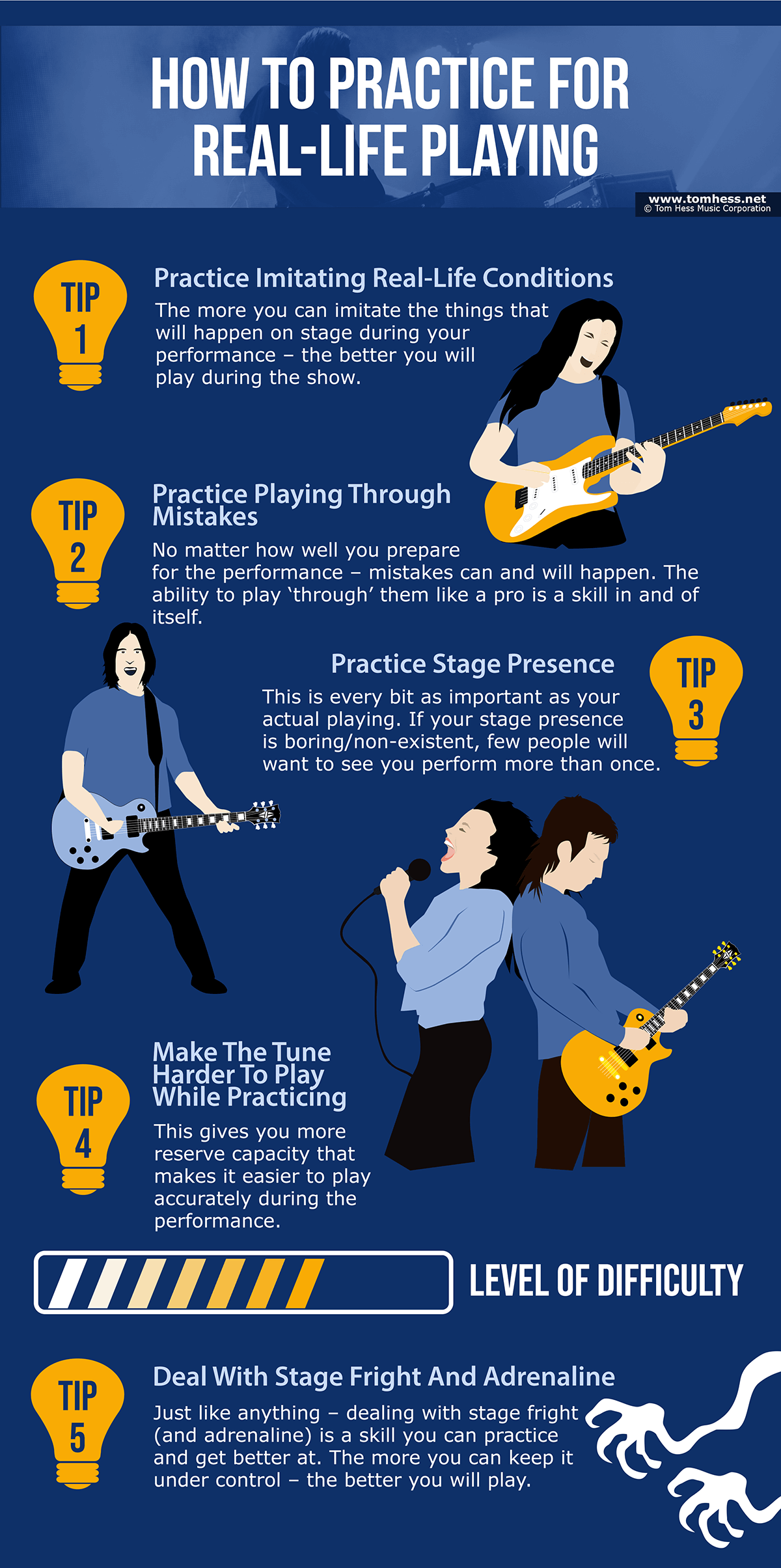
That 👆 is the kind of practice Thomas (and my other top students) committed to and Bobby kept avoiding.
Similar behaviors continued with both Bobby and Thomas until Thomas eventually reached his goals … and Bobby decided to give up.
So, Which Of These Two Guitar Players Are You?
Here's why I'm telling you this story:
From the inside, both Bobby's and Thomas's paths feel exactly the same.
Bobby wasn't being lazy or foolish. Every choice he made felt responsible.
If you'd asked him, he'd have told you he was doing everything right. That's what makes the linear approach so dangerous: while you're on it, it feels like the smart one.
Which means you can't fully trust how the right path feels from the inside.
I put together a free guide that walks you through the 4 pillars behind the geometric approach that helped Thomas - and hundreds of my other top students - to play guitar like pros (despite practicing less than 1 hour per day).
It shows you exactly what to focus on when you practice - and in what order - so you have way more clarity on how to reach your goals too.
But here is what's perhaps most interesting about the Bobby and Thomas story:
For a long stretch, the difference between them didn't look dramatic.
Bobby was actually ahead on paper (he had a bit more speed than Thomas). If you looked at them at the end of their first month of lessons, you might have bet on Bobby.
 Practice Less To Get More Results
Become highly effective with your guitar practicing time.
 Create A Guitar Practice Schedule
Learn 8 steps to creating your own guitar practice schedule.
 Powerful Guitar Practicing Secrets
Download a free 100+ page eBook
with guitar practice tips.
But Thomas's playing had been compounding as he followed the geometric learning path the way Bobby's was not.
And it wasn't just limited to the 3 examples of visualizing scales, playing in front of others and learning to improvise … it helped him to develop all the other skills that went into reaching his goals AND use them.
All the while - despite my best attempts to warn him against it - Bobby was trying to master one skill at a time … and getting deeper and deeper into a rut.
This is why Thomas - after just 14 months of lessons - managed to audition and get into a local band and is now having fun playing out for real … while Bobby quit lessons out of frustration.
They both had access to the same teacher and the same resources.
The difference between them was coachability.
Thomas heard the guidance, trusted it, and acted on it ... even when the geometric choice felt harder or less obvious than the linear one.
Bobby heard the same guidance and talked himself out of it, because from where he was standing, the linear approach looked so reasonable.
That's not a character flaw. Most players do exactly what Bobby did. But without the willingness to override that feeling, you'll choose the linear approach every time.
This is part of the reason I'm telling you about Bobby and Thomas … to help you see what the road to great guitar playing really looks like.
And if you're willing to travel that road and BE coachable - the way that Thomas was, but Bobby was not - you need two things free content can't give you.
The first is a strategy built around where you actually are now and where you actually want to get to. A real plan for your playing ... not some generic approach built for everyone else.
The second is someone giving you feedback on your actual playing - what you're working on, how you're working on it, and which fork you're taking at every decision point - so the wrong turns get caught before they cost you years of wasted time.
That is what I do for guitar players in Breakthrough Guitar Lessons. I've helped thousands of people reach their goals and play way better than they ever thought they could ... without practicing for hours per day.
To see how I can help you too, click the button on the banner below.
Which Guitar Player Will You Become?
A year from now, you could be like Thomas - sending me videos of your own gigs, with long solos played live in front of a real crowd.
Or you could be like Bobby - still alone in the same room, where the temperature is right and your tone is dialed in and your hands are warmed up exactly how you like, playing the same things you have played for years.
That's where the linear approach took Bobby, and I don't want it to take you there too.
Go through Guitar Mastery Decoded and see which path you're on - while the difference between the two is still small enough to close.
The sooner you get on the right path towards your goals, the faster you'll become the guitar player you want to be.