Practice Guitar Like This To Fix Sloppy Guitar Playing Fast

EMAIL TO GET ACCESS
By submitting your info, you agree to send it to Tom Hess Music Corporation who will process and use it according to their privacy policy.
Picture this:
You’re playing something on guitar and it sounds … fine. Then you push the tempo up - and everything falls apart. Sloppy string noise, unclear notes, picking hand and fretting hand out of sync.
So you do what every guitar teacher has ever told you to do: slow down.
You practice carefully, patiently, repetition after repetition. Weeks pass. Months. Maybe years.
And the moment you push the tempo back up … the same sloppy playing comes flooding back. Like you never practiced at all. (You practiced. That’s not the problem.)
The bad news: the reason your practice hasn’t fixed your sloppy playing isn’t that you haven’t done enough of it.
The good news: once you understand what’s actually going on with your technique, learning to play fast becomes much clearer - and much faster than you’d expect.
The advice to “practice slow and gradually speed up” is the most common advice on the planet.
It’s also the reason most guitarists never learn to play fast no matter how many hours of practice they put in.
Here’s why:
The Misdiagnosis
The logic behind slow guitar practice seems bulletproof: if you can’t play something cleanly at full speed, slow it down. Get it perfect. Gradually work your way up.
This makes so much sense that most guitarists never question it - even after years of following this approach with zero results.
What happened to one of my students shows exactly why this advice backfires - and what actually works.
Meet William.
Today, William plays in a weekend band in Flagstaff, AZ, ripping through Stevie Ray Vaughan and Gary Moore covers - including the parts that used to expose every flaw in his technique. His picking is precise, his hands stay in sync, and his playing sounds like a different person.
But when he first came to me for help at age 42 - an engineer with three kids at home and limited time to practice - his playing was full of the exact problems you probably recognize: hands out of sync, sloppy string noise, unclear notes, inconsistencies in his pick attack, bends out of tune, notes not in time.
He told me: “I’ve taken lessons from 3 teachers who all said to slow down and only increase speed when the playing is perfect. I’ve done this for 17 years and none of it worked.”
William didn’t lack discipline or time to practice. He had the wrong diagnosis. And the advice he’d been following for 17 years was making it impossible for him to improve his guitar technique and play fast.
I’ll show you what I spotted when William sent me a video of himself practicing - and what changed - later in this article.
First, let me show you why the “slow down and speed up” approach can never fix the technique problems that show up when you try to play fast.
The Real Problem
Here’s what most guitar players don’t understand about sloppy guitar playing:
The mistakes that show up when you try to play guitar fast are invisible at slow speeds. Not “hard to spot.” Invisible.
When you practice at a slow tempo, there’s more time between each note.
More time for your fingers to get into position and produce notes that sound acceptable.
Your playing sounds clean enough - so you think your technique is fine.
But the motions you’re using at those slow speeds aren’t the motions you’d need to play fast.
And most guitarists don’t know what the correct motions should be.
So they practice guitar slowly, using movements that only “work” because slow tempos are forgiving - pausing between notes, moving hands in wider arcs than necessary, using more fretting pressure than needed.
At 60 bpm, none of this matters.
At 120 bpm, those same motions can’t keep up.
The body scrambles to find different movements the hands haven’t practiced - and the result is the sloppy, out-of-control playing you’ve been struggling with.
This is why “slow down and gradually speed up” never works as a practice strategy.
You’re practicing below the speed where the problems exist.
Every repetition is wasted - because you have no corrective target. You don’t know WHAT to fix in your technique.
Think about it: how can you fix a technique problem you can’t see or hear?
You can’t.
The real solution: you have to diagnose your technique problems at the speed where they actually happen.
By recording yourself at full speed and listening back at a reduced speed - 25% or 33% - so you can finally hear exactly what’s going wrong in your playing.
This is the approach that changed everything for William - and what I’ve taught thousands of guitar players over the last three and a half decades.
Watch this video where I walk you through the entire process - how to record yourself, what to listen for when you practice guitar, and how to start fixing the specific guitar technique problems that are making your playing sloppy:
But diagnosing your mistakes at speed is only half the story. Because there’s a second problem with slow practice that most players never realize - and this one is worse:
Why It Gets Worse
If slow guitar practice simply didn’t help, that would be bad enough. But it actively works against your guitar playing in ways most players never realize.
Every time you practice, your brain is learning. It doesn’t care whether what you’re doing is correct or incorrect. It only cares about repetition. Whatever motions you repeat, your brain encodes as “the way this is done.”
So when you practice at slow speeds using motions that only work because the tempo is forgiving - your brain locks those in. Not as bad habits. As the correct way to play. (This is why changing your technique feels so strange - your body genuinely believes the old way IS correct.)
And it gets worse the more you practice.
EMAIL TO GET ACCESS
By submitting your info, you agree to send it to Tom Hess Music Corporation who will process and use it according to their privacy policy.
Whenever you try to change it, your hands want to do it the old way. Your brain fights the correction because the wrong motion has been repeated so many times it feels natural - and the right motion feels awkward and foreign.
This is why so many players describe the experience of feeling “stuck” in their playing.
The sloppy playing you hear when you push the tempo up isn’t a lack of practice. It’s the result of practice - the wrong practice, reinforced thousands of times until your body treats it as correct technique.
This is exactly what happened to William for 17 years.
Every teacher reinforced the same advice. And every year of following it didn’t just fail to fix his playing - it made the real problems harder to undo … all because of the wrong diagnosis.
But the damage doesn’t stop there. Because this wrong diagnosis doesn’t just create one problem in your playing - it sets off a chain reaction that most players never connect:
The Chain Reaction
And here’s what most guitar players don’t realize about their own situation:
Sloppy guitar playing isn’t one problem. It’s a chain reaction - and every link feels like a separate issue.
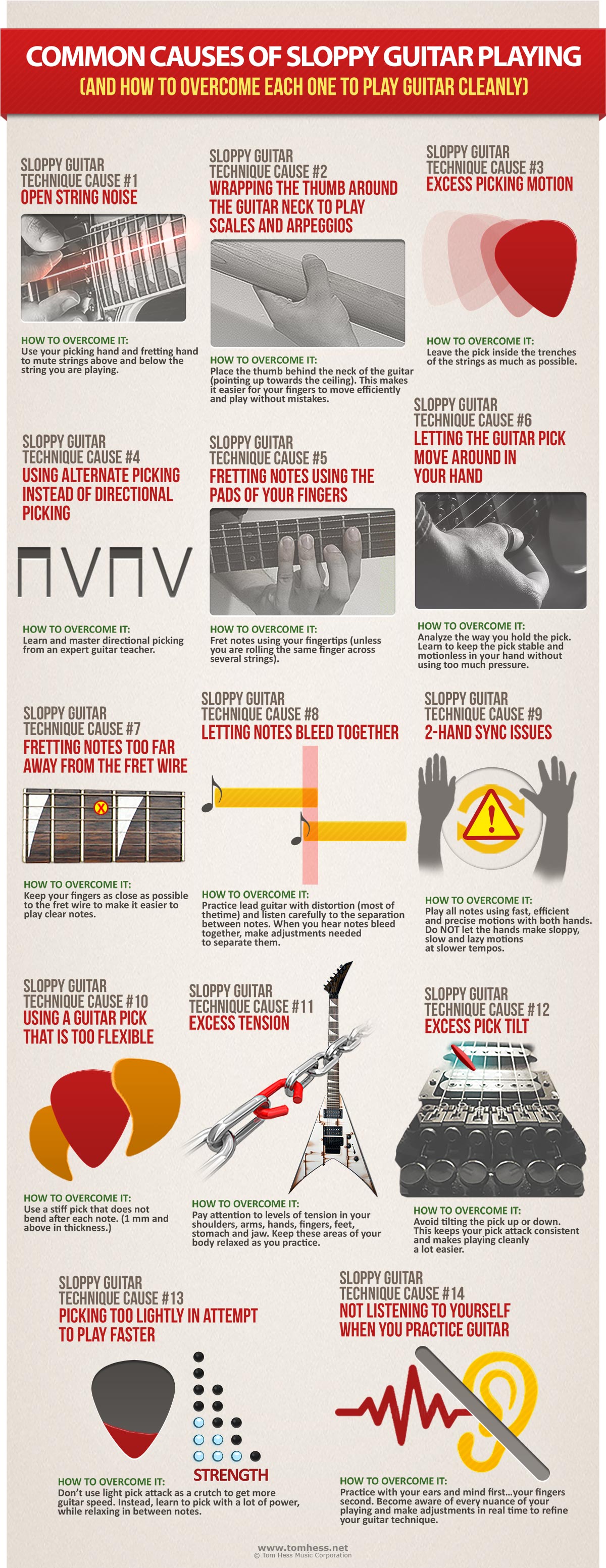
Because you can’t pinpoint specific flaws in your technique, you can’t isolate them.
So when you hear something wrong at speed, your instinct is to fix everything at once. Picking sounds uneven? Fix that. Hands out of sync? Fix that too. String noise? Add it to the list.
But you can’t fix four technique problems simultaneously.
Scattering your focus across multiple problems during practice means zero progress on any of them.
That frustration produces tension. Your picking hand grips harder. Your fretting hand squeezes the neck. Your shoulders rise.
And tension is a guitar speed killer - the tighter your muscles, the slower they can move, the sloppier your playing becomes when you try to play fast. Which creates more frustration.
Which creates more tension.
And on top of all this, many players practice with distortion and effects that hide the very mistakes they need to hear.
Distortion compresses volume, masking uneven pick attack. Reverb fills gaps between notes, covering up synchronization problems.
Five things going wrong. All feeling like separate problems in your playing.
All flowing from one root cause: you never diagnosed your specific technique mistakes at the speed where they actually happen.
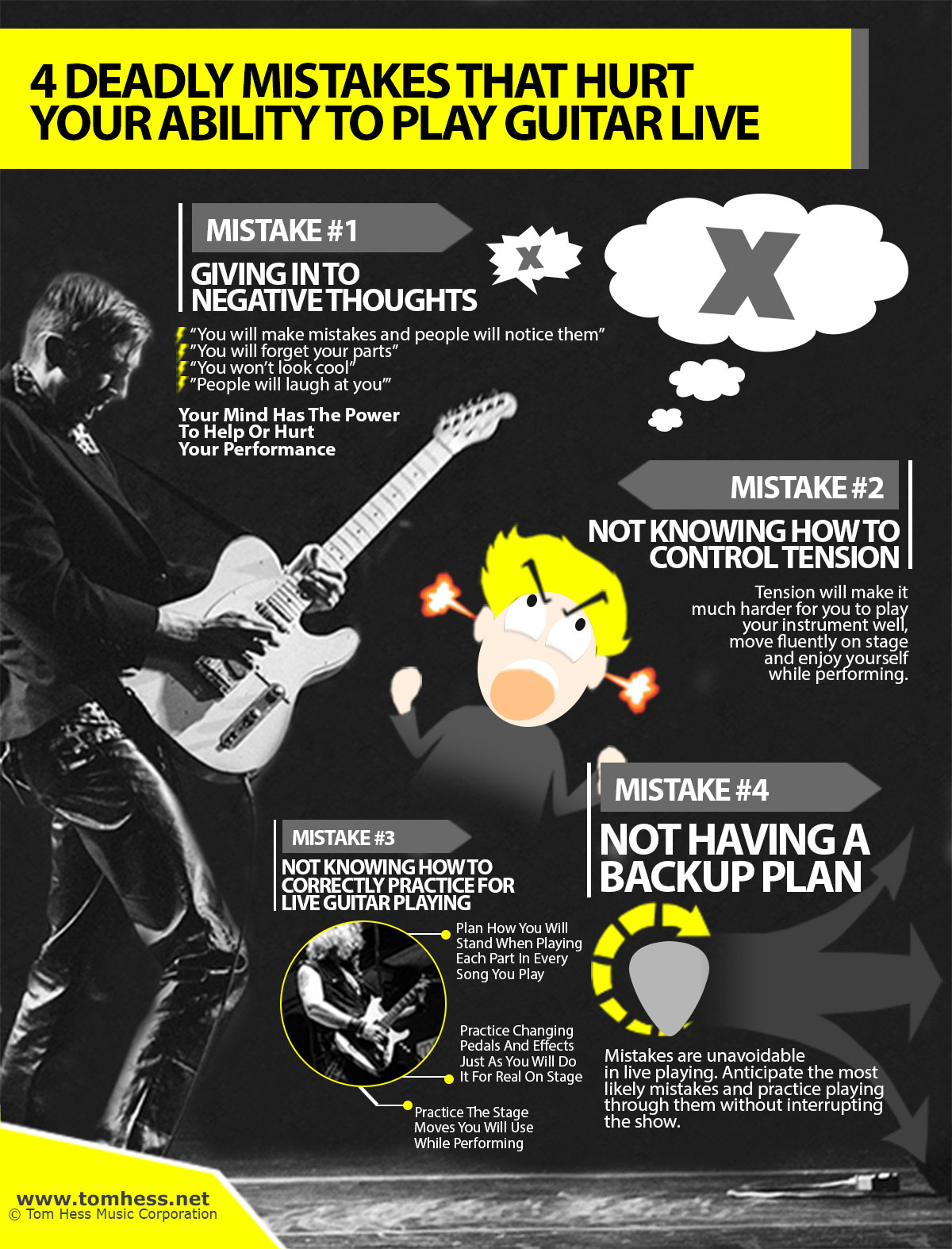
So what does it actually take to break this cycle? The answer is simpler than you think - but there’s a catch:
What It Actually Takes To Fix It
Hearing the problems isn’t the same as knowing what to do about them.
When you record yourself and listen back at reduced speed, you’ll probably hear multiple things wrong at once. Uneven picking. Timing gaps. String noise. Notes that blur together.
The instinct is to start fixing whatever sounds worst. But that’s the wrong move - because some of those flaws are foundational and some are downstream consequences. (I know - it feels like you should attack the loudest problem first. Almost everyone thinks this.)

Fix a downstream problem first, and it comes right back - because the root cause is still feeding it. Worse, you burn weeks of practice on something that would have resolved on its own once the foundational issue was corrected.
The challenge is that which flaw is foundational and which is downstream is different for every player. (Which is exactly why general advice - including this article - can only take you so far.)
One person’s sloppy playing might be rooted in picking motion.
Another person with identical-sounding problems might have a tension issue that’s driving everything else.
The sequence matters as much as the diagnosis. And the right sequence depends entirely on what’s happening in YOUR technique - not on a general rule anyone can follow.
So here’s something worth thinking about:
Do you actually know what your specific technique flaws are?
Have you ever recorded yourself playing at full speed and listened back at a reduced tempo to find out?
And even if you have - do you know which flaw is the foundational one, and which ones are downstream consequences that would clear up on their own once the real issue is corrected?
If you’re not sure - or if you suspect your guitar practice approach might be the very thing holding your guitar playing back - I put together a free training video that shows you a completely different way to practice guitar. The way naturally talented guitar players do it.
It’s not about practicing more. 45 minutes a day is enough - if you’re practicing the right way.
You won’t just learn about it. By the end of the video, you’ll have already started practicing guitar this way yourself.
To watch the free training, enter your name and email on the banner below.
Remember William - stuck for 17 years, three teachers, all giving the same advice? Here’s what I actually saw when he sent me that video:
What I Saw In William’s Video
This is exactly what I saw when William sent me a video of himself practicing guitar on Stevie Ray Vaughan’s “Scuttle Buttin’.”
Within seconds, I spotted five connected problems that 17 years of slow practice had never revealed to him:
His motions at slow speeds were completely different from his motions at speed - wide, deliberate arcs that were physically impossible to maintain at the tempos “Scuttle Buttin’” requires.
He couldn’t hear his own playing degrading as the speed increased - the mistakes were a blur.
He was practicing with heavy distortion and effects that masked every technique flaw he needed to find.
His entire body was tightening as the tempo rose - clamping down harder, which made his technique worse with every second.
And he was trying to fix everything at once, scattering his focus and making zero progress on any single issue.
Five problems. All connected. All invisible to William despite 17 years of practice.
I spotted them within seconds of watching one video … because I’ve watched thousands of guitar players make these exact mistakes and I know exactly what to look for.
Once William understood what his real problems were and started working on them one at a time - starting with the foundational technique issues first - his playing started changing within weeks.
Not months. Not years. Weeks.
William’s story changed in weeks. But here’s the part that matters most for YOU:
What No Article Can Tell You
Now - there’s something important this article can’t do for you.
It can’t watch you play. It can’t hear your guitar playing and tell you whether the problem is your picking motion, your fretting hand, your tension levels, your two-hand synchronization, or something else entirely hiding in your guitar technique.
It can’t tell you which flaw to fix first.
It can’t tell you whether what you think you’re hearing when you listen back to your recording is actually the real problem - or just another symptom of something deeper.
I know this might sound self-serving.
But it’s the truth: a single article can show you that the diagnosis matters more than the practice method. But it can’t replace someone watching YOUR specific situation, identifying YOUR specific problems, and telling you exactly what to fix, in what order, and how.
That’s what I do in Breakthrough Guitar Lessons.
I create personalized guitar lessons based on your exact skill level, strengths, weaknesses and goals.
And along the way, I give you detailed feedback on your guitar playing and practicing guitar - so you make rapid progress and actually sound the way you want to sound.
I’ve trained thousands of guitar players to reach their goals. Over 100 of them now play at a professional level.
And the vast majority started out as ordinary people without natural talent - they simply followed a personalized strategy.
If you practice guitar at least 30 minutes a day, I can help you too.
Click the button on the banner below to learn more.
But whether you take lessons with me or not, remember William.
Seventeen years of following the “slow down and speed up” advice.
Three teachers. Zero results. Not because he lacked talent or discipline - but because he had the wrong diagnosis.
Once he got the right one, his playing changed in weeks.
Today he plays Stevie Ray Vaughan and Gary Moore covers in a weekend band - nailing the parts that used to expose every flaw in his technique.
Not because he found more time to practice. Because he finally understood what was actually wrong.
A year from now, you could be in a very different place with your guitar playing.
Or you could be exactly where you are today - stuck at the same speed, grinding through the same slow practice, wondering if you’ve hit your ceiling.
The only difference is what you decide to do next.
Start with the free training video. It shows you a completely different way to practice guitar - the way naturally talented guitar players do it - and by the end, you’ll have already started doing it yourself.