Do This To Improve Your Improvisation Skills On Guitar
EMAIL TO GET ACCESS
By submitting your info, you agree to send it to Tom Hess Music Corporation who will process and use it according to their privacy policy.
If your technique is fine but every lead guitar solo you improvise comes out lifeless and mechanical, here is the good news:
This problem has nothing to do with talent.
I’m going to show you what it takes to improvise guitar solos that sing and drip with emotion.
And it works no matter how old you are or how late you started.
Take my student Diego. Today he plays guitar solos he loves hearing himself play - the kind of emotional, singing lead guitar he used to think only naturally gifted players could pull off.
But when Diego first came to me, things looked very different.
He was 46, working as a software developer in Mexico City, and he had only started playing guitar at 43. He loved 80s metal - Van Halen, Randy Rhoads, Warren DeMartini, George Lynch - but he was sure he got a very late start.
He told me: "These guys all start so young, and look at me - I am 46. For me I think is too late already, no? With my job and my family, no way I can practice the hours to recover all this lost time. But I love so much the guitar!"
I will show you exactly what changed for Diego, and the video he sent me afterward, a little further down.
EMAIL TO GET ACCESS
By submitting your info, you agree to send it to Tom Hess Music Corporation who will process and use it according to their privacy policy.
First you need to see what was really going on with his playing, because there is a good chance it is going on with yours too.
Diego had decent guitar technique for someone who had played about three years, practicing an hour a day.
But the second he tried to improvise, it broke down into noodling - notes that were technically in key, but said nothing. You could not even trace a real guitar lick in there. It was just notes.
He assumed what most guitar players assume: that he was missing some talent you have to be born with.
But when Diego came to me for live one-on-one feedback, I showed him that what he was really lacking were concrete skills that go into great improvising.
I laid all five out in this video:
These five skills 👆 are what separate players who improvise with real feel from players stuck noodling, and not one of them requires natural talent. Below, I’ll take you through each one, show you what was breaking down in Diego's playing, and what we did to fix it.
Why You Freeze Up The Moment You Move Out Of The One Box You Know
Diego knew his scales - but only in one box each.
The moment he moved to a different area on the fretboard, he had to stop, think about how the pattern continued based on the 6th string and only then could he continue.
Problem is: while you are retracing your steps and figuring out where the next scale shape is based on the 6th string, the music has already moved on and you’re behind. (This is a huge roadblock for many guitar players who are struggling to solo.)
So I taught Diego to see every position of each scale he started learning ... and to picture them starting from any string he happened to be on, not just the 6th.
The trick I used to make it click for him is in this video:
Seeing the neck clearly was step one. But it exposed the next problem fast, because once Diego could go anywhere, he still did not know what anything was going to sound like before he played it.
Why You Only Find Out A Note Was Wrong After You've Already Played It
Diego had never trained his ear. He figured ear training meant perfect pitch, and he "knew he didn't have the talent for that."
That one misunderstanding keeps most guitar players from ever building this skill and becoming musically free when they solo.
Most players who think they are playing by ear are actually playing by trial and error.
They play a note, hear it, and then decide: did that sound good or not? If not, they try a different one. That is guessing - not “playing by ear”.
Real aural skills mean you know what a note is going to sound like before you play it.
You already know whether it fits over the chord, so you are choosing on purpose instead of fishing. (And no, this is not the same as naming the exact pitch you hear ... that is perfect pitch, it is much harder, and you do not need it to improvise with real feel.)
Best of all, for someone in Diego's situation with a full-time job and a family, most of this can be practiced away from the guitar.
Here is one way you might do it:
Now Diego could hear where he was going. But hearing a note is not the same as knowing what it will do over a particular chord, and that is where the next piece comes in.
Why Your Licks Can Be Good And Still Never Fit The Song
Like most guitar players, Diego could build a basic major or minor chord. What he had never learned is that every chord carries its own emotion, and that you can know that emotion before you play a single note.
Picture a backing track moving through E minor, C major, A minor, and B7. Which of those chords sounds the most triumphant? Which one sounds the most sad? Which one has the most fire and passion in it?
If you do not know the answer before you begin to play your guitar solo - you’re once again guessing. You are laying licks over the top and hoping they fit.
And this was exactly Diego's problem ... one that was causing him to think he had “no talent” to play emotional guitar solos.
But - as I told him - once you know the built-in emotion of each chord, and which note over which chord brings that emotion out, improvising guitar solos that actually sing gets dramatically easier. You are not guessing anymore. You know where the emotion lives and how to reach it.
Your favorite players are doing this constantly. They are not throwing out random licks (or notes) and hoping. They learned it (which means you can learn it too, no special wiring required).
This video shows just how emotional a guitar solo can get once this clicks:
Knowing the right emotional note is one thing. But two players can hit the exact same note, and one of them makes you feel something while the other makes you reach for your phone to distract yourself. The reason is the next skill, and it is the one almost nobody works on.
Why The Same Notes Sound Boring In Your Hands And Emotional In Someone Else's
This was the lowest-hanging fruit for Diego, and it usually is. Like most guitar players, he was thinking only about which notes to play. He never thought about how he played them.
That "how" is phrasing. Most guitar players do not just ignore it - they do not even know the word (most have never once thought about it).
Think of phrasing as your tone of voice. The same words mean completely different things depending on how you say them. Say "nice job" warmly and it is a compliment. Say it flat and it is an insult.
Your guitar soloing works the same way. Most of the emotion you will ever put into a solo comes from phrasing, not from the notes themselves. That is why players who chase scales, speed, and new techniques so often sound lifeless when they play guitar solos. They have built everything except the skill that carries the feeling.
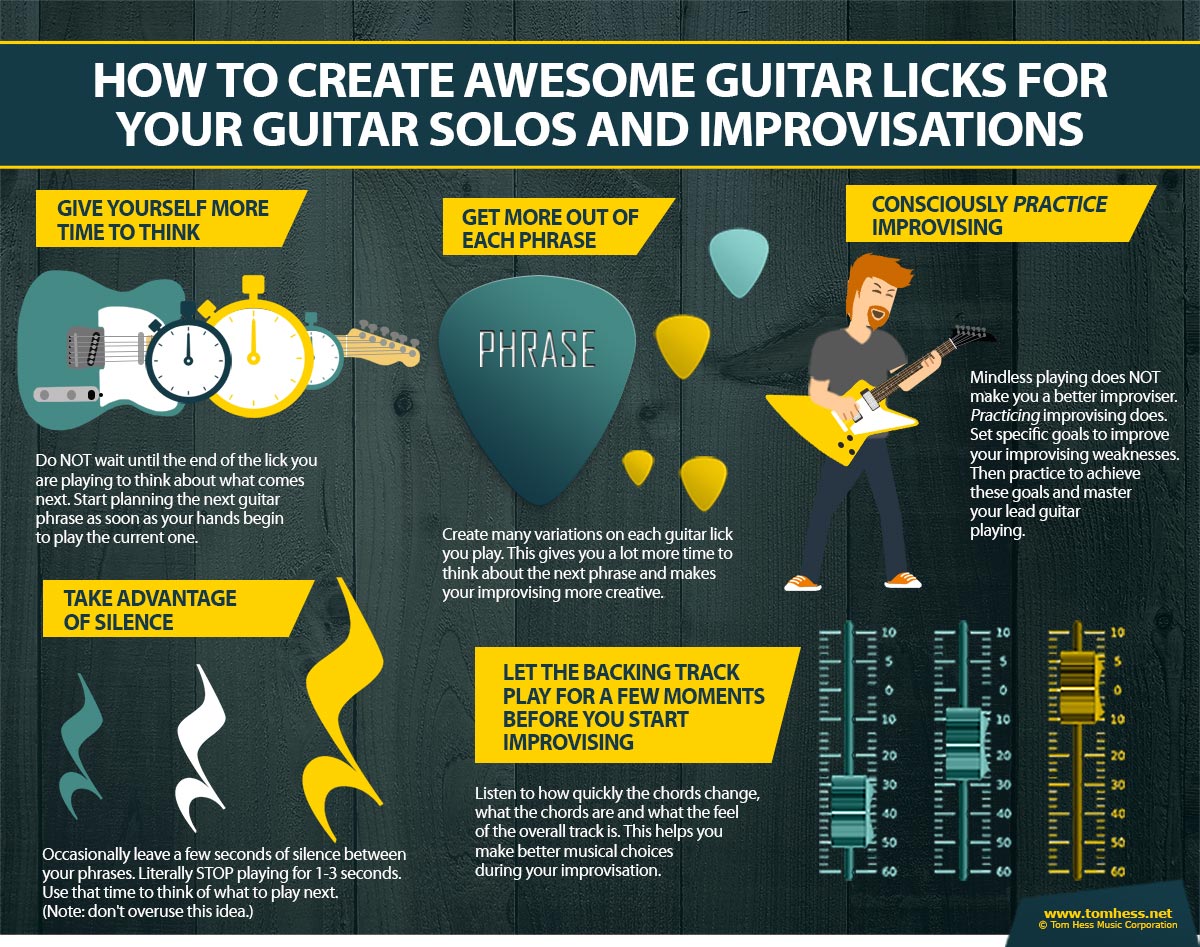
So I showed Diego how to squeeze far more life out of a small handful of notes, and how to turn a plain string of notes into a guitar lick that actually says something. This infographic lays out how to build guitar licks like that:
But even great phrasing needs one thing behind it, or it is just decoration. That last piece is what tied everything together for Diego.
Why You Can Play For Hours And Still Say Absolutely Nothing
This is the big one. Intention.
Intention means starting your guitar solo with a specific emotion you are trying to express (instead of stringing together licks you happen to know) and squeezing every drop out of it.
Without that, even a player with good technique sounds like someone who talks and talks and never actually says anything.
Intention and phrasing are the two things I find missing in almost every player who struggles to improvise.
Here is what pulling it all together looks like once the pieces are in place:

Diego had never thought about any of this, for one simple reason: nobody had ever made him. So he did what almost everyone does. He blamed talent or luck.
But once the first four skills were in place, intention is what let him tie them together into solos he was proud of - playing that finally sounded like him.
What You've Been Calling A Lack Of Talent
How many of the things you have decided you "don't have a talent for" are actually just skills nobody ever showed you how to build?
Because once you realize that talent is NOT something you either have or don’t have ... but is something you can install into your own playing on purpose ... you begin to see how much guitar playing potential you actually have.
I made a free training video that shows you exactly how natural talent REALLY works. In it you will see what natural talent really is (and why "you either have it or you don't" is flat wrong) ... the hidden thing that has probably kept you stuck for years ... and a completely different way to practice that takes about 45 minutes, not 8 hours a day and unlocks incredible gains.
By the end you will not just understand the idea - you will already play a little better than you could before.
Now back to Diego.
About eleven months after we started working together, he sent me a video of his improvising ... and it truly sounded great.
There was no more noodling. He was playing real guitar solos, with feeling, in the 80s style he had loved his whole life.
But here is the part Diego could never have figured out on his own.
The skill holding him back the most was not technique, and it was not speed. It was hearing the emotion living inside each chord and matching his phrases to it. That is the one thing that changed everything for him.
And until I pointed it out, the thought had never once entered his head. Like most guitar players, Diego only ever thought about the mechanics - which chords were in the song, what notes those chords were built from, and which notes he was allowed to play over them.
The actual emotion sitting inside those chords was invisible to him. (And even on the rare day a player does feel it, he usually has no clue how to pull that emotion out through his own solo.)
That is why Diego could have practiced for years on his own and never found it.
Here is what he wrote with it:
"Now I can play like my heroes, not only listen them. I never think I will feel this thing. Is very special for me. Thank you for getting me there!"
Diego started at 43, juggling a full-time job and a family, and was sure he was too old and too untalented to ever sound like the players he loved. He was wrong about all of it. What he was missing was never age or talent - it was one skill nobody had ever shown him.
Why Knowing The Five Skills Still Isn't Enough
You now know the five skills that decide whether your improvising sounds awesome or ... just mediocre. That is more than most guitar players ever figure out.
But knowing the five skills is not the same as knowing which one is holding YOUR playing back the most - and exactly how to fix it for the way YOU play.
That diagnosis is exactly what I gave Diego when he came to me for live one-on-one feedback. This is what I do for guitar players every week inside Breakthrough Guitar Lessons. I listen to YOUR playing and find the one skill that will change the most for you the fastest - then show you exactly what to do about it so you improve fast and enjoy the process.
A year from now, you could be improvising guitar solos you are proud of - the kind of lead guitar that sounds like the players who first made you want to pick up a guitar.
Or a year from now you could still be hearing that same lifeless noodling every time you try to play a solo - playing notes that are technically in key but saying nothing.
Diego made his choice at 46. The only thing between where you are and where he is now is the same decision he made: to stop guessing alone and let someone who has diagnosed this thousands of times show you what your playing actually needs.
Come join me inside Breakthrough Guitar Lessons, and let's get to work, so you can improvise guitar solos you are proud of.