How To Express Yourself On Guitar And Become An Expressive Musician

EMAIL TO GET ACCESS
By submitting your info, you agree to send it to Tom Hess Music Corporation who will process and use it according to their privacy policy.
To express yourself on guitar, you need lots of natural talent, right?
Wrong.
In this musical creativity article…
I'll show you how to express yourself on guitar and master musical expression...
... without needing to have been born with some musical creativity gene...
... and without needing to practice 12 hours per day.
In fact...
The musical expression techniques I'll show you are all:
1. Simple
2. Don't require much guitar practice time
3. Don't require you to be an advanced guitar player to use and benefit from.
You can begin using them right now to get on the path to becoming an expressive musician.
EMAIL TO GET ACCESS
By submitting your info, you agree to send it to Tom Hess Music Corporation who will process and use it according to their privacy policy.
First...
... check out this video that lays out some of the key principles that go into learning to express yourself on guitar:
Now that you know the basics, let's go deeper.
Here are 5 more strategies for mastering musical expression and musical creativity:
Musical Expression Guitar Practice Tip #1: Practice Building Your Levels Of Musical Expression (And Musical Creativity).
One of the reasons you may struggle to express yourself on guitar is: not practicing musical expression (and musical creativity) like any other skill.
Fact is, musical creativity is not much different from any other area of guitar practice (like fretboard visualization, phrasing or picking technique).
How to practice musical creativity?
Break down the larger musical creativity goals you have into their micro skills. For example: break down guitar soloing into: phrase construction, phrase refinement, note choice, rhythm control and phrasing ornaments mastery…
Then, create guitar practice assignments that make you better at these elements of musical expression, so you can grow your ability to express yourself on guitar. (If you don’t know what guitar practice assignments to create, ask a guitar teacher to create them for you).
Here are a few examples:
1. Phrase construction – Example: choose any 2 notes in a scale to be the starting and ending notes of a guitar lick. Then, improvise 4-6 notes in the middle of the starting and ending notes. This guitar practice process trains your musical creativity by forcing you to create guitar licks with clear start and end points (instead of noodling through notes or relying on the same old patterns you always play).
You can create lots of guitar licks using the same single pair of start and end notes. Then, create a new pair of notes to book-end your lick and keep going.
What I just described can be a single musical creativity guitar practice session (that helps you become an expressive musician)… or it can be done together with the musical expression guitar practice drills below.
2. Phrase refinement – playing musical ideas you come up with to make them sound more expressive.
The best way to do it is to play your guitar lick only once… pause… play it back in your mind and ask yourself: "how good did it sound on a scale of 1-10?" And if it wasn't a 10, what adjustment might you make to get it (closer) to a 10?
Then, play your guitar lick again (just once) with the adjustment you wanted to make. Pause and see how good it sounds relative to what you want.
Keep going through this process until you either make your guitar lick sound exactly how you want, or you run out of guitar practice time.
Watch this video to see this process in action:
Question: "Tom Hess, should I practice phrase refinement in the same guitar practice session, or should I work on this on other days?"
Answer: You can do either. It's totally ok to only work on refinement of guitar licks you've created in the past, just like it's acceptable to create a few guitar licks and then spend the rest of your guitar practice refining them. Both approaches help you express yourself on guitar and become a more expressive musician.
3. Note choice: This is different from phrase construction, because it's about choosing the most appropriate notes that create specific emotion over specific chords.
Guitarists who are good at this skill tend to master musical expression and become expressive musicians much faster than most.
This video shows how:
4. Rhythm: here is a good test that reveals how well you're able to express yourself on guitar using rhythm: take any guitar solo you've written (or improvised) and only listen to the rhythm of the notes. Ask yourself: if you removed the pitches and heard only the rhythm, how musical creativity would there be in it?
For most guitarists, the answer is: "not much". (Because most lead guitarists play non-stop streams of quarter notes, eighth notes, sixteenth notes and triplets.)
Few consider using creative rhythmic guitar soloing ideas, such as soloing over the bar or using rubato, the way I show in this video:
5. Phrasing ornaments: this refers to your ability to execute (expressively) various phrasing elements, such as: vibrato, slides, double stops, pinch harmonics, picking hand rakes, etc.
The better (and more expressively) you are at playing the individual phrasing elements, the easier it becomes to practice phrase refinement.
Take vibrato, for example. On top of needing to balance the speed and the width of your vibrato, there are several ways to make vibrato more expressive, such as:
– doing delayed vibrato, where you pick a note and let it sustain for a second or two before adding vibrato. This makes your vibrato sound like that of a (great) singer.
– delayed vibrato with re-articulation, where you pick a note, let it sustain and then pick the note again before adding vibrato.
– synching vibrato with the tempo of the song, the way I show here:
The more time you spend refining each of these elements of musical creativity in your guitar practice, the easier it becomes to express yourself on guitar and the faster you become a truly expressive musician.
Musical Expression Guitar Practice Tip #2: Practice Composing And Soloing Under Restrictions
Writing guitar solos (and songs) under restrictions is a fantastic way to improve your musical expression.
Here is how:
When you sit down to write a guitar riff, or guitar solo, the infinite number of musical choices you have can feel paralyzing.
This creative paralysis makes most guitar players default to playing the same notes, patterns, licks and ideas they always play – limiting their musical creativity.
 Become A Better Guitar Player
Learn the most critical mistakes
to avoid in your guitar playing.
 How To Write Great Guitar Solos
Quickly learn how to write killer
guitar solos that sound awesome.
 14 Day Guitar Speed Mini Course
Discover the most effective ways
to quickly build your guitar speed.
But when you intentionally limit yourself to just one musical element and force yourself to create musical ideas with it?
You often will discover new ways to express yourself on guitar you wouldn't have come up with any other way.
Some examples to practice composing and soloing under restrictions include:
For example: solo (or write a guitar riff) using only a single rhythm… or only one string… or only one type of note value… or only one technique (e.g. slides)… over a single chord… or using a pre-determined number of notes per phrase.
Another fun restriction is to play a guitar solo using a single guitar lick (changing it as little as possible to fit the changing chords in a song). You may vary the phrasing and the rhythm as much as you want, but keep the notes as close to the same as possible.
Choose any of these ideas (or think of your own) and create an entire guitar practice session, where you challenge yourself to write a guitar solo (or guitar riff) using it for 10-20 minutes.
This will be much harder than it seems at first (but it will make you much better at musical expression and boost your musical creativity).
You may or may not end up using the ideas you create, but the process itself will force your ability to express yourself on guitar to improve massively.
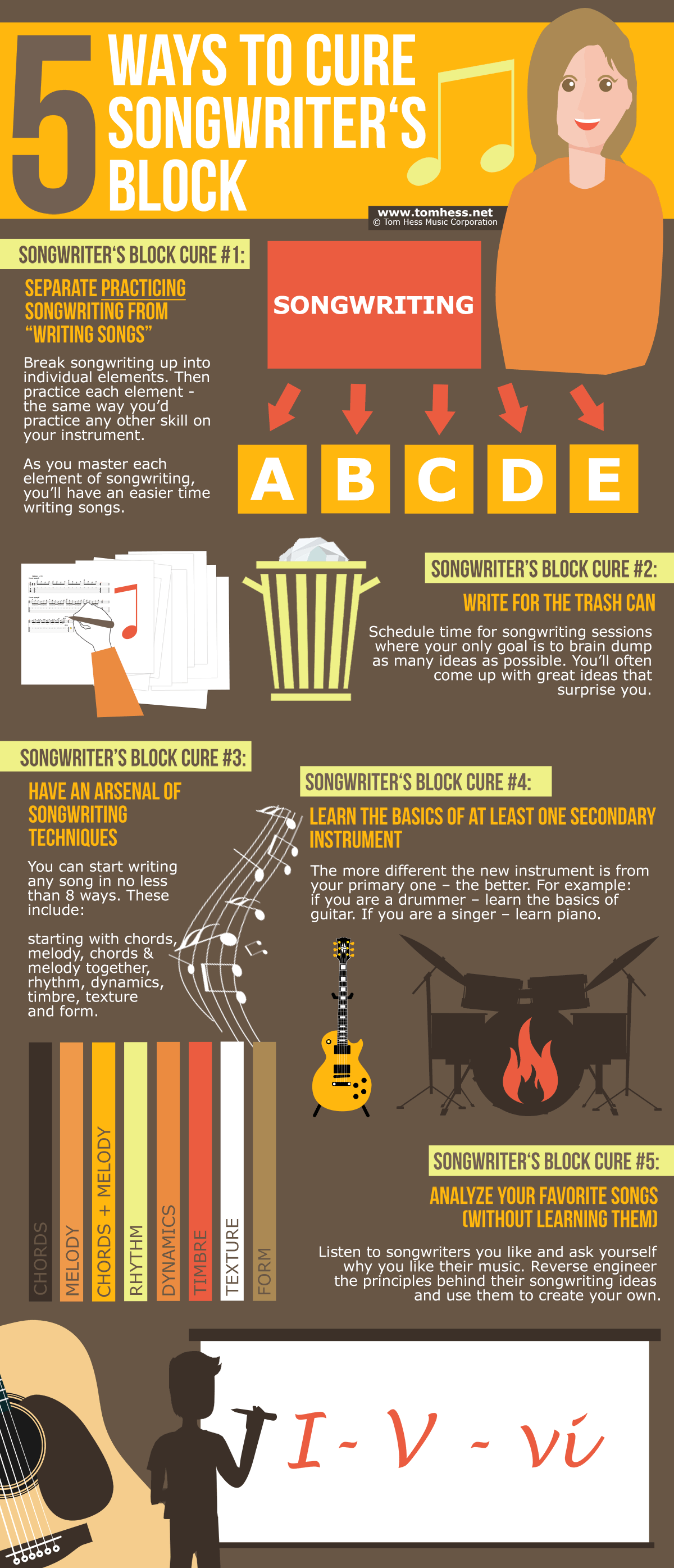
Musical Expression Guitar Practice Tip #3: Write Songs And Guitar Solos For The Trash Can
The best way to train to express yourself on guitar is to get in a lot of reps writing music (songs and guitar solos) as part of your guitar practice.
If you are new to, for example, songwriting: make it your goal to write your first 100 (bad) songs as soon as possible. You won't ever let anyone hear them. Write your "trash can" song to experiment with music theory concepts and songwriting techniques that you're learning.
The same applies to writing guitar solos.
This guitar practice idea might just be the single fastest way to boost your musical expression.
(The faster you write your 100 “bad” songs, the sooner you’ll get to the level of writing (much) better songs and guitar solos.)
Musical Expression Guitar Practice Tip #4: Train Your Ear
The better your ear, the easier it is to express yourself on guitar. That's because a great ear makes it possible to identify the sounds you hear in your head and quickly find them on guitar.
Here are some ways you can easily train your ear during your guitar practice:
1. Transcribe (by ear), songs, chords, melodies and solos, using your guitar as little as possible. (i.e. instead of meandering on your guitar, hoping to stumble upon the right notes, use your ear to decide what the notes/chords are and then play them on guitar to see if you were right.)
2. Sing scales and chords (arpeggios). Start by singing along with your guitar. Then, play every other note, but sing every note. Eventually, don't use your guitar at all.
3. Sing intervals (two notes a certain distance apart on guitar).
4. Sing melodies (where the notes do not follow each other linearly as they do in a scale). Pro tip: sing using scale degrees (the numbers of the notes in the scale: 1 2 3 4 5 6 7 – NOT using letter names or syllables like "la"). Singing on scale degrees helps you to remember the sounds of specific notes in the scale.
Training your ear applies not only to identifying the sounds of notes you hear, but for learning to play in time:

Musical Expression Guitar Practice Tip #5: Have Multiple Ways To Begin Writing Every Song Or Solo
Most guitarists struggle with musical expression because they approach their songwriting (and soloing) in the same general way.
The most common process is to pick up the guitar and improvise until they discover something that sounds good.
This method is simple and fun, but it is also limiting (as any single method would be). It's much harder to achieve musical expression (and musical creativity) breakthroughs unless you add other methods to your creative repertoire.

Here are a few ideas:
– start with your voice (hum a melody with your voice and then transcribe it on guitar).
– start with a rhythm (clap a rhythm with your hands and then write a riff or lead guitar idea using that rhythm).
– start with a different instrument (e.g. write a musical idea on drums or piano and then try to play it on guitar).
– start with a motive (e.g. create a rhythmic or melodic idea and then develop it into a riff or a solo idea on guitar).
– plan out the pitch range for your solo before you play a note
– decide on a phrase length cadence (e.g. short phrase followed by a long phrase, two short phrases followed by a long phrase, etc.)
These approaches help you approach writing music in ways most musicians never try.
Now that you know more about how to become an expressive musician, I'd like to help you master one of the crucial guitar playing skills for musical expression. That skill is: learning your scales all over the guitar, so you can solo in any key without getting lost. I show you how in my free eGuide: Fretboard Freedom Blueprint. Download it today and discover fretboard mastery secrets most guitarists will never know.


Learn guitar from the best rock and metal guitar teacher online.
