Easy Guitar Speed Lesson: How To Fix Slow Guitar Playing
BY AT LEAST 100%
EMAIL TO GET ACCESS
By submitting your info, you agree to send it to Tom Hess Music Corporation who will process and use it according to their privacy policy.
If you practice guitar regularly and your speed hasn't changed in years ...
The reason is almost never the one you think it is.
Most guitar players treat slow playing as one single problem:
Their hands don't move fast enough.
So the fix looks obvious ...
Most guitarists simply try to make their hands move faster.
But that diagnosis is wrong.
And it's the reason so many players stay at the same tempo for a decade or longer.
(Even if they're doing everything they were told to do.)
Here is what most don't realize:
Guitar speed is not one thing.
It's seven things working together.
And the one that nearly everybody trains first is the one that matters LAST.
Here are all seven of them:
But those seven 👆 elements are not the point of this article.
Because knowing them isn't the same as knowing what to do about them.
What changes your playing is knowing WHICH of them are the roadblocks to YOUR speed right now. And that's a much harder question than it sounds.
BY AT LEAST 100%
EMAIL TO GET ACCESS
By submitting your info, you agree to send it to Tom Hess Music Corporation who will process and use it according to their privacy policy.
Before I get into why it's so hard, let me show you what's waiting on the other side of it. This is the difference between another decade at the same tempo and playing faster than you thought your hands were capable of.
To do that, I have to tell you about my student Sean.
Sean is 54 and lives in Ireland. He plays 16th notes at 168 bpm now, clean and under control.
But for 13 years before that, he was at 118 bpm and couldn't break through it.
He practiced close to 1 hour per day, most days. He used a metronome the way he thought you're supposed to.
And 13 years later he was still nowhere near his speed goals.
Here's what he told me when he first contacted me:
“I've been sitting at the same tempo for years. I practice, I'm not lazy about it, I do the slow practice like you're supposed to do. And nothing changes. I don't know if my hands are just not built for this. I'm 54, so maybe that's my answer and I don't want to hear it.”
Fourteen months later he was at 168 bpm. I'll come back to what changed for him.
The Wrong Diagnosis Nearly Every Guitar Player Makes About Guitar Speed
Sean's guitar speed problem looked obvious to him, the same way it looks obvious to most players. His hands wouldn't go fast enough, so he needed to train his hands to go faster.
But he only thought of speed as the top metronome tempo at which both of his hands could play together.
In 13 years he had never once tried to uncover how fast each hand could go on its own. This was a big blind spot creating his speed plateau.
That may sound like a small oversight - but it isn't. (It's a bit like a mechanic telling you your car is slow without ever opening the hood to find out what's causing the car to not be faster.)
If you don't know what each hand can do separately, you have no idea which hand is the problem ... or whether either hand is the problem at all.
And when you don't know that, there's only one thing left to do. Push both hands harder and hope.
Watch this guitar technique video to see what happens when you get clarity on the speed of each of your hands separately:
But finding the top speed of each hand is just the beginning. Which brings me to ...
The Real Reason Your Guitar Playing Isn't Getting Faster
The real reason most guitar players never play guitar fast has very little to do with how quickly their hands can move. It has to do with how FAR they're making their hands travel.
Sean was only ever thinking about speed. He never considered that his hands could move less and play the same notes with greater efficiency. As a result, his fretting hand fingers - and his pick - were moving much more than they needed to for every single note.
This was killing Sean's speed ... and he had no idea.
Bigger motions take more time. They also hurt your accuracy (at every speed), because the longer the distance your finger (or the pick) travels - the more opportunities for mistakes there are.
Sean's hands were already moving fast enough to play far above 118 bpm. He just spent most of that motion traveling through the air instead of hitting notes, because his guitar technique was so inefficient.
This is where it gets ugly.
Why Your Playing Sounds Worse The Faster You Try To Play
If your motions are bigger than they need to be, it's not only harder to break through your speed plateau - it's even harder to keep your hands in sync as your playing gets faster.
Sean's synchronization shows exactly how this happens. He believed 2-hand synchronization was something you get handed by doing exercises with “2-hand sync” in the name. Play the drill, make the motion, and synchronization shows up.
That's backwards. Synchronization is a skill you train, or fail to train, in everything you play ... from the major scale ... to a lick in a solo ... or even a rhythm guitar riff with fast palm-muted notes. And unnecessarily large, inefficient motions make synchronization nearly impossible to develop.
Lack of synchronization was a huge part of what capped Sean's speed at 118 bpm.
That's what most guitar players never see coming. The practice was working. It just wasn't working on the right thing.
Why It Feels Like One Guitar Speed Problem When It's Actually Four
By the time Sean contacted me, he was certain he had one problem: guitar speed.
But he had four problems.
And none of them looked to him like they had anything to do with his speed when I revealed them to him.
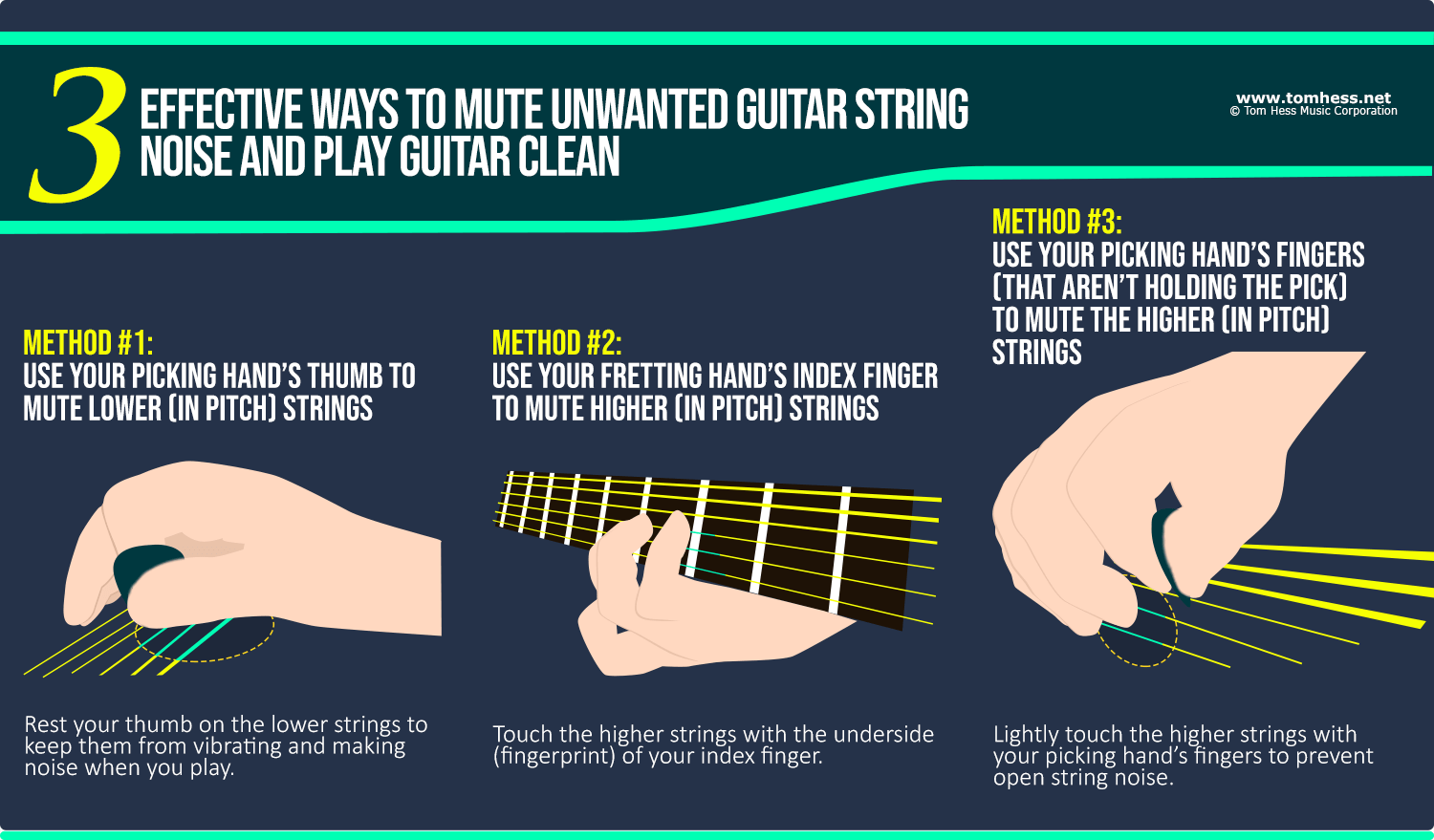
His playing was full of string noise. Like most players, he was muting with the palm of his picking hand. This hurt his playing in two ways:
First, it positions the pick away from the strings when it isn't playing, so his picking got even LESS efficient.
Second, the palm sits much closer to the bridge than the thumb does, which makes it WORSE at killing the strings he wasn't playing.
And it had never crossed Sean's mind that his fretting hand had any muting job to do at all. (It does.)
His playing was inconsistent. Some days it was decent, as long as he was fully warmed up and alone in his room.
Other days it broke down and he had to drop below his already slow top speed.
 The Fastest Way To Level Up What You Already Play
If your licks break down the moment two techniques meet, this one shows you what to practice instead.
 How To Get Rid Of Sloppy String Noise For Good
Find out where sloppy noise actually comes from and how to shut it down.
 Play Your Best When Someone Is Listening
A way to practice for playing in front of people instead of only playing well alone in your room.
That's not “bad luck”. Guitar technique that inefficient only works when everything is going perfectly. So on any day when something was off (like having cold hands, not enough warm-up, someone else in the room watching, etc.) he had to slow down just to get through it.
He couldn't integrate (combine) guitar techniques together reliably. He knew certain licks felt harder when they mixed several techniques together ... but he took that as a sign to do more slow practice - instead of a sign that he had a whole skill he'd never trained.
And he wouldn't play in front of anyone. He'd decided he would let people hear him once he could play his shred guitar licks at the speed his favorite players played them.
So he either avoided playing for people or he embarrassed himself on the occasions he couldn't avoid it.
Sean never experienced these 👆 as four problems. They all felt like the same thing to him ... being slow.
He kept trying to fix all of it the only way he knew, by making his hands go faster.
So, ask yourself this:
If you've been stuck at the same tempo for a long time, which of the guitar speed elements are the primary obstacles for you? Not which ones sound most likely. Which ones EXACTLY?
Most guitar players can't answer that, and it isn't because they haven't read enough. From your own perspective, all seven can feel identical.
Every one of them produces the same sensation: “I'm playing as fast as I can and it isn't fast enough.”
Most guitar players have never measured what each of their hands can actually do on its own. I made a free guide that gets you playing faster with the hands you have right now. Click below and grab your copy:
What It Takes To Finally Play Guitar Fast
On top of getting clear on which of the seven guitar speed elements are holding back YOUR playing, you need to establish the order the elements need to be trained in.
That order matters more than most guitar players expect. Working on the fifth element while the second one is your actual biggest priority doesn't get you anywhere.
At best, it makes you more consistent at playing slowly, which is exactly what was happening to Sean for 13 years.
And the order isn't the same for everyone. Two players can both be stuck at 118 bpm, both practice guitar the same amount every day, and need completely different things fixed first.
I've had students whose main problem was string control, and students whose string control was excellent and whose oversized motions were the main thing holding them back. They were stuck at the same tempo, but the first thing each of them needed to work on was completely different.
Whatever your primary problem is, it won't stay your primary problem.
Fix it and something else becomes the main thing holding you back, often within a few weeks.
What's right to practice in your first month is rarely what's right to practice in your fourth. (This is the part that holds back even those guitar players who diagnose their speed challenges correctly the first time.)
That's why knowing the seven elements is useful - and still not enough by itself.
What Happened When Sean Got The Right Diagnosis
Sean's fix wasn't what he expected. It also wasn't what he wanted to hear.
He came to me wanting more speed. I told him to stop trying to get faster.
Instead I showed him what each hand could do on its own, which he had never measured in 13 years of playing.
I got him making his motions smaller rather than quicker. I taught him thumb muting. I had him train synchronization as a skill using musical licks - instead of random drills he didn't know how to practice. And I trained him to make his playing dependable even in front of an audience.
That was the right order for Sean. Give me a different player at the same 118 bpm and I would start somewhere else entirely.
Not one of these 👆 changes was about making his hands go faster.
But fourteen months later he was playing 16th notes at 168 bpm.
Sean told me he thought building speed was going to take him a very long time. And doing it his way, it would have.
He'd have spent years trying to play faster while those four problems held him back.
But once we fixed those four problems, he hardly worked on speed at all. He made his motions smaller, got rid of the string noise and got his hands in sync. The speed was ALREADY there.
What To Do Next To Increase Your Guitar Speed Right Now
You can read every article ever written about guitar speed and still not know which of these seven elements is costing you the most right now.
The only way to know is to have someone who has diagnosed this many hundreds of times listen to YOUR playing and tell you.
That's what I do with my students in Breakthrough Guitar Lessons. I show you where your speed roadblocks are, I tell you which one to fix first and how to fix it, and I give you the exact lessons you need to reach your guitar speed goals. As you improve, I refine your lesson strategy to always keep you on track towards your goals. You never have to guess what to work on again.
Sean spent 13 years at 118 bpm and fourteen months getting to 168. He wasted the first 13 years not because he was too old or too untalented, but because he was fixing the wrong thing.
One year from now, you could be hearing yourself play a lick you can only imagine playing today ... Or you could be hearing yourself struggling to play the same licks you're struggling with now, slow, sloppy, choppy, etc. after another year of practicing.
To get on track to the speed breakthroughs you want and deserve, click the button on the banner below: