Heavy Metal Rhythm Guitar Lesson: How To Play Tight Guitar Riffs
Technique Much Faster
EMAIL TO GET ACCESS
By submitting your info, you agree to send it to Tom Hess Music Corporation who will process and use it according to their privacy policy.
If you struggle to play heavy metal guitar riffs at full speed without sounding sloppy … or your picking arm starts getting tired after 30 seconds ...
… there is nothing wrong with you, but there is likely quite a bit wrong with the way you're trying to practice your rhythm guitar playing.
I've taught thousands of guitar players who had already tried (and failed) at all the usual ways to improve their rhythm guitar playing: practicing more … slowing down and speeding back up … working with a metronome … and trying to "muscle through" hand fatigue … who now play better than they ever thought they could.
(What these students were missing was an accurate roadmap to tight rhythm guitar playing.)
Let me tell you about one such student: Tony A. from Canada.
Today, Tony plays Metallica, Slayer and Anthrax riffs at full speed without his arm cramping. (He writes his own guitar riffs too.)
And he recently joined a band in Calgary playing 80s-style speed and thrash metal, where he plays entire setlists start to finish and stays locked in with the drummer the whole way.
But when Tony first came to me, things looked very different.
He was 46, practicing about an hour a day, and he'd been playing for 11 years. He couldn't get those riffs up to speed without his arm getting tired and his palm muting becoming sloppy.
Worse, the bass player and drummer friends of his he was jamming with at the time - both more advanced than him - kept telling him he was rushing instead of locking in.
This is what he told me:
“I feel very insecure about this, because I can't often hear when my playing is off, but multiple people told me I'm not in time. And my whole forearm locks up on me after about half a minute - I have to stop. I'm frustrated because I don't know what to do about it.”
Technique Much Faster
EMAIL TO GET ACCESS
By submitting your info, you agree to send it to Tom Hess Music Corporation who will process and use it according to their privacy policy.
I'll show you exactly what changed for Tony later in this article.
For now, here's the map he followed.
There are five areas that go into playing tight, fast heavy metal rhythm guitar:
1. Getting your rhythm tightness under control - consistent palm muting and locking in with the beat.
2. Building speed, tension control and endurance at the same time.
3. Training your rhythm creativity so you can write your own guitar riffs.
4. Understand the theory behind your favorite riffs.
5. Recording yourself so you can hear what's really going on.
But there are two crucial things to know about this map:
First, these 👆 five areas are NOT a checklist you work through in order. You don't master number one before you touch number two. You work on a bit of the first area, then start the second while the first keeps improving ... and later areas send you back to make the earlier ones stronger.
Second, everyone's journey on this map looks different. How you go through this map depends on your starting point, your goal and your strengths and weaknesses.
(This is why many guitar players struggle to go through it on their own - even when the five areas look simple.)
Let's dive into each step in more detail:
Get Your Rhythm Tightness Under Control
Before you build any speed, your rhythm guitar sound has to be right. I'm not talking about the tone of your amp - I'm talking about the heavy metal tightness of YOUR playing, no matter what gear, amp or pedals you're using.
Because if you get faster at something that sounds sloppy, you're just speeding up the sloppiness.
For tight rhythm guitar, it comes down to two things: your palm muting has to stay consistent from note to note, and your picking has to lock in with the drums and bass. If some notes are muted hard and others are barely muted, it doesn't sound tight, and no amount of speed will fix that.
This is what goes into getting it right.
Watch this video to see and hear the massive difference between 'tight' and 'not tight' rhythm guitar riffs:
This 👆 is the sound you're training your ear to recognize.
There's a simple way to find out whether you need work in this area.
Find instrumental versions of your favorite heavy metal songs. (Where you can just hear the rhythm guitar parts, with the vocals removed.)
Listen closely to the rhythm guitar and how tightly it locks in with the drums and bass (and how consistent the muting is) …
… then compare your own playing to what you hear.
If your muting jumps from soft to aggressive at random, you've found something to work on.
This is where most players get it wrong.
They think they're done with this area the moment they've learned to palm mute and started using a metronome.
But knowing HOW to palm mute and actually playing tight are two different things ... and you usually can't hear how tight or sloppy you really are until an expert hears you play and tells you exactly where it's off.
Everything else you build comes from this foundation.
Once you know what tight actually sounds like, the next challenge is holding onto it as you get faster - without your arm giving out.
This leads us to the second point of the map:
Build Speed, Tension Control And Endurance 'At The Same Time'
As you get clear on what tight metal riffs sound like, you need to learn to play that tight rhythm at faster tempos … without hand fatigue.
There are specialized practice methods built for exactly this in rhythm guitar. They're different from simply starting slow and speeding up, and different from the speed bursts most players know from lead guitar.
Watch this video to see one of these practice methods in action - and why it builds your speed and your endurance at the same time:
Now, the mistake almost everyone makes, and Tony made it too: they try to build speed first and assume tension and endurance are things you deal with later, 'after' you've reached your goal speed.
That's wrong ... and backwards.
You develop endurance and tension control at the SAME time as your speed. That's what makes your speed reliable instead of breaking down after a few seconds.
So ask yourself: when you play your riffs faster, does your picking arm start to get tired and give out on you?
If it does, that's not just your arm getting tired. It's tension - and there are nine different sources of it that most guitar players never even notice. Number nine is the one that does the most damage.
I made a free master class that walks through all nine, one at a time, and shows you how to get rid of them so you can play faster and longer with far less effort:
And if you notice muting problems at faster speeds you didn't notice while playing slowly …
… that is a sign to go back to step 1 and tighten up your muting. Don't worry, this is a normal part of the process of refining your skills and making them usable at higher speeds.
Now, here is something that surprises a lot of players at this point: you don't have to wait until your technique is polished to start being creative with it.
This is where the third point of the map comes in:
Train Your Rhythm Creativity
Most players think creativity is something you're born with or you're not.
But you can actually build it on purpose, the same way you build any other skill on guitar.
More importantly, you can and should train it WHILE you work on the first two areas, not years down the road.
And you don't need to know a ton of chords or be an advanced guitar player to start.
Watch this video to see how to train your riff writing - even if you only know a handful of chords:
Tony didn't know much about music theory or rhythm when he started. But I showed him how to be creative with the skills he already had, and he started writing his own guitar riffs a lot sooner than he thought he could.
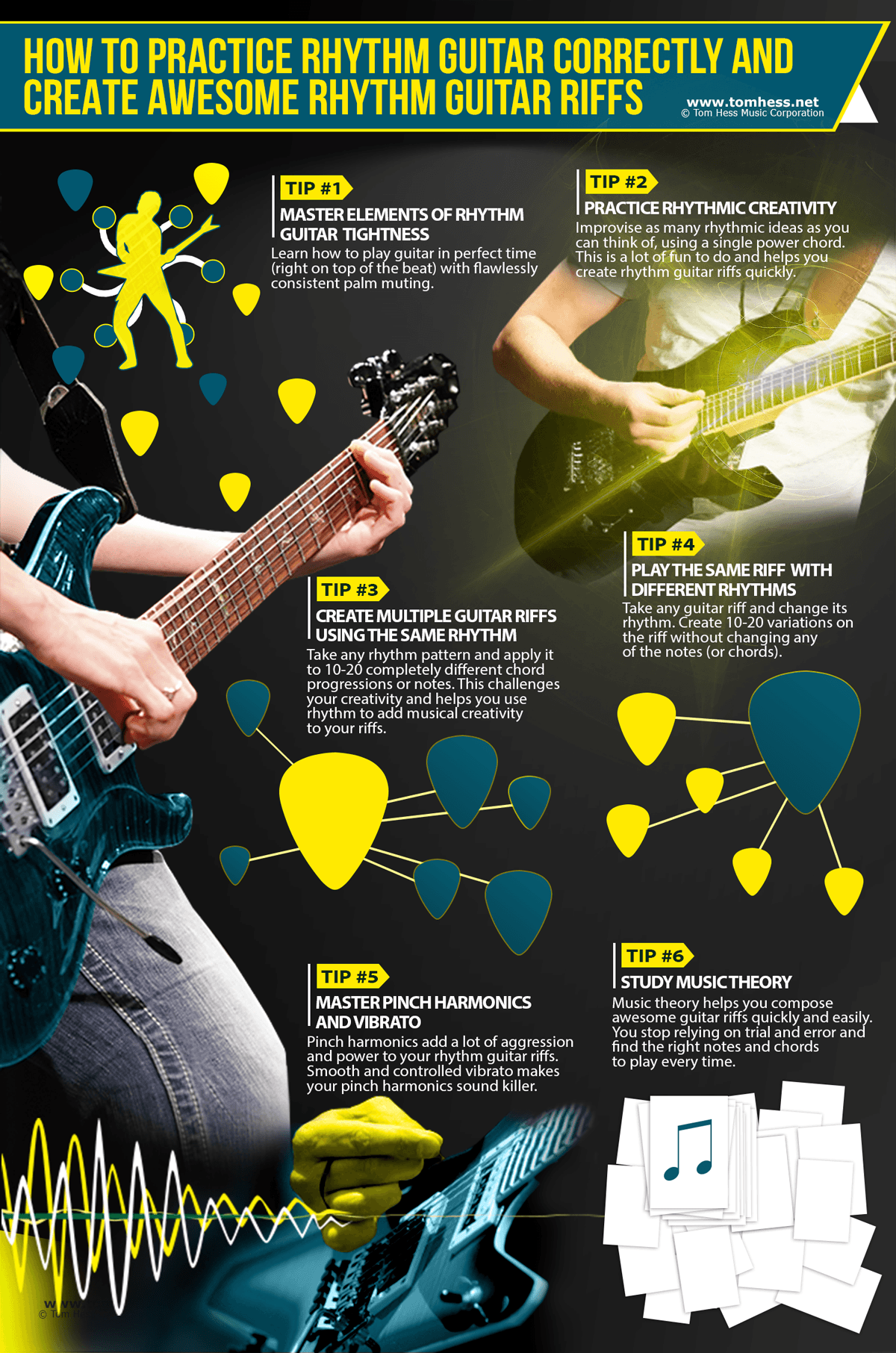
He wrote even better riffs once he understood WHY his favorite riffs sounded the way they did after he explored the next area of the rhythm guitar roadmap:
Understand The Theory Behind Your Favorite Riffs
You CAN write cool riffs without knowing any music theory. But you'll write better ones, a lot faster, the more you understand about why your favorite guitar players' riffs sound as good as they do. Music theory is what explains it.
This is why I combined Tony's rhythm guitar technique work with music theory training. It helped him break down those riffs and understand how to write his own in that style, without feeling like a copycat.
Notice how this area feeds back into the last one. The more theory you understand, the more tools you bring back to your riff writing.
There's one more area, and it's the one that lets you hear the truth about your own playing.
I'm talking about:
Recording Yourself And (Critically!) Listening Back
Recording is one of the best ways to check how tight your rhythm guitar playing really is - and to learn to sound more pro.
When you record yourself, you can analyze your playing without the distraction of playing it.
Listen back in headphones, and you'll catch problems in your muting, your string noise and your timing far more easily than you ever could with your hands busy on the guitar.

But there's a catch. Recording shows you that 'something' is off. Knowing exactly 'what' is off (and how to fix it) is a different skill ... and it's the one that sends most players in circles.
Which brings me to the hardest part of this whole map.
The five areas are not the hard part. Any serious player can understand them.
The hard part is knowing exactly WHEN to move between them, how much to work on each one, and what to fix inside each area - because that depends entirely on YOUR specific weaknesses as a player.
 How To Play 7 String Guitar More Creatively
Check out these easy tips for playing a 7-string guitar like a pro.
 6 Easy Ways To Master Pinch Harmonics
Pinch harmonics are easy when you practice them like THIS.
 6 Powerful Tips For Writing Songs On Guitar
Here is how to write songs, even if you're not talented.
That's the one thing you can't get from an article or a video.
It takes someone who can hear where you actually are and tell you what to work on next.
Which brings me back to Tony.
When Tony came to me, he was sure his only problem was the arm fatigue.
He thought if he could just stop his arm from burning, the rest would sort itself out.
But the first thing he actually needed was an ear for what tight playing sounds like. So that's where we started. From there we built his endurance and tension control at the same time as his speed, so his speed would hold up. We trained his riff writing using the skills and knowledge he already had.
We added the theory that helped him understand the riffs he wanted to play. And we used recording so he could hear his own progress.
The real key was never any single one of those areas. It was knowing, for HIM, which one to work on and when.
It took about 25 months. Today he plays Metallica and Slayer riffs at full speed, relaxed, and writes his own.
The map I just showed you is one version of the path to getting there. But YOUR version depends on where you are right now, what you're trying to play, and your specific strengths and weaknesses.
And putting these steps into the right order for you is exactly what I do inside Breakthrough Guitar Lessons. I look at YOUR actual playing, tell you which area to work on first, what to fix inside it, and when to move on ... and I adjust all of it as you improve until you reach your goals.
Tony was 46, practicing an hour a day, his arm burning after 30 seconds, being told he was rushing and unable to hear it himself. Today he plays the thrash riffs he wants to play at full speed, relaxed, and writes his own.
The difference between where Tony is now and where he was then came down to one decision - he stopped trying to figure it out alone.
A year from now, you could be playing tight rhythm guitar on fast heavy metal riffs that locks in with any band ... or you could be right where you are today, still fighting the same arm burn and the same sloppy muting.
If you want the same guidance Tony got, here's where to start: