Holding The Guitar – The Correct Way To Hold The Guitar
BY AT LEAST 100%

EMAIL TO GET ACCESS
By submitting your info, you agree to send it to Tom Hess Music Corporation who will process and use it according to their privacy policy.
Question:
Can something as “minor” as your sitting position for playing guitar REALLY impact how easy your guitar playing feels...
... and help you improve and reach your goals as a player more quickly?
Answer:
Yes.
Yes, it can.
And in this article...
I show you the best way to hold the guitar for maximum progress and ease of playing...
I’ll list all the reasons why – in my experience – this way of holding the guitar is superior...
And finally...
I’ll give several guitar practice tips for getting used to this sitting position for playing guitar, so you can reach your guitar playing goals faster and easier.
BY AT LEAST 100%
EMAIL TO GET ACCESS
By submitting your info, you agree to send it to Tom Hess Music Corporation who will process and use it according to their privacy policy.
To begin...
Watch this video that reveals the best position for playing guitar and lays out the reasons why you should consider holding the guitar this way:
Now, let’s go deeper.
Here are 5 areas of guitar playing that the classical position for playing guitar makes easier to do, as well as tips for how to master those areas of playing faster and with far less practice time:
Advantage #1 Of The Classical Sitting Position For Playing Guitar: It Makes It Easier To Learn And Master Directional Picking
What is directional picking?
It's the most efficient way of playing scales and scale sequences on guitar by always picking in the direction of the next note.
Like this:
When you're picking on a single string, you alternate your pick strokes all the time.
When you're changing strings, one of two things can happen:
1. When you move towards a thinner (higher in pitch) string, you pick the first note on the new string with a downstroke.
2. When you move towards a thicker (lower in pitch) string, you pick the first note on the new string with an upstroke.
Directional picking helps you tremendously with playing guitar fast because it eliminates the clunky outside-the-string picking hand motion that happens with strict alternate picking.
The result?
Your guitar practice (especially when you use classical position for playing guitar) becomes more effective because you're no longer wasting energy on unnecessary picking motions. Instead, you're taking the shortest path to each note – making it possible to build guitar speed much faster.
Watch this video to see how to do directional picking the right way:
Question: "Tom Hess, why does classical sitting position allow you to learn and master directional picking?"
Answer: Holding the guitar in the classical sitting position ensures that your shoulders are in a T-formation. This makes your upper body more relaxed. And having relaxed shoulders makes it much easier to build guitar speed and play guitar for longer without becoming tired. (More on this below.)
In addition, the classical position for playing guitar makes it easier for your picking hand to move in a straight vertical line through the strings. This makes it equally easy to pick fast on both the low strings and the high strings alike. This guitar technique video shows how.
Advantage #2 Of The Classical Sitting Position For Playing Guitar: It Makes It Easier To Learn And Master Sweep Picking
Sweep picking is used for picking through string changes in some guitar licks. To sweep pick, your pick must move in a single motion through several strings.
Sweep picking is often used when playing arpeggios on guitar (i.e. chords where you play one note at a time), as well as in some scale and scale sequences.

Here are some common mistakes to avoid with sweep picking (that can occur no matter what position for playing guitar you use while practicing):
1. Stopping the picking hand between strings – losing momentum that is essential for fast sweep picking. Your pick must never stop moving (even if there are hammer ons and pull offs used in the arpeggio in combination with picked notes). It could slow down, but it should never stop.
This is the secret to doing sweep picking fast and clean.
Bonus tip: when sweep picking, your picking hand should always move in two motions: one motion up the strings (ascending) and one motion down the strings (descending).
This is true no matter if you're sweeping through two strings, three strings, four strings, five strings or six strings (or more strings).
2. Allowing the notes to bleed (ring) together. The secret to making your sweep picking sound good is to separate the notes clearly (without bleeding) at every tempo.
To make this possible, concentrate on releasing the finger that finished playing a note the moment your next finger plays (frets) the next note. This keeps your guitar playing clean, no matter what speed you are playing at.
3. Making pull offs faster than the other notes in your sweep picking licks. This is a common problem that throws off your timing (and it happens no matter what position for playing guitar you use). Fortunately, it is very simple to fix.
Practice your sweep picking guitar licks in quarter notes (one note per metronome click) and get used to keeping each note's duration perfectly even. Then, work up to 8th notes and 16th notes (or triplets), keeping the duration of the notes the same.
Watch this video to see me coaching one of my guitar students through this issue:
4. Allowing gaps of silence to happen between notes. This problem is opposite to that of allowing notes to bleed together. Instead of sound of the notes overlapping, the notes now sound choppy and staccato.
To fix this, listen for the transition between notes, and make sure that each note begins to ring at the exact moment the previous one stops – not a millisecond before or after.
5. Struggling with fretting hand finger rolling. What is finger rolling? It's a technique used for playing multiple notes on the same fret across multiple strings (with the same finger). It often happens in sweep picking licks, and – if you're not careful – can cause the notes to bleed together.
Watch this video to see how to do finger rolling the right way:
Question: "Tom Hess, why is it important to hold the guitar the way you showed (in the classical sitting position) when practicing sweep picking?"
Answer: Holding the guitar in the classical sitting position makes it easier for the fretting hand to play the big stretches that happen in many sweep picking licks. (Plus, it forces your picking hand to be in a more efficient position for playing.)
Advantage #3 Of The Classical Sitting Position For Playing Guitar: It Makes It Easier To Learn And Master Legato
Here are some of the ways that using the classical position to sit with the guitar helps your legato playing:
1. When you sit with the guitar and hold the guitar in the classical sitting position, it becomes easier to get used to playing with the thumb behind the neck, the way I show in this video lesson:
2. Holding the guitar in the classical sitting position makes it easier to maintain an open hand when you're playing hammer ons, pull offs and slides.
This makes your legato playing faster cleaner and more consistent.
And as a consequence…
3. When you hold the guitar in the classical sitting position, it becomes much easier to do wider stretches with your fretting hand that would be impossible if your thumb was hanging over the top of the guitar neck.
This way of holding the guitar puts a lot less strain on the wrist – which helps to avoid guitar playing injuries that can take a long time to heal.
Question: "But Tom Hess, what about string bending and vibrato? Shouldn’t the fretting hand thumb be on top of the guitar neck for those techniques? Does the classical sitting position work for bending and vibrato?"
Answer: The thumb does come up over the top of the guitar neck for bends and vibrato… and this can easily be done when you hold the guitar in the classical sitting position.
You simply need to practice switching between the two thumb positions (having it behind the guitar neck and wrapping it over the fretboard when doing bends and vibrato), depending on what you are playing.
Advantage #4 Of The Classical Sitting Position For Playing Guitar: It Makes It Easier To Control Excess Muscle Tension
Holding the guitar in the classical sitting position not only helps your picking hand shoulder be more relaxed (as described earlier)…
It also makes it much easier to relax your entire body when you play guitar.
That said, even the best sitting position for playing is not enough to ensure you always stay relaxed when you play guitar.
This is why I also teach all my guitar students to perform a 'tension audit' when they play guitar.
A tension audit is a way to check all parts of your body for relaxation, so you can relax anything that's tense.
It works like this: as you play any guitar lick (sitting in the classical sitting position), rotate your attention through different parts of your body, such as: your jaw, your shoulders, your stomach, your thighs, your calves, your feet and relax any tension you find.
Here is what this looks like:
Advantage #5 Of The Classical Sitting Position For Playing Guitar: It Makes It Easier To Practice Guitar For Real-Life Playing
One of the huge benefits of holding the guitar in the classical sitting position is: it makes it very easy to switch between playing guitar sitting and playing guitar standing up.
When you stand up, your guitar (should be) in the same exact position on your body as it is when you hold the guitar while sitting.
This is very helpful for learning to play guitar in 'real life' (e.g. on stage).
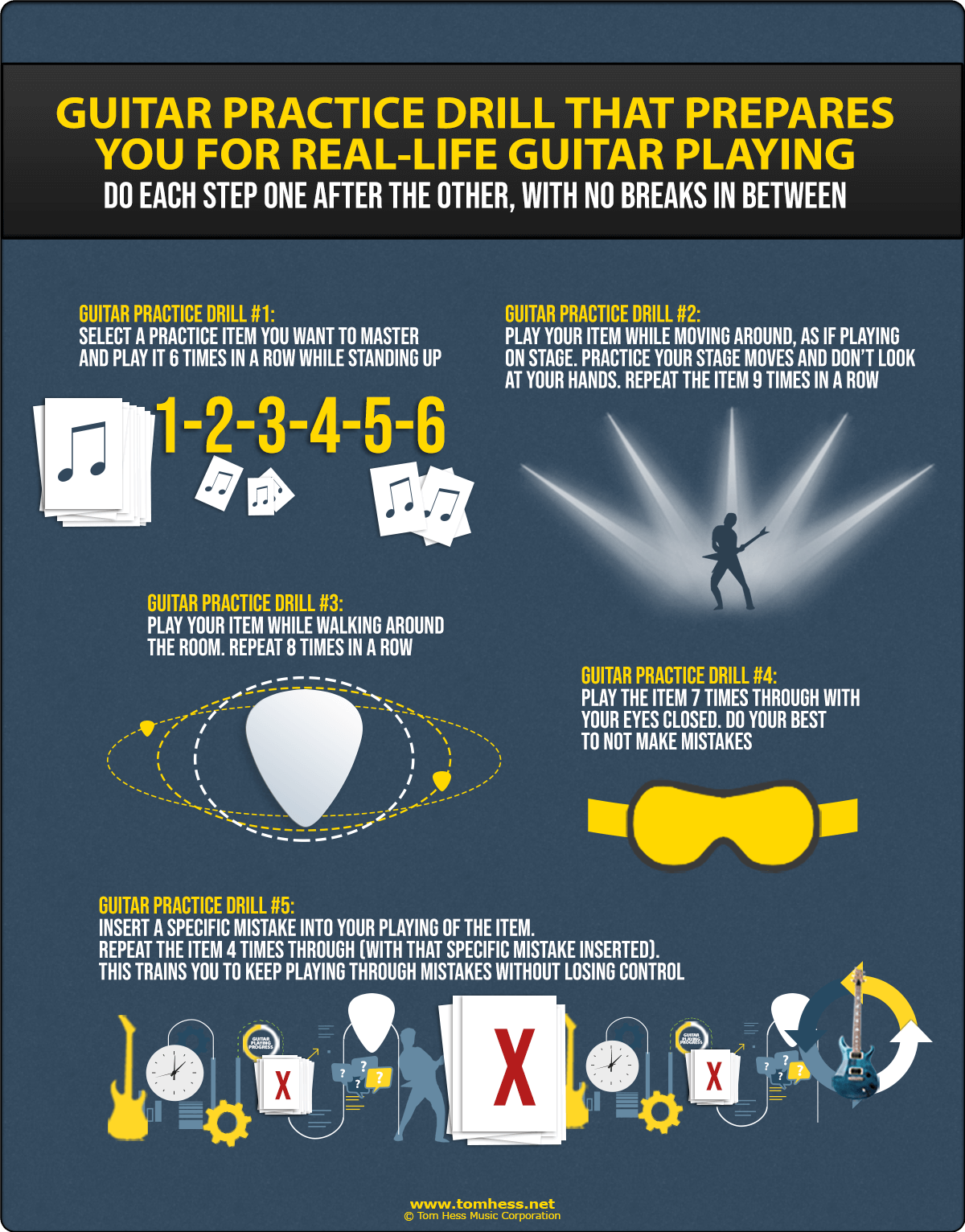
And if playing live is important to you, here are a few more specific ways to get better at real-life playing:
1. Practice imitating real-life conditions. The more you can imitate the things that will happen on stage during your performance – the better you will play during the show.
2. Practice playing through mistakes. No matter how well you prepare for the performance – mistakes can and will happen. The ability to play 'through' them like a pro is a skill in and of itself.
3. Practice stage presence. This is every bit as important as your actual playing. If your stage presence is boring/non-existent, few people want to see you perform more than once.
4. Make the tune harder to play while practicing. This gives you more reserve capacity that makes it easier to play accurately during the performance.
Now that you know the best way to hold the guitar, I want to help you master the rest of your guitar playing and fully reach your musical goals. I can do that for you in my Breakthrough Guitar Lessons. Here is how it works: First, you tell me about your guitar playing goals, musical background and your biggest challenges and frustrations. Then, I create personalized guitar lessons to help you develop the skills you need to reach your goals fast. And as you practice your lessons, I give you a massive amount of help, feedback and support (including live on video) to ensure you improve lightning fast and reach your guitar playing goals, while having a lot of fun along the way.
I’ve helped thousands of guitar players reach their goals and you can be next. To learn how, click the button on the banner below.

Improve your guitar playing with the best rock & metal guitar lessons.
