How To Pick Faster On Guitar Without Practicing Guitar More
Technique Much Faster
EMAIL TO GET ACCESS
By submitting your info, you agree to send it to Tom Hess Music Corporation who will process and use it according to their privacy policy.
In this guitar speed article, I'm going to show you how to pick faster on guitar - without adding a single minute to your practice time.
And to prove it works, let me tell you a story.
Meet Andreas.
Today, Andreas rips through instrumental shred guitar solos - including the outro to Dream Theater's "This Dying Soul" - for fun.
But when he first came to me for help, things looked very different.
He was working as a scientist in a cancer research lab in Berlin. Most days, he could only practice 45 to 60 minutes.
And on top of limited practice time, he's a left-handed guitarist who plays right-handed - which (he thought) added another layer of difficulty to everything he worked on.
As he told me when we began working together: "I wonder if I have what it takes to pick as fast as Petrucci when I cannot practice very much. While Petrucci famously made a pact with John Myung to practice 6 hours per day when he was getting his playing together."
(Think about that for a moment. He was comparing himself to a guitarist who practiced 6 hours a day - while he had less than one hour.)
I'll tell you exactly what changed for Andreas - and how he went from doubting his potential to outpacing the recordings of his guitar heroes - later in this article.
Technique Much Faster
EMAIL TO GET ACCESS
By submitting your info, you agree to send it to Tom Hess Music Corporation who will process and use it according to their privacy policy.
First, let me show you what is possibly the simplest and quickest way to boost your picking speed in the next 10 minutes:
Now, let's go deeper.
Here are 5 more guitar technique tips for how to pick faster on guitar that work like crazy whether you're practicing guitar for 30 minutes a day or 3 hours per day.
Tip #1: Use Directional Picking
If you want to pick faster on guitar with less effort, the single most impactful change you can make is switching to directional picking.
Here's the principle: when you play on a single string, you use strict alternate picking (down-up-down-up). But when you change strings, you pick in the direction of the next string - using the shortest possible path to get there.
This means sometimes your string changes will look like alternate picking. Other times, they'll use a sweep picking motion. You simply move the pick in the most direct way possible to reach the next note - with zero pre-planning.
Why is this so much more effective for building guitar speed than strict alternate picking?
With strict alternate picking, your pick is forced to hop over the next string on certain string changes - just to maintain the rigid down-up pattern. That extra motion might seem tiny. But at high speeds, those extra millimeters of pick travel multiply across thousands of notes ... and the inefficiency becomes the bottleneck that stops you from being able to play guitar fast.
Directional picking eliminates that wasted motion entirely.
Watch this video to see why directional picking helps you build guitar speed more easily:
Now, I know what some of you might be thinking:
Question: "Tom Hess, I've been using alternate picking for years. Won't switching to directional picking make me slower at first? Is it worth the transition?"
Answer: Yes, there is a short adjustment period. And yes, it is absolutely worth it. The adjustment typically takes a few weeks of focused practice - not months or years.
And here's why it pays off so dramatically: directional picking doesn't just help your scale runs. It also builds the same motions you use for sweep picking.
So by practicing guitar technique one way, you improve two techniques at once. Strict alternate picking doesn't transfer into sweep picking at all - meaning you'd have to practice each technique entirely separately, using more of your limited practice time.
Think about it: if you only have 45 to 60 minutes per day (like Andreas), you can't afford to use a guitar technique that forces you to spend double the time building your skills. You need the approach that gives you maximum results per minute of practicing guitar.
Andreas came to me using strict alternate picking. He had to relearn his picking approach using directional picking - and he'll be the first to tell you it was the best decision he ever made for his guitar speed.
Once the adjustment period passed, tempos that felt impossible before suddenly felt within reach.
And the transition was smoother than he expected ... because of the next tip:
Tip #2: Do Picking-Hand-Only Practice
This might be the biggest hidden gem in all of guitar technique practice.
Here's how it works: you mute all the strings with your fretting hand (just lay your fingers across them lightly, so no notes ring out). Then you practice your picking motions on the muted strings.

That's it.
No fretting. No notes. Just the raw mechanics of your picking hand.
Why is this so powerful?
Because it lets you isolate and fix problems in your picking hand that you'd never notice while playing normally.
When both hands are working at the same time, your brain has too many things to track. You're thinking about fretting the right notes, keeping your fingers close to the fretboard, watching your timing ... and your picking hand runs on autopilot.
The problem is, your autopilot might be full of inefficiencies.
Maybe your pick bounces too far away from the strings between notes. Maybe your wrist bends out of alignment with your forearm during string changes.
Maybe your forearm tenses up more than it should. You'd never catch these things while playing normally - because your attention is split.
Picking-hand-only practice eliminates all distractions and lets you focus entirely on the efficiency of your picking motion.
Watch this video to see how to do picking-hand-only practice:
This was the single biggest aha moment for Andreas. He had never practiced this way before - and when he tried it, it exposed a ton of flaws in his picking hand that he'd been carrying around for years without knowing it.
Which brings me to something important:
Tip #3: Control Tension In Your Body (Especially Your Fretting Hand)
Excess muscle tension is the #1 killer of guitar speed.
And most guitarists don't realize how much tension they're carrying - because it builds up gradually and feels "normal" after a while.
Here's what makes tension so tricky: you need some tension to play guitar. Your fretting hand has to press the strings. Your picking hand has to grip the pick and attack the strings. Tension isn't the enemy - excess tension is.
Watch this video to learn how to control excess muscle tension:
The big challenge with controlling excess tension comes from the fact that different guitar techniques require different amounts of tension.
When you want to play guitar fast through scale runs, you need very light fretting pressure.
Aggressive string bends need much more.
 How To Play Awesome Guitar Riffs
Find out how to play killer rhythm
guitar riffs in a rock/metal style.
 10 Ways To Improve As A Guitarist
Learn 10 things that will help you quickly become a better guitarist.
 Learn What To Practice On Guitar
Learn how to become a balanced
guitarist and fix your weaknesses.
Your hands need to adjust independently based on what you're playing at any given moment.
This is called hand independence - and it's one of the most overlooked elements of guitar technique.
Here's what hand independence means in practice: when your picking hand strikes the strings harder (for more volume or articulation), your fretting hand must not tense up in response.
And when your fretting hand works harder (during legato passages or wide bends), your picking hand must stay relaxed.
Most guitarists' hands are linked - when one hand tenses, the other tenses in sympathy. This creates a chain reaction of excess tension that makes it nearly impossible to play guitar fast - no matter how hard you try.
Andreas had to work on hand independence in particular, because his pick attack was quite aggressive. That aggressive picking was causing his fretting hand to tense up in reaction - creating a bottleneck in his guitar speed that had nothing to do with how fast his fingers could move.
Once he learned to keep his fretting hand relaxed while his picking hand attacked hard, a huge barrier to his guitar speed simply disappeared.
So here's a question for you: how much excess tension are you carrying right now without realizing it?
If you're not sure - or if you suspect tension might be limiting your guitar speed - I put together a free video class that walks you through it.
It's called "Total Guitar Playing Tension Control" and during the class, you'll discover how many of the 9 types of tension you have - and how to eliminate them one by one.
By the time the class ends, you'll have actually reduced (or eliminated) all 9 sources of tension and learned how to practice so that tension never creeps back in.
To watch the class for free, enter your name and email on the banner below.
Now, here's the good news: once you start getting tension under control, the next tip helps you to increase your speed a whole lot faster:
Tip #4: Work On 2-Hand Synchronization
Your guitar speed is only as fast as your two hands can stay in sync.
Here's what I mean: most guitarists have a gap between their "potential speed" and their "usable speed." Potential speed is how fast your hands can move. Usable speed is the fastest tempo where both hands are perfectly synchronized - where every note is clean, articulate, and in time.
That gap? It's almost entirely a synchronization problem.
And here's something that most guitarists overlook when trying to pick faster on guitar: a massive component of staying in sync is consistency of pick attack between upstrokes and downstrokes.
If your downstrokes are louder than your upstrokes (which is extremely common), your two hands are receiving inconsistent signals. The fretting hand is reacting to one volume on the downstroke and a different volume on the upstroke.
This inconsistency throws off the timing between your hands - especially at higher speeds where there's zero margin for error.
You need the ability to make upstrokes and downstrokes equally loud. Not just "close enough" - truly equal.
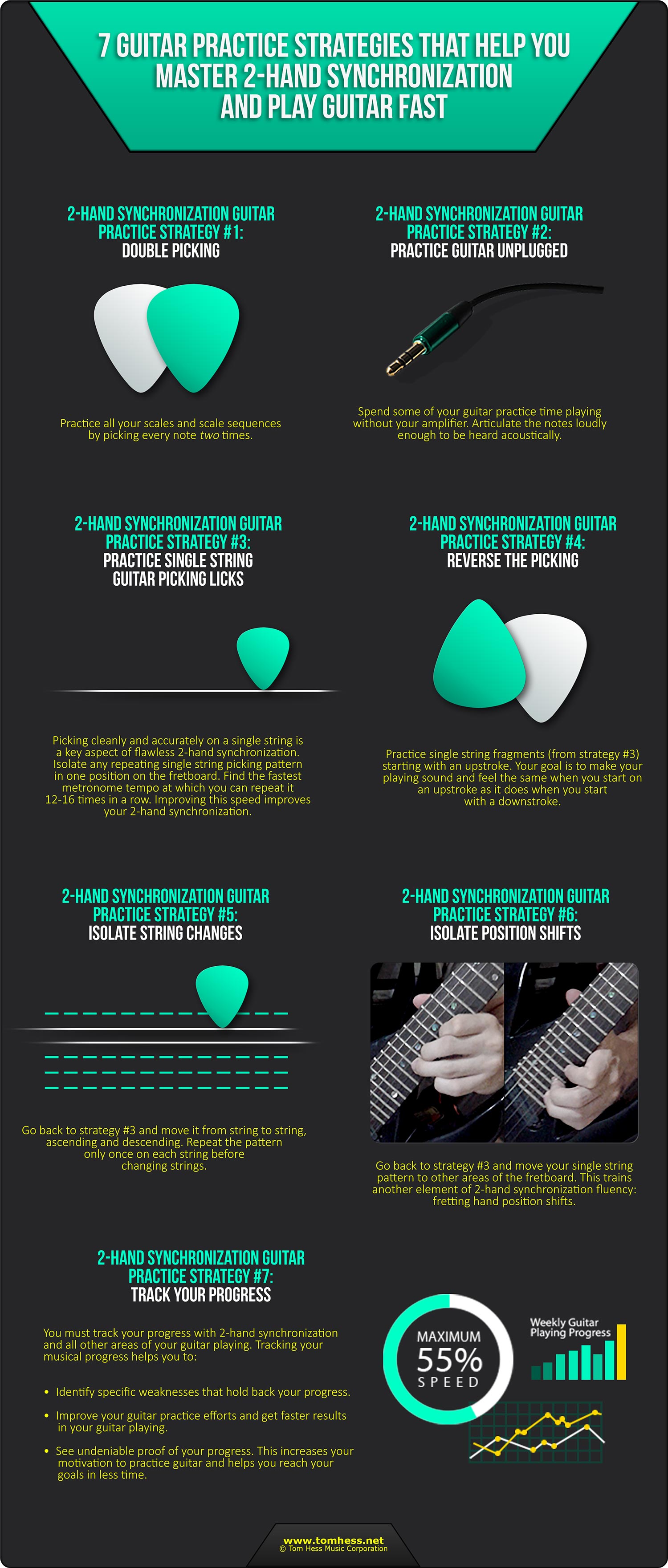
Andreas had to work specifically on evening out his pick attack after switching from alternate picking to directional picking. The switch exposed an upstroke/downstroke imbalance he'd been compensating for without realizing it.
Once his pick attack became consistent in both directions, his 2-hand synchronization improved rapidly - and with it, his usable guitar speed.
And as you apply the first four tips to increase your picking speed, the last one begins to put everything into overdrive:
Tip #5: Use Speed Bursts To Build Speed
This is the practice approach that ties everything together - and it's one of the most effective ways to pick faster on guitar that most guitarists don't know about.
Here's how speed bursts work:
Instead of starting a phrase at a slow tempo and gradually speeding up (the conventional approach), you break the phrase into short fragments of 4-8 notes and practice each fragment at or above your top speed.
You play the fragment once - fast - then stop completely for 3-4 seconds. During the silence, you analyze what you just played. Was it clean? Were your hands in sync? Was there excess tension? Then you play the fragment again, making one deliberate adjustment based on what you heard.
That's a speed burst.
The silence between bursts is also where you release excess tension. Remember Tip #3? Speed bursts have a built-in tension release mechanism.
Every time you pause, you can relax your hands, your arms, your shoulders - resetting before the next burst. This trains your body to associate fast playing with relaxation rather than tension.
Watch this video to see speed bursts practice in action:
Andreas used speed bursts to push through every speed plateau he encountered.
Combined with directional picking, picking-hand-only practice, tension control, and improved synchronization - speed bursts were the tool that brought all the other elements together and turned them into real, measurable guitar speed gains.
Now - there's something important this article can't do for you.
It can't watch you play. It can't hear your picking and tell you whether the problem is your picking motion, your tension levels, your hand synchronization, or something else entirely.
It can't tell you if you think you're doing speed bursts correctly ... but you're actually reinforcing the same mistakes at a faster tempo.
And it can't look at your overall playing and show you how picking speed fits into the bigger picture of everything you want to accomplish on guitar - from guitar technique and speed to phrasing, creativity, fretboard knowledge, improvising, and songwriting.
What I'll say next might sound self-serving. But it's the truth: a single article can show you powerful concepts (and these concepts really are powerful).
But it can't replace personalized guidance for your specific situation.
That's what I do in Breakthrough Guitar Lessons. I create personalized guitar lessons based on your exact skill level, strengths, weaknesses and goals. And along the way, I give you a ton of feedback on your playing and practicing guitar - so you make rapid progress and actually sound the way you want to sound.
I've trained thousands of guitar players to reach their goals. Many of them now play at a professional level. And the vast majority started out as ordinary people without natural talent - they simply followed a personalized strategy and put in focused practice with expert guidance.
If you practice at least 30 minutes a day, I can help you too.
Click the button on the banner below to learn more.
But whether you take lessons with me or not, there's one thing I want you to take away from this article:
My student Andreas was a scientist in a cancer research lab in Berlin, practicing guitar 45 to 60 minutes a day, wondering if he could ever pick as fast as John Petrucci - a guitarist who famously practiced 6 hours a day to build his chops.
He didn't have 6 hours. He didn't have 3 hours. He didn't even have 2.
But today, he plays the outro to Dream Theater's "This Dying Soul" faster than the recording.
A year from now, you could be in a very different place with your guitar playing.
Or you could be exactly where you are today - stuck at the same speed, grinding through the same slow practice, wondering if you've hit your ceiling.
The only difference is what you decide to do next.
Start by getting your tension under control. It's the fastest way to unlock guitar speed you didn't know you had.
Watch the free "Total Guitar Playing Tension Control" class - it shows you the 9 types of tension that could be stopping you from being able to pick faster on guitar right now and how to eliminate all of them.