How To Instantly Increase Your Legato Speed
BY AT LEAST 100%

EMAIL TO GET ACCESS
By submitting your info, you agree to send it to Tom Hess Music Corporation who will process and use it according to their privacy policy.
In this article, I show you guitar technique and guitar speed tricks that can instantly make your legato faster and cleaner.
And on top of improving the speed of your hammer ons and pull offs...
These legato speed secrets make every part of your guitar technique feel easier to do fast...
... and allow you to play fast for longer without becoming tired.
I’ve taught these legato guitar technique tricks to thousands of my students who struggled to build speed for years… and many of them play like pros today, despite practicing around 1 hour per day.
Now is your turn.
BY AT LEAST 100%
EMAIL TO GET ACCESS
By submitting your info, you agree to send it to Tom Hess Music Corporation who will process and use it according to their privacy policy.
First, I show you a demo of me teaching these techniques to one of my guitar students and increasing his speed in a matter of minutes...
Then... I go deeper into each strategy and show you how to apply it to your guitar technique, so you can boost your guitar speed without practicing more.
To begin, watch this video to see one of my most guarded guitar speed tricks for improving legato speed:
Now, let’s go deeper.
Here are 5 more legato speed boosting guitar techniques that make you faster with hammer ons and pull offs:
Tip #1 For Faster Hammer Ons And Pull Offs: Build Thicker Calluses
This is one of the simplest and least-known tricks that increases your ability to play guitar fast.
The thicker your calluses are, the less effort it takes to cleanly (and quickly) fret notes on guitar.
As the skin on your fingertips becomes harder, it takes less time to push the string all the way down to the fret and produce a clear note.
This helps tremendously with your legato (and other guitar techniques) when you’re learning to play guitar fast.
How do you best develop your finger calluses?
Answer:
Work on slides, bends and vibrato.
These techniques require a lot of friction of the fingertips on the strings (much more so than playing regular chords, scales and guitar licks). That’s why these guitar techniques develop your calluses very fast.
As a side benefit, you also get to improve your guitar phrasing at the same time as you prepare your fretting hand for doing legato and develop your ability to play guitar fast.
For example, watch this video that shows you awesome string bending variations that not only improve your calluses (with legato), but also make your guitar playing sound much more expressive:
Of course, even with thicker calluses, you still need someone watching you play to verify your legato guitar technique (i.e. your hammer on and pull off motions) are how it should be.
Without this, it’s very possible to develop bad habits that make it incredibly hard to play guitar fast.
For example: I recently had a guitar player start Breakthrough Guitar Lessons who was convinced that his fretting hand is too small to play certain guitar techniques. But after watching him play, I told him to make one simple adjustment to his fretting hand thumb position that instantly increased his reach (and improved his guitar speed) after one evening!
Such is the power of personal feedback you can only get from an expert guitar teacher.
And one of the bad habits you absolutely need to avoid (because they not only affects your legato playing, but every aspect of your guitar technique) is what I talk about in the next guitar technique tip...
Tip #2 For Faster Hammer Ons And Pull Offs: Control Excess Muscle Tension
Tension is the silent killer of guitar speed. If you use more muscle tension than you need to fret (or pick) notes on guitar...
Or, if the levels of muscle tension in your body increase as you play...
It becomes almost impossible to play guitar fast (or to play guitar for long periods of time without getting tired).
Here are some of the simplest ways to control excess muscle tension when you practice legato (and other guitar techniques) that will help you learn to play guitar fast:
1. Do a tension audit. An 'audit' means systematically checking your body for tension. Watch this video to see a tension audit in action:
2. (Briefly) exaggerate tension. Yep, just like it sounds: if you’re struggling to stay relaxed when you play guitar fast, tense your body up momentarily and then relax it again. You will relax to a greater degree than you were before you tensed up.
3. Exhale before playing fast. Exhaling makes it easier to avoid the tension spiking in your body right when you begin to play guitar fast.
The very best way to get your excess muscle tension under control is to have an expert guitar teacher watch you play (or practice) guitar and pinpoint all kinds of places you might be holding tension that you might not be aware of.
(Without this awareness, you can spend years practicing guitar and struggle to increase your guitar speed.)
The second-best way is to study my free, on-demand video masterclass called Total Tension Control. In it, I break down the 9 types of excess muscle tension (most guitar players have about 6, and are only aware of 1-2) and show you exactly how to relax each one.
For a limited time, this master class is totally free. To watch it, click the button below.
Now your calluses are thick and you're better at relaxing tension. But there is still much more to playing legato. The next tip for improving your guitar speed with legato is…
Tip #3 For Faster Hammer Ons And Pull Offs: Master Excess String Noise Control
Nobody likes the sound of sloppy guitar technique. And sloppy legato guitar technique is no exception, even if you're able to play guitar fast.

What causes sloppy guitar string noise?
3 things:
Noise from the higher (thinner) strings.
Noise from the lower (thicker) strings.
Noise from notes bleeding (ringing) together.
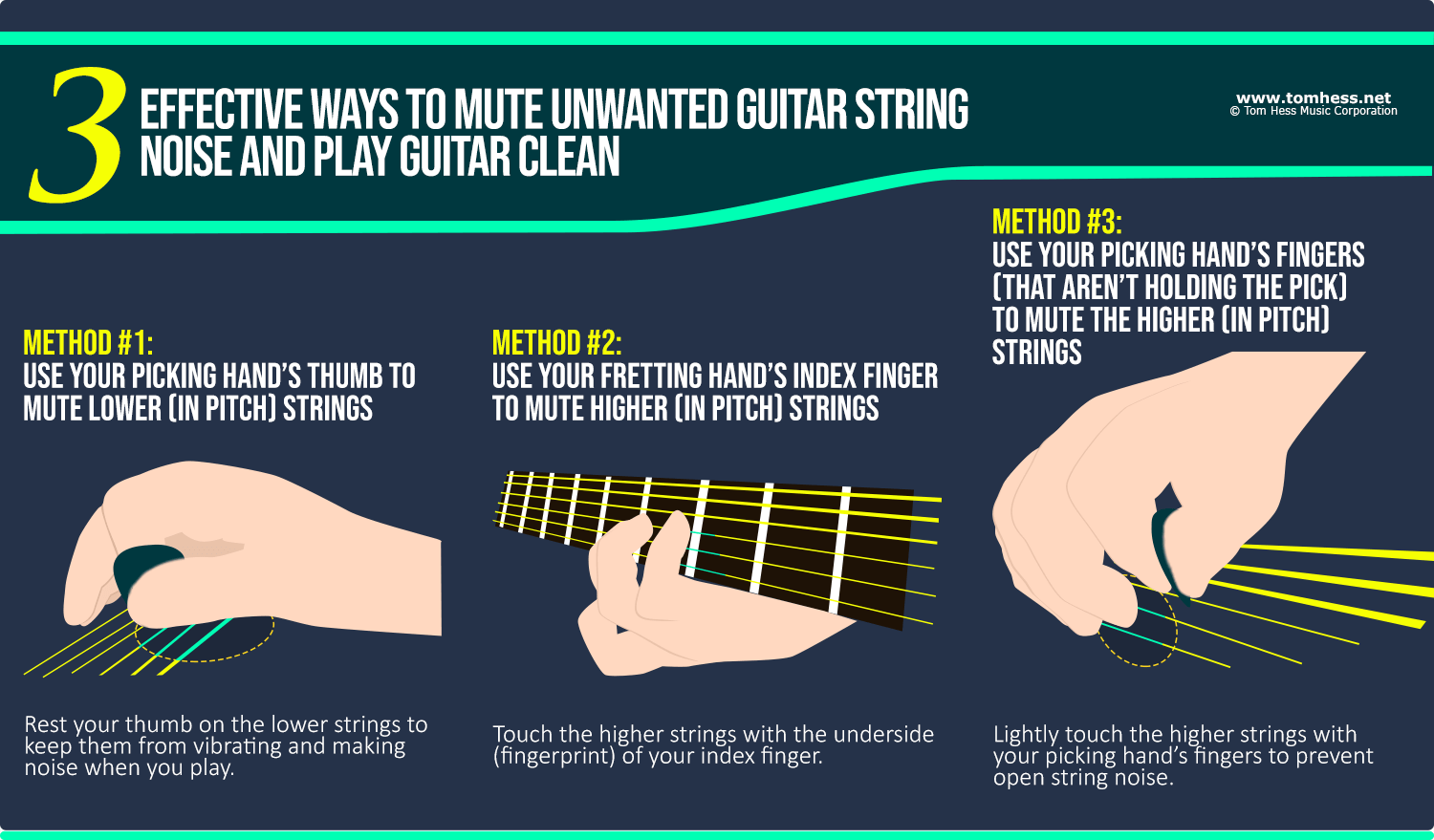
To mute string noise from the higher strings when you play guitar fast with legato, use the index finger of your fretting hand.
Simply rest it on the higher strings enough to keep them from vibrating and your playing will sound cleaner.
To mute string noise from the lower strings when you play guitar fast with legato, use your picking hand's thumb.
Rest it on the thicker strings and slide it up and down as you play your legato licks on guitar. This has the added benefit of making your picking technique much more efficient while helping you play guitar fast (and clean) with legato.
And as for controlling the notes bleeding together?
This is all about releasing the finger that finished playing from a note at the exact moment the next finger begins to play.
That said, for best results, you want to have an expert guitar teacher analyze your playing (when you're trying to play guitar fast) so they can pinpoint sloppy string noise you may not be able to hear on your own.
This is something I often do for guitar players who study with me in Breakthrough Guitar Lessons.
Just last week (at the time of writing this) a guitar student sent me a video of his legato practice… and I noticed that his picking hand's thumb wasn't on the strings the right way – creating sloppy noise.
After implementing my feedback and fixing the issue, he sent me an excited email 2 days later with a new recording that was way cleaner (and noticeably faster).
This is the impact that expert feedback can have on your guitar playing.
(And it's one of many ways you can have such feedback from me when you are a guitar student of mine.)
But even super clean guitar technique isn't enough by itself to achieve fast guitar speed with legato if you neglect the next (very common) guitar technique issue, which is…
Tip #4 For Faster Hammer Ons And Pull Offs: Control Flailing Fingers
Flailing fingers (fingers flying away from the strings) happen when you're not using correct guitar technique in your fretting hand during hammer ons and pull offs.
(They can also be caused by excess tension in your body as you work on guitar speed.)
Some of the most common guitar technique issues that lead to flailing fingers include:
– wrong thumb position
– slanted fingers instead of having the knuckles parallel to the strings
– using too much finger pressure when you fret notes (which can also lead to the notes becoming out of tune)
– collapsing the first knuckle of your fingers instead of keeping them curved when you fret notes.
This video shows how to best control flailing fingers when you're building guitar speed with legato:
Bonus tip 1: Most guitar players think the 'pinkie' finger is the one that flails away the most.
That is not correct. The index finger flies away from the strings far more than most guitar players notice or realize.
Bonus tip 2: Many guitar players misdiagnose flailing fingers in their own playing.
I often have guitar students ask me to help them fix this problem in their guitar technique…
But after taking one look at their playing, I tell them:
"You don't have to worry about flailing fingers. Your fingers look like they're flailing only from your point of view (looking down at your hand). When you watch other people play guitar (from the front), their fingers look a lot closer to the strings than they are. Fact is, everyone's fingers move away from the strings a little. But you don't have this problem."
This conversation has helped many a student of mine to stop worrying about an issue that was 'not' an issue in their playing… and saved them a ton of time and frustration.
But even if you have all 4 of these legato technique elements under control, there is one more mistake to watch out for that can make your fast legato playing sound amateur if you're not aware of it.
This mistake is ignoring the last (but not least) tip below…
Tip #5 For Faster Hammer Ons And Pull Offs: Control The Timing Of Your Legato
A common legato mistake guitar players make is distorting the rhythm of their pull offs.
i.e. Making the pull offs (or hammer ons) much faster than the other (picked) notes in the lick.
The solution is to play the lick by picking 'every' note without hammer ons and pull offs.
Get used to how the rhythm of the lick feels and sounds… then play it again using legato, following the same rhythm.
Bonus tip: play the lick using legato in quarter notes (one note per click to the metronome). This is another way to get the proper rhythm of the lick (vs. artificially making the legato notes shorter than the other notes).
Watch this video to see an example of this problem that I diagnosed in the playing of one of my guitar students (and how quickly I solved it):
Now you know how to improve your legato guitar technique and guitar speed. But what this article can't do for you is watch you play and diagnose the root causes of your specific legato challenges. It also can't help you improve with your other guitar techniques or tell you exactly what to practice to become the guitar player you want to be.
But I can do all these things for you in my personalized Breakthrough Guitar Lessons.
Unlike cookie-cutter courses or most guitar lessons you find online, I create lessons specifically for you, based on your challenges and your exact musical goals.
I've helped thousands of guitar players play like pros (even when guitar was just a hobby)… and if you can practice at least 30 minutes per day, I can help you do the same. Go here to learn more.