What NOT To Teach A Beginner Guitar Student
EMAIL TO GET ACCESS
By submitting your info, you agree to send it to Tom Hess Music Corporation who will process and use it according to their privacy policy.
If you keep attracting beginning guitar students but they quit after a few months, the cause may not be your teaching, your town, or your students' lack of discipline. Very often, it's what you put in front of them in those first lessons.
Fix that one thing, and the same students who used to quit start staying with you for years.
That's exactly what happened for Bob R., 41, a guitar teacher in a small town in Pennsylvania. Today Bob has 63 students and his guitar teaching income is nearly six times what it was.
But when he first came to me 23 months ago, his business was in a tough spot.
At that time, he'd been teaching guitar for just under two years. He had 11 students - 5 adults and 6 kids (between 11 and 14).
And while he was bringing in new students at a slow, steady pace, he had a big problem holding onto them. Most quit within a few months.
He told me: “I'm putting in the hours, but mostly treading water income-wise.” He wanted to know what he was doing wrong.
So I took a close look at what he was actually teaching his beginners. And I found the problem fast. I'll show you what it was ... and what I had him teach instead ... later in this article.
EMAIL TO GET ACCESS
By submitting your info, you agree to send it to Tom Hess Music Corporation who will process and use it according to their privacy policy.
First, the part most guitar teachers get backward.
Most guitar teachers teach their beginner guitar students topics that they ‘think’ beginners ought to learn first. But it is precisely these topics that drive those beginner students AWAY from lessons.
Here's the list of what NOT to teach a beginning guitar student - and what each one does to him.
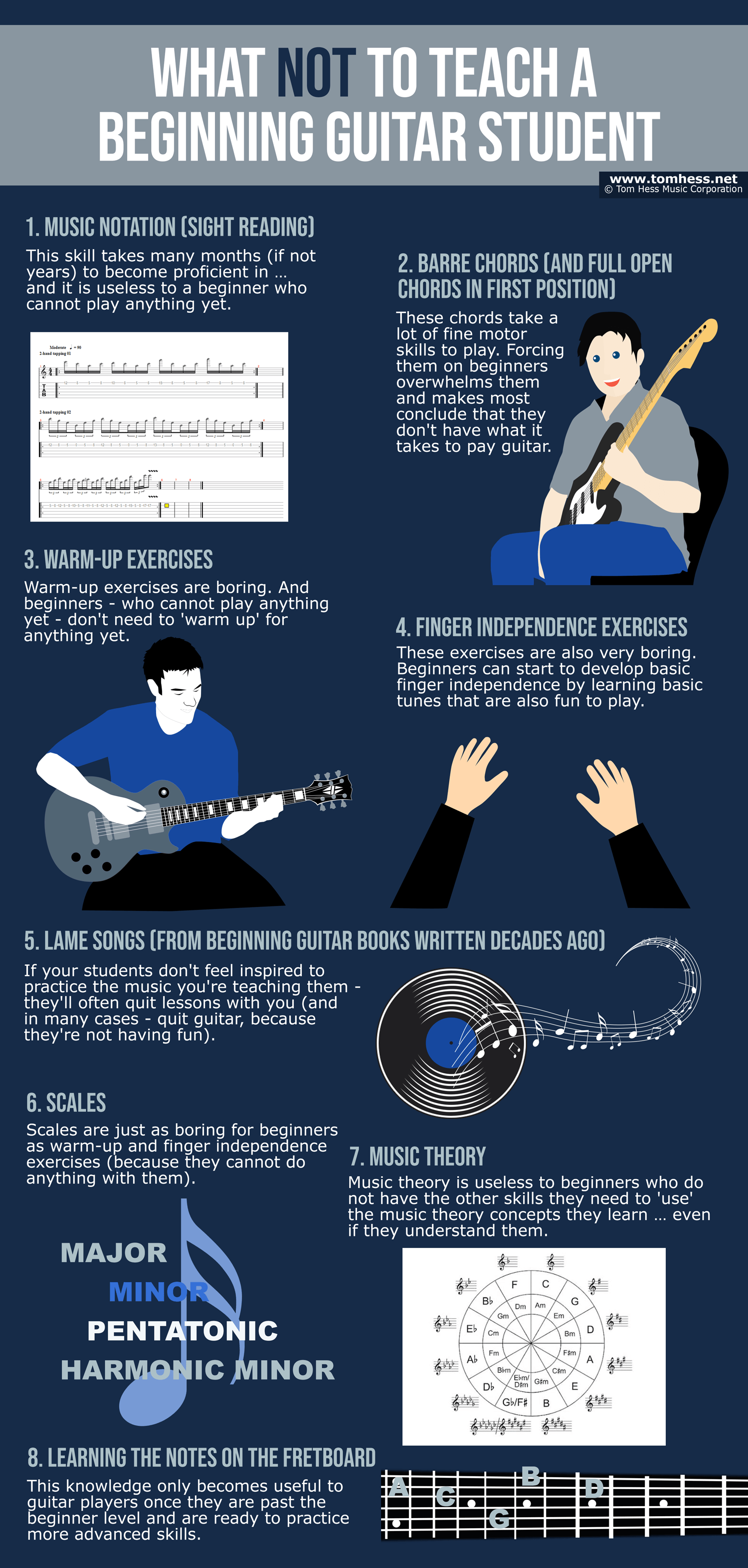
1. Music Notation (Sight Reading)
Reading standard music notation takes most people many months, and often years, to do well. A beginner who can't yet play a single thing on guitar gets none of the benefits of sight reading for a long, long time ... while being asked to put in the work RIGHT NOW.
When you teach music notation to your beginning guitar students, the first few weeks of lessons go to decoding dots on a staff instead of making anything that sounds like music.
The student has nothing he can play for anyone, and nothing that makes him feel happy about his decision to pick up the guitar in the first place. Plenty of beginners decide guitar is just tedious homework and stop showing up.
The next one is worse, because it not only bores the student - it makes him doubt his potential to learn guitar.
2. Barre Chords (And Full Open Chords In First Position)
Most teachers start beginners on full open chords - G, C, D, for example - and move toward barre chords soon after.
 How To Get Started Teaching Guitar
Avoid these crippling guitar teaching mistakes that cause most teachers to fail.
 The 3 (Big) Things You Need To Begin Teaching Guitar
Here is how to begin teaching guitar with no experience.
 How To Quit Your Day Job And Make A Living Teaching Guitar
Here is how to make way more money teaching guitar a whole lot faster.
But this “obvious” way to teach beginning guitar students is one of the fastest ways to make them quit.
Here is why:
Open chords require fine motor control in the fretting hand that a brand-new player simply hasn't built yet. Beginning guitar students have no calluses, so the strings hurt their fingers. This often causes the fretted notes to not ring clearly.
Second, since the lower frets are further apart and the fretting arm needs to be held away from the body, simply getting into the chord shape is a challenge ... not to mention playing chord changes.
A beginner who still can't fret a clean G major chord after weeks of trying doesn't think “this is a hard skill that takes time.” He assumes “I don't have what it takes to play guitar.” (And once a student decides that about himself, he's already half out the door.)
There are much simpler chord fingerings in the first position that sound good and that a beginner's hand can actually manage. For a closer look at how to introduce chords to beginners the right way, read my article on how to teach guitar chords.
But chords are far from the only thing guitar teachers add to lessons that hurt their beginner students more than they help. The next category is ...
3. Warm-Up Exercises
A beginner isn’t able to play anything demanding enough to need warming up.
So by teaching him warm up exercises, you’re spending the first few minutes of the lesson - when his attention and excitement are at their highest - on a dull routine with no result he can see or hear. This is a fast way to make guitar students bored of their lessons with you.
And this problem gets even worse if you combine warm up exercises with ...
4. Finger Independence Exercises
This skill IS important, but the way most teachers teach it (to their beginning students) is wrong.
Like warm-ups, isolated finger-independence exercises are boring ... and they kill the beginner's enthusiasm for learning guitar.
Beginners can easily build the same basic independence by learning simple tunes that are actually fun to play.
Yes ... you don't have to force your students to trade ‘fun’ for ‘skill development’.
But unfortunately, most guitar teachers do exactly this, because - on top of teaching boring finger independence exercises, they also teach ...
5. Lame Songs (From Beginning Guitar Books Written Decades Ago)
Most beginning guitar method books were written a long time ago and are full of songs nobody today - kid or adult - actually wants to play.
And here is why this matters for you - the guitar teacher:
If the music your student practices doesn't excite him, he won't practice it.
And a guitar student who doesn't practice doesn't improve, gets discouraged, and quits. In extreme cases he may even quit playing guitar altogether - convinced guitar just wasn't for him. (It was. The material was the problem.)
Now, think about your own beginning guitar students.
How many of them are still taking lessons with you three years after they started?
If the answer is “not many,” there's a pattern to how students decide to leave, usually before they ever say a word about it.
I made a free guide that lays out the 5 most common excuses guitar students give right before they quit, how to understand the deeper reason behind their excuse and how to best answer each one. It also covers the one thing most teachers do that repels serious students and keeps only the flaky ones. Get it for free here:

The next item many guitar teachers routinely teach to their beginner students will likely surprise you:
6. Scales
To most guitar teachers, scales feel like real fundamentals so they seem worth teaching right away.
But to a beginner, a scale is just a pattern of notes he can't yet do anything with. So practicing them feels like a lot of effort for no reward.
Pro tip: what beginners really need is lots of quick wins that keep them excited to come back to the next lesson.
And one thing that definitely does NOT deliver quick wins to beginning guitar students is the next item on our list, which is:
7. Music Theory
Music theory only becomes useful once a student has the playing skills to actually use it.
When you teach it to a beginner who can't yet play, you're handing him a pile of abstract information with nothing to attach it to ... even if he understands it perfectly.
Music theory (with no ability to apply it) makes learning guitar - and guitar lessons with you - feel like a school class instead of a fun activity students want to be part of for years.
And the last item on the list is another clear case of teaching something genuinely useful far too soon.
8. Learning The Notes On The Fretboard
Memorizing every note on the fretboard only becomes useful once a guitar player is past the beginner stage and ready for more advanced skills. For a beginner, it's homework with a payoff he won't see for a year ... and a year is far longer than most guitar students stick around.
What This Looked Like In Bob's Lessons
When I went through Bob's lessons, he was doing several of these at once. His beginners started with notation and a couple of open chords, got finger-independence drills for practice at home, and worked out of an old method book full of songs none of them cared about.
So here's what was happening with most of his students:
They would (usually) sign up excited.
On week one, Bob hands them notation and chords their hand can't form yet. By week three or four they are frustrated and start to wonder if they’re just not cut out for it.
Somewhere around the second month the songs begin to bore them and they stop practicing at home.
A few weeks after that, many of them were quitting ... usually with a polite excuse about time or money.
Bob couldn't see the true cause behind that, because he was inside his own lessons, teaching the way he'd been taught. That's the hard part about this.
From inside your own lessons, the guitar teaching materials all look normal. It takes someone who has watched this same sequence across a lot of different teachers to spot exactly where YOUR lessons are losing students.
Here is how I told Bob to begin teaching beginning guitar students instead:
What Beginners Actually Need
What a beginner needs in those first months is something he can play right now that sounds like real music. Music he thinks is fun and music that sounds impressive enough for him to want to play for his family and friends.
That's it. When you give that to your beginner students in your lessons, they will practice because they want to ... they will improve as a result and will want to continue learning from you because they’re enjoying the process. (Even if they aren’t naturally “disciplined”.)

For a deeper look at what to teach a brand-new student, read my article on teaching beginning guitar students.
For Bob, the change was fast. Within about ten months he'd gone from losing most of his beginners in the first 3 months to keeping most of them far past that. Twenty-three months into working with me, he's at 63 students, and his income is close to six times what it was.
How To Know What To Teach Your Own Students
I can tell you what not to teach a beginner. What I can't do in an article like this is give you the full system for knowing exactly what to teach any beginner - and in what order - or answer the specific questions that come up once you're using it with your own students.
That's what I do with the people who teach guitar for a living inside the Elite Guitar Teachers Inner Circle. I give you the exact system for deciding what to teach a beginner and in what order - the same system I gave Bob - and when a question comes up with one of your own students, you bring it to me and I answer it. Bob is one of many teachers I've coached this way, and his results came from exactly that kind of guidance.
Bob spent almost two years treading water, working hard and watching students walk away every few months. The difference between that and where he is now came down to one thing ... he learned how to stop teaching his students the things that were driving them to quit.
A year from now, you could watch the same students who used to quit still walking in for their lessons, the way Bob's do now. Or you could watch them keep quitting after a few months while you scramble to fill the empty slots on your schedule.
If you're a guitar teacher who's serious about keeping your students and growing your teaching income, come work with me in the Elite Guitar Teachers Inner Circle. I'll show you how to fill your schedule with guitar students, keep them with you much longer and make way more money teaching guitar.
Learn how to teach guitar for a living.
