How To Create Cool Guitar Licks That Are Easy To Play Fast

EMAIL TO GET ACCESS
By submitting your info, you agree to send it to Tom Hess Music Corporation who will process and use it according to their privacy policy.
You can learn to play guitar fast without having to practice more than you do right now.
Adam did exactly that.
He's 68, retired, and lives in Missouri. Today he plays 16th notes at 158 bpm. Eight months ago the fastest he could play them was 96.
When he first wrote to me, he'd been playing 46 years. His theory was solid and so was his rhythm playing. But he wanted to insert more speed into the melodies he was playing. And he could only practice about 45 minutes a day.
Here is what he told me:
“I've been at this 46 years. I know the theory, I can hold down rhythm all night, but I still can't play the stuff I wanted to play when I started. And I get maybe 45 minutes a day, and I'm 68. I don't know how many years I've got left to fix something I've been getting wrong this long.”
(If you've been playing for years and speed is the one skill that always eluded you, what happened to Adam applies to you too.)
EMAIL TO GET ACCESS
By submitting your info, you agree to send it to Tom Hess Music Corporation who will process and use it according to their privacy policy.
I'll show you what I had him change, and why it worked so fast on 45 minutes a day, further down.
But here is what I told him when we started working together:
Some guitar licks take very little practice to play fast (but they still sound very cool).
And one of the first things I showed him to help build his confidence in his guitar speed potential were licks like this:
These 👆 licks are easy for the picking hand on purpose. This is what makes them easy to play fast.
But playing someone else's licks is just the start of your journey in fast guitar playing.
The real value comes from developing the skills to create your own guitar licks that sound cool and easily add more speed to any guitar solo. That is what I worked on with Adam next by helping him develop these five skills:
Guitar Lick Tip #1: Learn One Scale All Over The Neck
Most guitar players know a scale in one or two shapes, which means they can only create guitar licks in one or two places on the neck. But they stay stuck in those same box shapes for every guitar solo they play.
The more deeply you know a single scale, the more licks you can build out of it. Learning every shape of one scale (and learning to visualize the scale all over the neck) does more for your guitar solo ideas than learning six scales in one position each.
But just 'learning' the scales is not enough. You also need to know how to make them sound musical. To do that, use the next tip, which is:
Guitar Lick Tip #2: Turn Your Scales Into Sequences
All the fast guitar licks you've heard in other players' guitar solos use scales … but those guitar players (usually) are not playing the scale up and down.
They are using something called sequences.
This is where you play a melodic fragment from the scale shifted up (and down) through the scale, one note at a time.
Scale sequences are much more fun to practice compared to playing straight scales up and down. (And because they're fun and sound more musical, practicing them helps you memorize scales faster.)
Watch this video to see how awesome scale sequences sound and how to use them in your guitar playing:
I showed Adam a few simple scale sequences and - more importantly - showed him how to create his own and use them to come up with cool guitar licks whenever he wanted.
Then it was time to show him how to play the licks faster. For that, I trained him on the most powerful picking technique for fast guitar playing, which is:
Guitar Lick Tip #3: Use Directional Picking
One of the best ways to increase your guitar speed and play faster guitar licks without much effort is to use a technique that lets you move the pick to the next note in the shortest way possible.
 Cool And Simple Pentatonic Blues Guitar Licks
Simple pentatonic ideas that make your guitar solos sound pro without advanced technique.
 3 Easy Ways To Play Guitar Faster That Most Guitarists Miss
Speed builders that work even when your practice time is very limited.
 Tired Of Playing The Same Old Guitar Licks? Do This
Fun ways to create rock guitar licks of your own for your next guitar solo.
Directional picking - NOT economy picking or alternate picking - is it.
Here is how directional picking works:
On a single string, that means down, up, down, up. When you change strings, you pick in the direction of the change. Moving toward the thinner string, pick the first note with a downstroke. Moving toward the thicker string, play the first note with an upstroke. Every time, and without planning your picking out in advance.
Compare that to alternate picking that forces your pick to go over the string you want to play, then stop, change direction and move back to finally play it. This inefficiency only grows with every note you play … and makes building speed much harder.
Sure, some players get fast with alternate picking anyway … but they have to work much harder to build the same levels of speed you can achieve faster with directional picking.
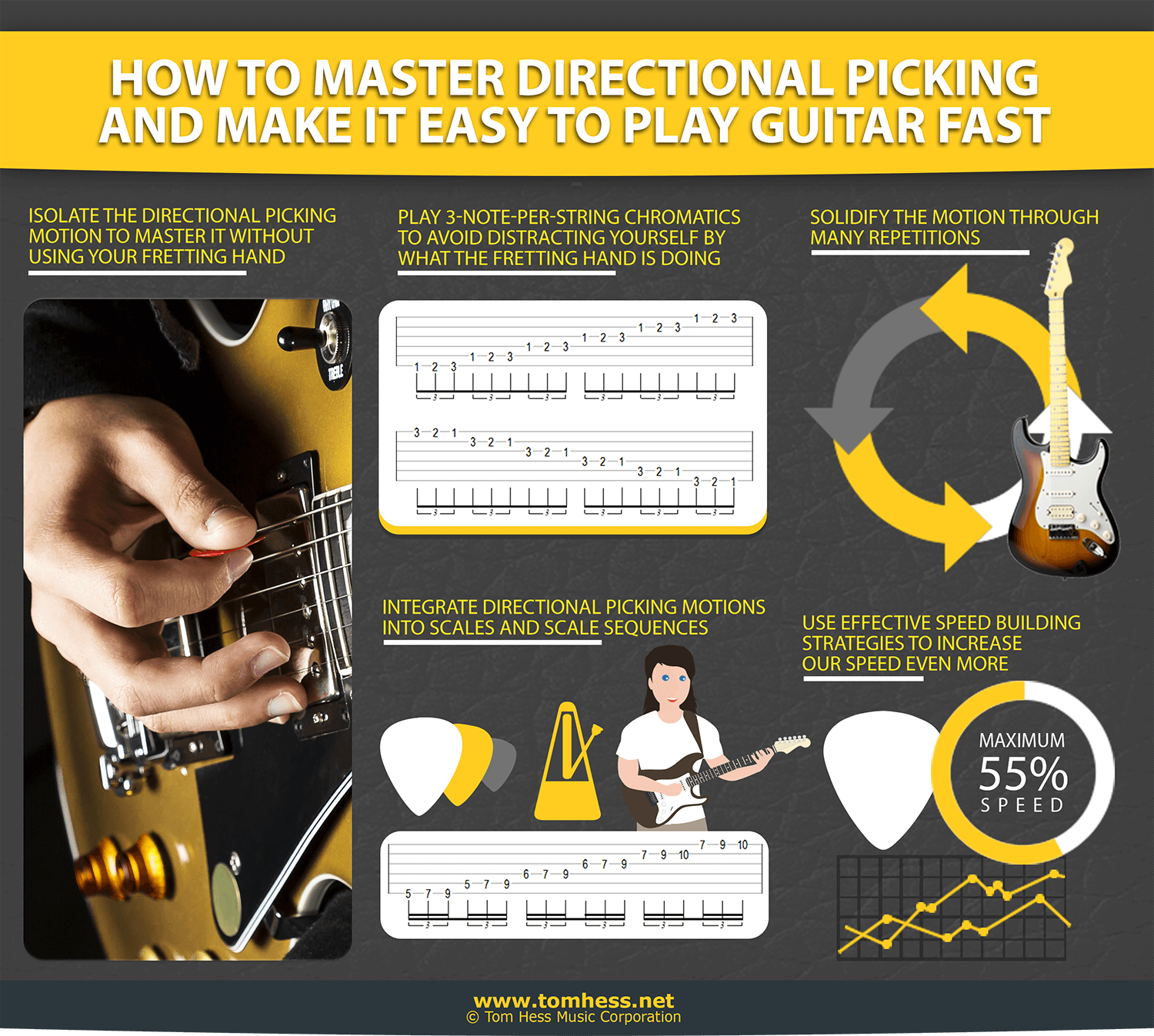
One warning, because this is where guitar players go wrong on their own. In the short term, changing your picking (or any guitar technique habit) makes your playing feel worse before it feels better. That's because you have to now focus on training your hands to do new motions … which forces you to slow down until they become automatic.
But once they do - your playing improves in a huge way (and very fast). This is what I coached Adam through to help him persevere through the technique adjustments I was training him on.
I'll come back to what that did for Adam later on. But there is something you can do about your speed a lot faster than that.
The Fastest Way To Boost Your Guitar Speed
Most of the elements of guitar speed take a good amount of practice time to develop. But there is one thing you can do in a single practice session that will have you playing faster tonight.
I explain it in a free video called: The 5-Minute A Day Guitar Speed & Accuracy Routine. It shows you how to see a measurable speed breakthrough in a single day. There's no new technique to learn and no months of practice to get there. You'll hear the difference in your speed by this time tomorrow.
Download it free here:
But simply moving the hands 'faster' is not enough to make your fast playing (and your fast guitar licks) sound good.
To make your guitar licks sound great at every speed, focus on the skill in the next tip, which is:
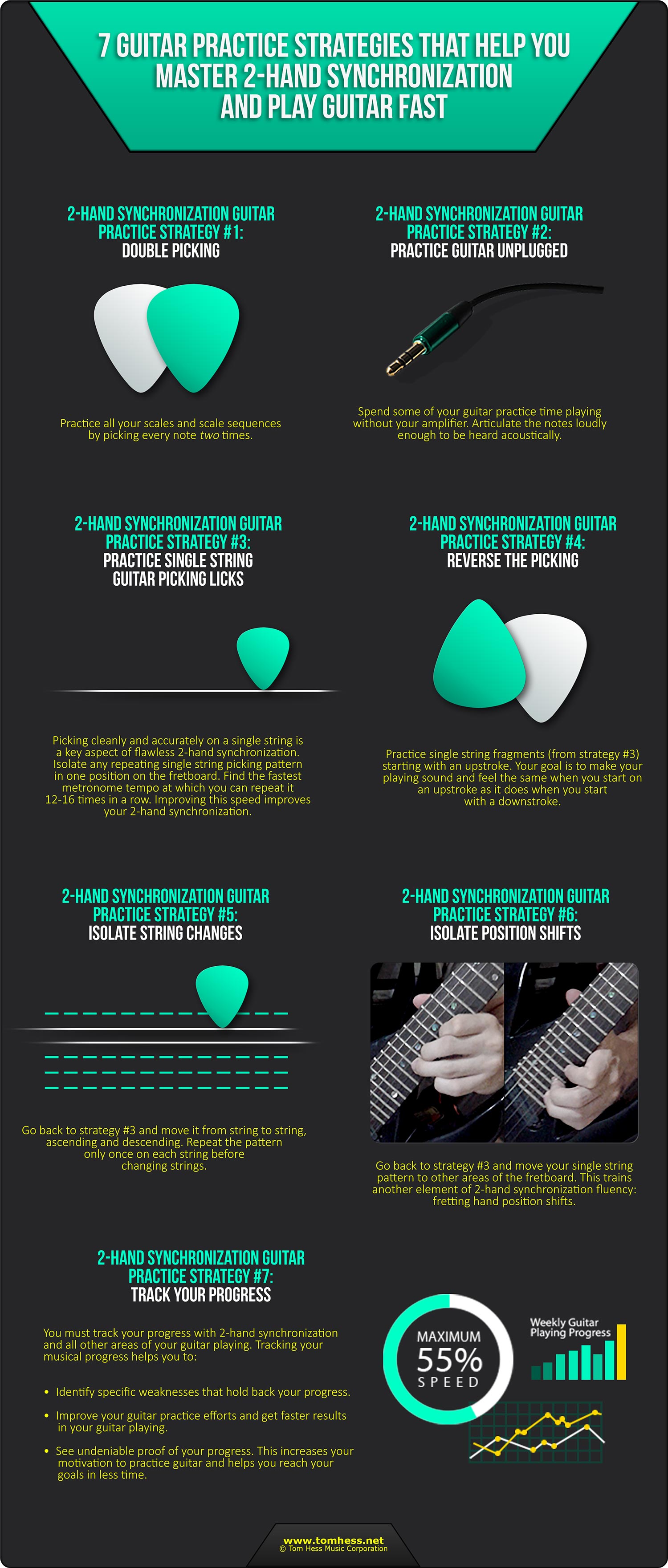
Guitar Lick Tip #4: Get Your Hands In Sync To Play Guitar Fast
Your hands have to arrive on each note of a guitar lick at the same time. When they do, your fast guitar licks sound clean.
When they don't, you hear it as sloppiness. But most guitar players assume their issue is "not enough speed" and try to play even faster … which makes the problem worse.
Here is what I said to Adam (whose practice time was limited to 45 minutes a day):
"Raising your absolute top speed takes months of work for a few bpm. But getting your hands to be in better sync at the speed you already have takes far less time."
(More importantly, once your 2-hand synchronization improves, your top speed tends to increase on its own without you trying.)
Everything so far has been about playing the notes. The last one is about the note people actually remember.
Guitar Lick Tip #5: End Your Fast Guitar Licks With Vibrato
The final note of a guitar lick is the most expressive one you play - it's the note that sustains and sticks in everyone's mind after you finish your guitar lick.
So end the fast guitar licks in your guitar solos with vibrato, and make your vibrato controlled and in tune. Uneven, out-of-tune vibrato makes everything in front of it sound amateur, no matter how clean the fast part was.
Also, everybody makes mistakes sometimes when they play fast. (I do too.) A confident note with great vibrato on the end of a lick covers up a lot of sloppy playing before it, and most listeners never hear the mistakes.
Here is how to make your vibrato sound amazing.
So those are the five skills I trained Adam on. But before you go practice all five of them, there is something you need to know about how these work.
Why These Five Don't Work The Same For Everyone
These 👆 five things aren't a checklist to work through from top to bottom. They are just 5 pieces of a giant "guitar playing" jigsaw puzzle … and every guitar player is missing different pieces.
These five were the ones Adam was missing … but no two guitar players are exactly alike. Not in the skills they're missing, not in how good they already are, and not in their practice time, personality, musical interests or strengths and weaknesses.
And the skills that are a waste of time for one guitar player can make another improve lightning fast.
That is what happened with Adam. I diagnosed the exact skills HE was missing and told him what to practice. His speed jumped from 16th notes at 96 bpm to 158 in just 8 months … despite practicing just 45 minutes per day.
Which Guitar Playing Skills Should YOU Be Practicing To Improve Your Speed Most Quickly?
In an article like this one I can show you what happens when you practice the right skills in the right way, and I can list the skills guitar players struggle with most often.
But in an article I can't watch YOUR playing and tell you what skills YOU need the most right now, or how to best fit them into the practice time you actually have on a Tuesday night.

That's what I do in Breakthrough Guitar Lessons. I create a personalized lesson plan (and lessons) specifically for you, given your skill level, practice time, goals and musical background. I give you feedback on your playing, show you what's holding you back and in what order to fix it. And I keep refining your lesson strategy as you improve … because what you need in your first month isn't what you'll need in your sixth.
Adam was 68 when he wrote to me. He'd been playing 46 years and he was doing the math on how many he had left. Eight months later he was playing faster than he had at any point in those 46 years, on 45 minutes a day.
What he had that most guitar players don't is somebody watching him play and telling him exactly which skills he needed ... and how to fit them into the 45 minutes a day he had to practice.
A year from now you could be playing the fast guitar licks that feel out of reach today - and playing them in your own guitar solos, not just in a practice room. Or you could be right where you are now, just a year older.
To get on the fast track to progress, click the “Start Now” button below: