Easy Ways To Write Songs On Guitar - Songwriting Lesson For Guitar Players
Emotion To Any Guitar Lick

EMAIL TO GET ACCESS
By submitting your info, you agree to send it to Tom Hess Music Corporation who will process and use it according to their privacy policy.
If you've always wanted to write songs on guitar but you fear that you don't have what it takes to do it, let me tell you about my guitar student David T.
Today David, 48, plays in a hard-rock band in Liverpool. And these days, he doesn't only cover other people's songs the way he USED TO.
He slots his own songs into the band's set ... something he'd wanted to do for as long as he'd been playing.
And today, he understands writing songs isn't a gift some people are born with and others aren't. It's a skill … and you can build it the same way you built everything else on the guitar.
Emotion To Any Guitar Lick
EMAIL TO GET ACCESS
By submitting your info, you agree to send it to Tom Hess Music Corporation who will process and use it according to their privacy policy.
But four years ago, things looked nothing like that.
Three things changed everything for him, and none of them are what most guitar players guess. You'll see all three below. But first, look at the mistake he was making for years, because there's a good chance it's the same one standing between you and the songs you want to write.
David could already play, and he'd put in the years to get there. But when it came to writing songs, he had no idea where to start.
So, he did what most players do. First, he tried writing riffs, and they came out boring and repetitive to his own ears.
Other times, he'd start a song and have no clue how to finish it.
He worked harder, trying to force something album-worthy out of himself, but he wasn't getting any better as a songwriter.
After enough of that, he reached the conclusion most stuck players reach. He decided he just wasn't the creative type.
Here's how he put it to me: "I feel like a monkey who can play other people's stuff but can't create anything."
The Real Reason Most Players Can't Write Songs
When David sent me his playing and told me what he was after, the problem was obvious to me.
The problem was in how he was practicing, not in how much talent he was born with.
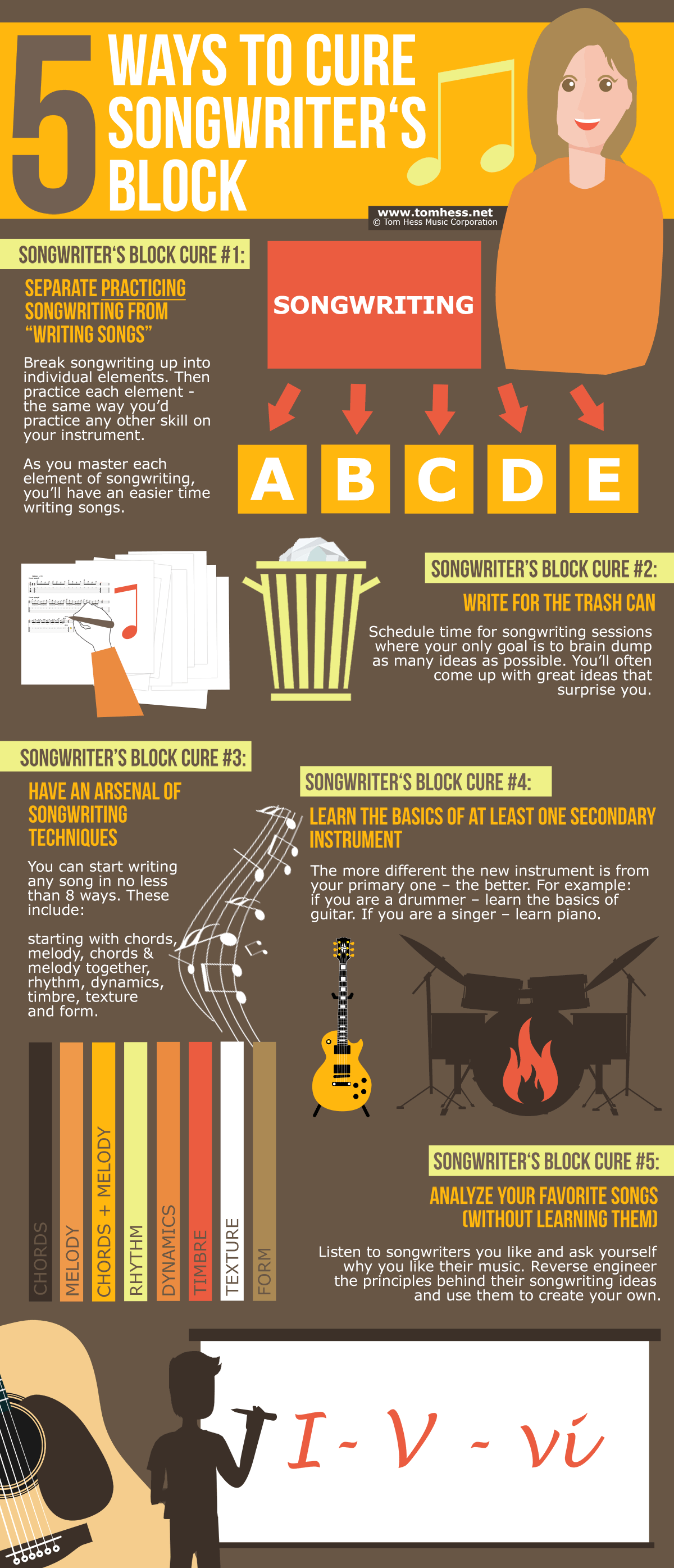
David was trying to 'write' songs instead of practicing to become a songwriter.
Think about how you got good at everything else on guitar.
You took the hard part, you isolated it, and you worked on it slowly until it was clean and smooth and in time. Then you put it back into the music.
Writing songs works the same way. (Your songwriting practice isn't supposed to sound like a finished song, any more than drilling a tricky lick is supposed to sound like a performance.)
It should look more like this:
You take one musical element - rhythm, say - and you practice creating with it. In the process, you develop the ability to use rhythm to create songwriting parts.
Watch this video where I explain how I once went through this exact process as a music composition student:
Then, you repeat this process with other musical elements (like: melody, harmony, timbre, etc.)
David, like most people new to this, was skipping that step. He was trying to write finished songs with the almost non-existent songwriting skills he had.
This realization changed everything for David ... because it showed him that yes, you can actually PRACTICE songwriting and get better at it, the same as anything else you've ever worked on.
But my next instruction to David made him do a double take:
Why I Told David To Write Bad Songs On Purpose
Yes, I told him to write bad songs. On purpose. And a lot of them.
As you can imagine, he wasn't sure about that.
But here is something most musicians don't realize:
The harder you push to make every idea album-worthy, the worse songwriter's block gets. So, I told him - and I'm telling you - to schedule time to write songs "for the trash can." (Focus on QUANTITY over quality.)
The deal was simple ... expect to throw out almost everything you create. (And if you do come up with something cool, fine. Consider it a bonus.)
Write as many as you can, as fast as you can, and let most of them be bad. (Exactly how many, and for how long, depends on where your songwriting skills are right now.)
This is exactly what happened once David let himself write garbage. Free of the pressure to be good, he started coming up with more ideas - and better ones - than he ever did when he was trying hard.
But writing ideas was only the first piece. David had something most players writing alone don't have, and we put it to use.
How To Make A Simple Song Sound Huge
After David told me he had a second guitar player in his band, we got into an element of songwriting most guitarists never think about: arranging.
Most guitar players' eyes glaze over at the word "arranging." They assume they need years of music theory knowledge to "arrange" anything.
But you don't.
See, when a song idea you write sounds thin, the obvious move is to add WAY too many parts. That's almost always what makes it worse. A couple of simple parts, placed in the right range, can make a plain song sound enormous. (But over-arranged songs can sound very muddy and overwhelming to listen to.)
Here's a simple demonstration of cool arrangement techniques for rock guitar any songwriter can use:
David took what you see in that lesson 👆 straight into his own band. And his song ideas that used to sound thin suddenly sounded massive, without anyone in the band playing anything hard.
(And even if you don't have a band or a second guitar player to jam with, you can use this same idea simply by recording two guitar parts for yourself and combining them into an arranged song you'll love the sound of.)
There was one more skill that changed how David wrote. And it started with how he listened to music.
Steal From The Songs You Love (Without Copying Them)
When most players want to learn a song, they sit down and practice playing it note for note from tab. That takes hours - hours you could spend writing your own music - and it still doesn't teach you how to write.
I had David do the opposite. Analyze the songs he loved. But don't force yourself to learn to play them all the way through (unless you really want to).
It works like this. Listen to the part you like best, and ask yourself why it makes you feel the way it does.
Then write down the ideas behind the sound. Not the notes … the musical ideas.
Once you understand the principle that makes a part work, you can use it in your own songs, and it will never sound like the thing you took it from.
This same skill also applies to your soloing. Once you can hear WHY a solo (or a phrase within a solo) makes you feel a certain emotion, you can write guitar solos that amplify the emotion already in a song, instead of just playing scales over the top of it.

So ask yourself this:
If you've been telling yourself you're just not the creative type, is that actually true? Or have you simply never practiced the thing you've been judging yourself for?
The part of playing that sounds the most like a gift - making a handful of notes drip with fire and emotion, so a listener actually feels something - is surprisingly learnable. I wrote a free eGuide that shows you how to add that fire and emotion to licks you already know, even if you can't play fast yet.
If you want to hear what I mean, and start doing it tonight with the licks already under your fingers, get it here:

What Happened With David
It took David about seven months to write his first song he felt good about performing with his band.
 Become A Much Better Songwriter
Learn new and innovative ideas to
quickly improve your songwriting.
 Improve Guitar Playing Creativity
Learn the main reasons why you
struggle to be creative on guitar.
 How To Create Killer Guitar Licks
Get tons of new ideas to improve your lead guitar playing creativity.
He stopped forcing songs. He spent his practice time generating ideas for the trash can, arranging simply with his bandmate, and pulling apart the songs he loved to find out what made them work.
Those three things 👆 are what turned it around.
Then one day, the "rough ideas" became a song of his own … in the style he actually wanted to play, not a copy of someone else's.
In his words, he feels like a true musician now, not a jukebox.
And here's the part that matters for you. At every stage, the right next step depended on me hearing David's specific playing and telling him what to work on next ... which skill to practice, and in what order. I also told him when he was ready to move on to the next thing. He never had to guess. That's the part he couldn't have done on his own.
And if you too want to create your own songs you'd love to have other people hear, the way David did, that's exactly who I built Breakthrough Guitar Lessons for.
Here's how it works. You tell me about your playing, your skill level, what you already know, and what you want to be able to do. I build a lesson plan and lesson materials made for YOU. Then, as you practice, I'm with you the whole way - I give you feedback on your actual playing, I answer your questions on live video every week, and I change what you're working on as you grow.
A free article can show you the idea. It can't listen to YOUR songwriting and tell you the one thing to fix this week. I can. (And you can see lots of proof of this by seeing my students play on the page below.)
Four years ago, David was certain he just wasn't creative. Today he plays songs he wrote himself, in front of a room, in his own band.
A year from now, you could be doing the same ... playing your own music you can feel proud of. Or you could be right where you are today, still setting your guitar down after another session with nothing of your own to show for it, still playing other people's songs at every rehearsal.
The difference was never talent. It's whether you practice the skill, and whether you have someone who can hear your playing and tell you exactly what to work on next.
That's what I do. If you want me to do it for you, start here: https://tomhess.net/Guitar