Best Way To Overcome Guitar Teacher Imposter Syndrome
EMAIL TO GET ACCESS
By submitting your info, you agree to send it to Tom Hess Music Corporation who will process and use it according to their privacy policy.
If you want to teach guitar but some part of you worries your students will "know" that you're "unqualified" and call you out as "not a REAL guitar teacher" ... You can absolutely solve this problem and build a thriving teaching business a lot sooner than you think.
A guitar teacher I know in Texas (I'll call him Brett) teaches 47 guitar students. He works 13 hours a week and takes home $7,300 a month. This is less than 1/3 of the hours he used to work at his old IT job and he's on track to surpass his old salary.
17 months ago he had never taught a single guitar lesson.
Brett could already play well enough to describe himself as a "late intermediate" player.
He was certainly better than most of his guitar playing friends, but plays nowhere near as well as his favorite players.
And because of that, he felt he wasn't ready to teach guitar just yet. Like most people, he thought that his teaching skills would come from playing ability ... and since his playing chops were not that great yet ... he was afraid to begin teaching.
He told me: "Who's going to pay me for lessons when I can't play half the stuff I listen to? I'd feel like I was ripping them off."
EMAIL TO GET ACCESS
By submitting your info, you agree to send it to Tom Hess Music Corporation who will process and use it according to their privacy policy.
So he waited ... and waited ... and waited ...
First he practiced more, because he assumed more (guitar playing) skills would cure his imposter syndrome.
And to his credit, he DID become a better player ... but his syndrome feeling stayed the same.
That's the part most people who're interested in teaching guitar don't realize: you don't become less afraid by waiting ... you only lose time.
Finally, Brett asked me to help him learn how to teach and start a business ... and we had a lot of conversations about his imposter syndrome.
What I Told Brett About Feeling Like A Fraud When You Teach Guitar
When we first talked, I didn't tell him he was good enough to teach guitar. He wouldn't have believed me anyway (anyone else's opinion of your playing does nothing about a fear that is inside YOUR head).
I told him: the feeling he was trying to get rid of was never going to go away on its own.
 Guitar Teaching Mistakes Caused By Fear
10 mistakes fear talks guitar teachers into, starting with waiting too long to teach at all.
 How To Get Started Teaching Guitar
11 mistakes inexperienced guitar teachers make, so you can skip every one of them.
 Why Big Money Teaching Guitar Isn't Complicated
5 advantages teaching guitar has over almost any other business, and how to use each one.
Most people in his position want to feel confident BEFORE they teach guitar ... but you only become confident after you've started teaching.
Then I told him the second thing, which surprised him even more: he was right to feel like an imposter ... but not for the reason he thought.
He was measuring the wrong skill.
Brett was treating guitar playing ability and guitar teaching ability as the same things - they're not.
Your guitar skills are only about your ability to play - that's it! Your guitar teaching skills are your ability to help OTHER people play guitar better.
Those 2 things have nothing to do with each other. (Which is why many of the best guitar players in the world are horrible teachers ... while players of very ordinary ability earn a great living teaching guitar, once they get trained in HOW to teach).
So, in one sense Brett WAS an imposter (because he had no skills as a teacher yet). But it didn't make sense for Brett to compare his playing to his favorite players as a judgement of his teaching potential.
So, the first thing he needed was to start learning HOW to teach - not how to play better himself.
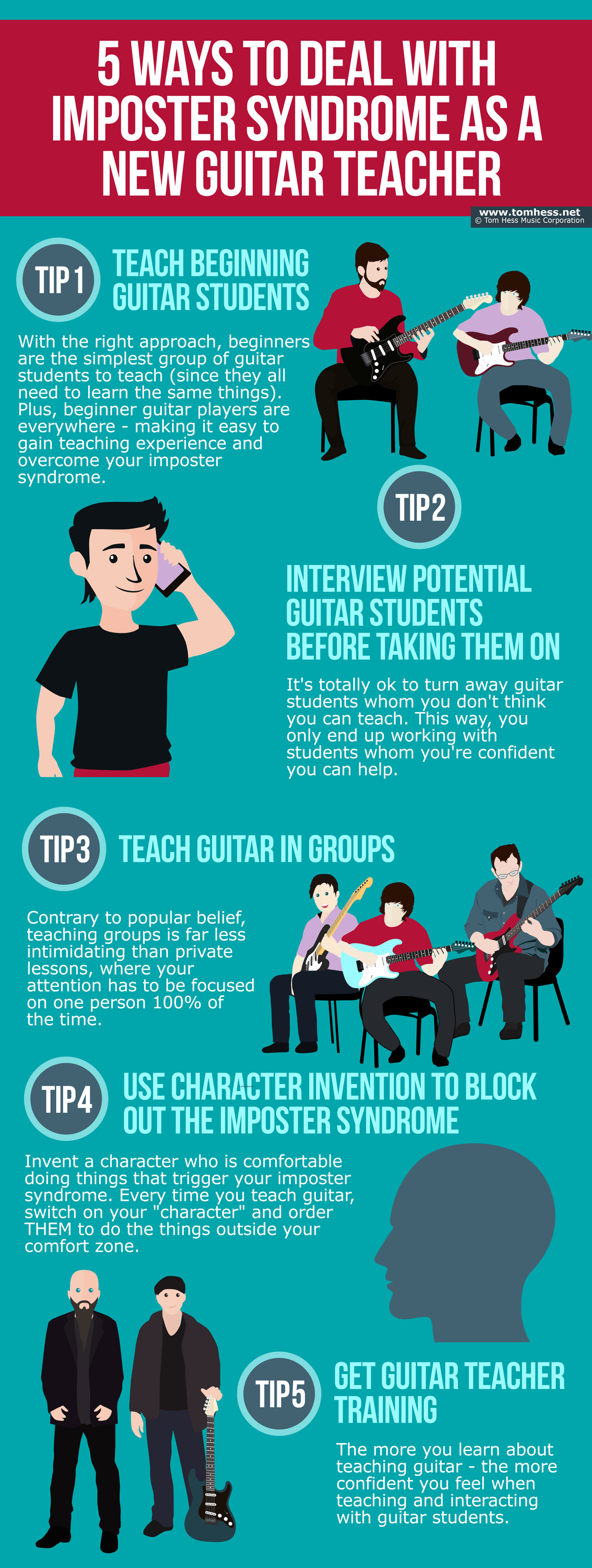
And as he started doing that, I gave him the approach to get over his imposter syndrome and begin making money teaching guitar. It has 5 parts:
The Best Group Of Guitar Students To Teach When You're New To Teaching Guitar
Beginner guitar students are the ideal group of guitar players to teach when you're new to teaching guitar.
Beginners all need the same things (and usually in the same order). And the questions they ask are so basic that you almost never get asked something you can't answer. That's what scares most new guitar teachers.
Plus: beginning guitar players are everywhere, which makes it easy to get enough practice at teaching guitar for your imposter syndrome to disappear.
This is especially true if you follow the next recommendation I made to Brett about how to teach beginning guitar students:
The Ideal Guitar Teaching Format For Overcoming Imposter Syndrome
Brett planned to teach 1-1 guitar lessons for a year or 2 and move to group guitar lessons later, once he felt more comfortable teaching guitar.
I told him to skip the 1-1 stage completely and start with groups.
He didn't agree at first (because he was afraid) ... he assumed, wrongly, that having 5 people watching him had to be 5 times scarier than 1.
But the truth is the other way around.
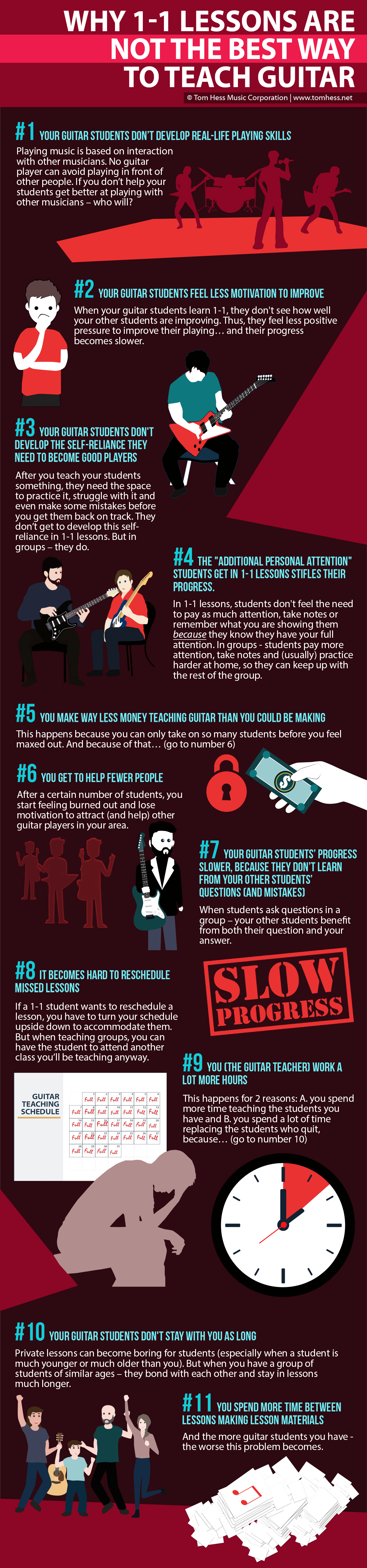
A group class is mostly about training your students while they play. You're getting them to DO things.
A 1-1 lesson, the way most guitar teachers run it, is mostly about the teaching of things. Which is exactly what a guitar teacher with imposter syndrome fears most and is least prepared for.
So he either over-prepares out of fear, or wings it out of desperation. Both create far more anxiety than a group class ever would.
Groups are also better for your guitar students' progress.
Your students learn to play with other people instead of only playing alone. They have more fun by being around other students who are on the same path as them. They develop better practice habits by doing some practicing right in front of you.
And they stay more focused, precisely because they're NOT getting 100% of your attention 100% of the time.
Where Are You In This Story?
Maybe you're at the part where Brett was still waiting to feel ready. Or maybe you already teach a few guitar students and you're waiting for the nervousness to end.
Either way, the thing that kills the imposter feeling most quickly is guitar students saying yes to studying with you, often enough that you stop doubting yourself.
That's what turns "I hope I can do this teaching thing" into telling people "I'm a guitar teacher" with a straight face. I made a free eGuide that shows you how to get far more of the people who ask about guitar lessons with you to actually start taking them. Get it here:

When It's A Good Idea To Turn Guitar Students Away
4 months in, Brett had 11 guitar students and a new problem. 2 of them wanted to learn fingerpicking ... and he couldn't help them, because he played electric guitar with a pick.
So I showed Brett how to find out what a guitar player wants to learn BEFORE taking him on as a student ... and how to get comfortable saying no to anyone he wasn't confident he could help.
When you screen guitar players before taking them on, you ONLY end up teaching students whom you're ready to work with ... whom you'll turn into better players while building your confidence to teach guitar.
Saying no (to some students) also makes you look MORE professional, not less. The guitar players who contact you about lessons trust you more for it, and they are more likely to send you their friends who ARE a better fit for you.
At first, Brett was afraid he'd never grow his income if he turned students away. But despite turning away 3 people over the next 4 months, his income went up, because the guitar students he kept stayed longer. (Plus one of them sent him a referral.)
Of course there is a right way and wrong way (lots of wrong ways, actually) to talk to prospective students to find out if you can help them, without accidentally turning away a potentially GOOD student.
But when you do it right, interviewing guitar players before you take them on is a very simple way to make sure every new student helps reduce your imposter syndrome ... as is the next strategy I showed Brett, which is:
A Simple Trick To Superhuman Guitar Teaching Confidence
Like most new guitar teachers, Brett was nervous when selling his lessons, and especially when it was time to discuss his prices.
So I told him to stop being himself for that part of the conversation.
Invent a character who is comfortable doing the things that trigger your imposter syndrome. Talking about money. Selling. Getting on the phone with a guitar player you have never met. Standing in front of a room full of students.
Then every time you teach guitar, switch that character on and order THEM to do what is outside your comfort zone.
The character makes you act. It doesn't tell you what to say.
Brett still had to learn what to say to a guitar player who tells him the price is too high, or who thinks private lessons are better than group lessons or who objects to some part of his lesson policy. You have to learn HOW to behave confidently in such situations from someone who can show you how.
Somewhere around month 12, Brett taught a full Saturday of group classes and drove home without replaying a single moment of it in his head.
No student had asked him anything he couldn't answer. No student had looked at him like he didn't belong at the front of the room. And earlier that week he had quoted his price to a new guitar player without switching his character on ... he hadn't needed it, and hadn't noticed.
He didn't wake up confident one morning. He simply taught enough ordinary lessons, to enough students he was ready for, that he ran out of reasons to call himself a fraud.
By month 17 he was teaching 47 guitar students in 13 hours a week and taking home $7,300 a month.
The Guitar Teacher Training That Makes The Other 4 Things Work
But here is the big challenge with overcoming your imposter syndrome that you can't get from any article:
The path to building confidence as a guitar teacher is different for everyone.
The exact steps you need to do to overcome your imposter syndrome depends a lot on: your situation, your background, your current skills, where you live, your personality, your natural strengths and weaknesses, and of course - the specific fears and insecurities you have around teaching guitar.

Copying someone else's approach to overcoming imposter syndrome will not work for you unless you're the exact clone of that other person.
But in the Elite Guitar Teachers Inner Circle, I coach you every month on how to teach and how to build your business.
And I keep coaching you as your situation changes.
You also join a community of successful guitar teachers who started exactly where you are now.
Many of them now earn 6-figures a year teaching guitar part time, after they learned how to teach. And they will support you in reaching whatever goal you have for yourself as a guitar teacher.
I helped many guitar players, who - like Brett - started out with no experience, lacking confidence and wondering if they were ready to teach.
But those who made the choice to learn how to teach guitar, built their confidence and their guitar teaching businesses way faster than they ever thought they could.
You can make that choice too.
A year from now you can still be waiting to "feel ready" ... still afraid to start, still feeling like an imposter, still struggling to find guitar students, keep them, teach them and earn a living from them.
Or you can be teaching with ease and confidence, attracting and keeping more guitar students than you can fit into one day, earning more money in fewer hours because you teach in groups ... and watching your students improve faster with you than the students of other teachers who are teaching them 1-1.
To choose the second one, click on the banner below: