Pivot Pattern Guitar Licks – Neoclassical Pedal Point Licks
EMAIL TO GET ACCESS
By submitting your info, you agree to send it to Tom Hess Music Corporation who will process and use it according to their privacy policy.
If you like the neoclassical pedal point guitar licks in the style of Yngwie Malmsteen and Vinnie Moore…
Then in this neoclassical guitar article...
I'll show you simple guitar licks inspired by these awesome guitar players that you can use in your next guitar solo.
More importantly:
I'll help you create guitar licks like that.
(As you'll see, it's quite simple to do.)
These guitar licks are fun and quick to learn.
Plus, they sound impressive to anyone who hears you play.
They also develop your fretboard visualization and 2-hand synchronization.
(This helps your guitar speed sound clean and more pro.)
EMAIL TO GET ACCESS
By submitting your info, you agree to send it to Tom Hess Music Corporation who will process and use it according to their privacy policy.
To begin…
Check out this neoclassical pedal point (and pivot pattern) guitar lick lesson that shows what these licks are and how to play them:
Now, let's go deeper.
Here are 5 more tips for creating your own neoclassical pedal point guitar licks that will help you play awesome neoclassical guitar solos.
Neoclassical Guitar Lick Tip #1: Learn The Harmonic Minor Scale Shapes All Over The Guitar
A common mistake guitar players make when learning scales on guitar (that makes it particularly hard to play pivot patterns and pedal point guitar licks) is learning only one position of a scale at a time.
Here are the problems this causes:
– similar-sounding guitar licks (because you're playing everything in the same scale position).
– limited pitch range in your guitar licks and solos
– feeling uncreative and difficulty in coming up with cool guitar neoclassical solos.
To solve this, spend more time building fluency with each scale you learn – practicing until you can play it all over the guitar.
In the case of neoclassical guitar playing, this means: learn all seven shapes of the harmonic minor scale all over the guitar. Here is how:

There are 7 notes in the harmonic minor scale. For example, in A harmonic minor, the notes are: A B C D E F G#. This means you can play the scale starting from any one of the 7 notes, like this:
A B C D E F G#
B C D E F G# A
C D E F G# A B
D E F G# A B C
E F G# A B C D
F G# A B C D E
G# A B C D E F
And that gives us 7 fingerings of the scale to memorize. The bad news is: you have to memorize all 7 fingerings.
But the good news?
These 7 fingering patterns are exactly the same in all 12 keys on the guitar. So, once you learn them in one key, you'll be able to transpose them into any other key with almost no practice.
How do you best memorize the 7 scale patterns and use them for pivot pattern and pedal point guitar licks?
Here are some proven ways to do it:
1. As obvious as it sounds, practice them consistently (i.e. every day). The frequency of your progress is more important than the duration of your practice. Muscle memory (as well as memory of playing neoclassical guitar scales) is developed through lots of reps.
2. Spend more time practicing the shapes you know the least. Create pedal point guitar licks (and pivot patterns) using those shapes. This will help you build equal fluency across all the shapes.
3. Practice memorizing the scale shapes away from the guitar. This means: put your fretting hand on your picking hand's forearm and mime the scale fingerings up and down, as if you are playing an actual guitar.
Do this while commuting, while standing in line at the grocery store, while falling asleep or during any other time in your day when you can't physically practice your guitar and you aren't doing anything productive, either.
Question: "Tom Hess, why not simply practice scale fingerings during my guitar practice?"
Answer: You could, but unless you are able to practice guitar for hours per day, you'll make better use of your guitar practice time by using your guitar to practice skills you can only practice with your guitar.
This is especially true for neoclassical guitar playing – a style where you need to master a lot of guitar playing skills at a high level.
Question: "Tom Hess, should I learn the harmonic minor scale (and other scales used in neoclassical guitar licks) in all 12 keys?"
Answer: No. Leave this to pianists. On guitar, practicing scales in all 12 keys is largely a waste of time for 2 reasons: the scale fingerings are identical across all 12 keys… and because you'll rarely (if ever) need to play or improvise music in all 12 keys. That said, it IS helpful to practice scales in 3-4 of the most common guitar-friendly keys. (E.g. C major / A minor, G major / E minor, D major / B minor, A major/ F# minor.)
Neoclassical Guitar Lick Tip #2: Practice Sweep Picking
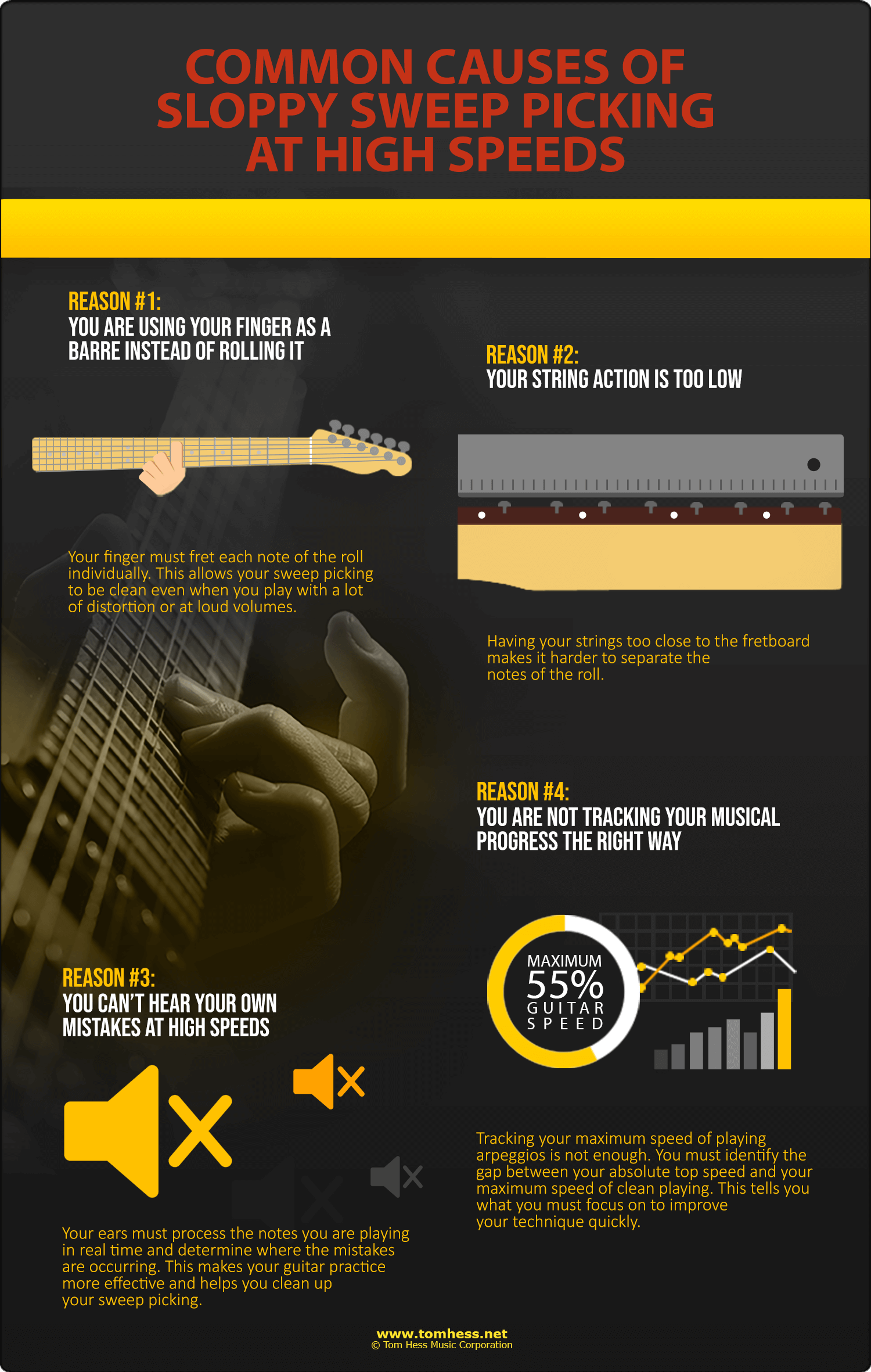
Sweep picking is used in neoclassical guitar licks (often – in combination with pivot patterns and neoclassical pedal point guitar licks) to create the baroque-influenced sound of that style.
What is sweep picking?
It's a technique used for string changes and is done by moving your hand through several strings in a single motion.
Watch this video tutorial that explains sweep picking in detail:
Here are the key elements of sweep picking to focus on as you practice guitar:
1. Your picking hand. The key to ultra-fast sweep picking (that will enable you to play clean neoclassical guitar licks) is to push your hand through the strings when you ascend (in pitch) and pull the hand back when you're descending (in pitch).
It doesn't matter if you're sweep picking through 2 strings, 3 strings, 4 strings, 5 strings, 6 strings, 7 strings, 8 strings or 9 strings…
Your picking hand always pushes through in one motion to ascend the guitar lick and in one motion to pull the hand back to descend the guitar lick. Your hand must never stop moving and never lose momentum.
2. Fretting hand. The key to efficient fretting hand motions for sweep picking is: separating the notes without letting them bleed together.
As you fret a note in a sweep picking guitar lick, the finger that played the previous note must release it, so the two notes don't bleed together.
3. Finger rolling. This is a fretting hand technique used for playing several notes on the same fret across several strings with the same finger. The challenge here is in separating the notes to prevent them from bleeding together.
This video shows you how to do fretting hand finger rolling the right way:
4. 2-hand synchronization. As you practice your sweep picking neoclassical guitar licks, find the top speed of keeping your hands in sync and spend plenty of time practicing at that tempo.
(This is the top speed where you can correctly do the motions of each hand and sync them up together.)
When this speed becomes easy, bump it up by 8-15 bpm and continue practicing to increase your 2-hand synchronization threshold.
Question: "Tom Hess, what should my picking hand do when I'm playing sweep picking licks that have hammer ons and pull offs?"
Answer: Don't stop moving your picking hand when you sweep pick, even if the fretting hand is playing hammer ons and pull offs.
The hand could slow down, but it should not stop.
Question: "Tom Hess, should I practice sweep picking guitar licks with a clean tone or distortion?"
Answer: Practice these licks with distortion. The reason is: distortion makes it much easier to hear bleeding between notes (as well as open string noise). This makes it easier to focus on those issues and fix them.
Clean tone masks sloppy guitar playing.
When you practice with a clean tone, open string noise and bleeding don't sound all that bad. Clean tone does have its place (and it can help improve your synchronization when practicing neoclassical pedal point licks and pivot patterns)… but distortion is the best tone to use when practicing sweep picking.
Neoclassical Guitar Lick Tip #3: Practice Your Vibrato
Vibrato (a series of rhythmic bends applied to a note) is key to playing neoclassical guitar licks. Great vibrato (like the kind Yngwie Malmsteen is famous for) makes your guitar sound like a violin – making your guitar licks sound more neoclassical.
Here are the elements of great-sounding vibrato:
1. It must be in tune. Meaning: when you bend a string, you have to return it all the way back down to the pitch of the original note… on every pulse of the vibrato.
2. It must be free of string noise. (Use thumb muting to mute the lower in pitch strings when doing vibrato.)
3. It must have a good balance between the speed of the pulses and their width. The faster your vibrato – the wider it should be. The slower it is – the narrower it can be. Wide and slow vibrato sounds like slow bends… and fast and narrow vibrato sounds out of control and nervous.
4. In sync with the tempo of the song (or backing track) you're playing your guitar licks (e.g. neoclassical pedal point licks and pivot patterns).
5. Consistent (as in: each pulse of the vibrato bends the string the same distance).
This video guitar lesson shows you how to do vibrato the right way:
Bonus tip for practicing vibrato: keep the note going for at least 10 seconds when you practice vibrato. This helps you assess all of the above elements of vibrato and refine them in real time. It also helps you develop great sustain in your guitar licks.
Neoclassical Guitar Lick Tip #4: Create Neoclassical Guitar Licks (And Rhythm Guitar Riffs) Using Open Strings
Try this: Play an E harmonic minor scale on the 1st string and memorize its fingering. (The notes are: E F# G A B C D#.)
Next, play the E harmonic minor scale again, but intersperse its notes with the open E string. You can play the open E string at random (whenever you want), and you can also play the notes of the scale in any order you want.
This alternation of fretted notes and open strings sounds very neoclassical… and you can create cool pedal point guitar licks and neoclassical pivot patterns doing this.
Next, repeat the process on the B string. Play the E harmonic minor scale on the B string and then create neoclassical-sounding patterns by alternating fretted notes on the B string with the open B string.
Watch this video that shows you even more cool single-string neoclassical guitar licks:
You can use open strings to also play rhythm guitar riffs as neoclassical pedal point patterns.
Neoclassical Guitar Lick Tip #5: Integrate Guitar Techniques Together
Playing neoclassical pedal point guitar licks and pivot patterns is fun, but if you want to truly master neoclassical guitar playing… you need to practice integrating (connecting) guitar techniques together.
This makes it possible to play advanced neoclassical guitar solos cleanly and fast.
Watch this video that shows how to practice guitar technique integration:
Now that you know how to create pedal point (and pivot pattern) neoclassical guitar licks, I want to help you improve your picking speed (without practicing more). I can do that in my free eGuide: How To Build Lightning Fast Guitar Picking Speed. Download it today and discover the guitar picking speed secrets most guitarists don't know.
Learn how to master guitar with the best online lessons for rock guitar.
