
Learn In 10 Minutes

EMAIL TO GET ACCESS
By submitting your info, you agree to send it to Tom Hess Music Corporation who will process and use it according to their privacy policy.
One of the most valuable lessons to be learned, in terms of achieving big musical goals, is to begin at the end. When working towards any goal, most people begin at the beginning (sounds logical doesn’t it?). The problem with starting at the beginning is most of us are focused on where we are right now. It is natural to begin from where our current strengths and weaknesses are, where our preferences lie or based on what our present circumstances are. Then what we normally do is put one foot forward (take action) based on those things. For many of us, the direction of that step (and the rest that will follow) is typically on the path of least resistance.
Learn In 10 Minutes
EMAIL TO GET ACCESS
By submitting your info, you agree to send it to Tom Hess Music Corporation who will process and use it according to their privacy policy.
You might be wondering, “why should it matter if I make plans from the top down versus the bottom up? Is there really a difference between top down and bottom up? Won’t all the steps be exactly the same?” The answer is almost always: NO! Why? Well there are many reasons, the main one is this: When you plan from the top down (starting from the end result you want and building your musical plans backwards to where you are now), you must take action IN ADVANCE to gain the knowledge needed to create the plan. This means you need to actually know (or be committed to learn) what the final steps are. Most people do not know what they are (which is perfectly normal), and/or don’t invest the time to find out (this is not good). What typically happens is people begin from the beginning (where they are right now) with an attempt to do things from the bottom up. Figuring out the first step to take from where they are now is usually easy to plan. And maybe the next 3 or 4 steps are also pretty easy to see how those things point in the general direction of their goals. Then they get stuck on what the rest of the steps might be and instead of really finding out, they usually begin to take action without a completed plan. They tell themselves things like this:
“I don’t know exactly what to do, but I have a general idea of the obvious stuff that I should be doing now, so I’ll do those things and then I’ll try to figure out what to do after that”.
Or
“I can’t plan that far ahead so I’ll just get started now and see where that leads me.”
Imagine if a corporation developed strategies in this way. What would happen? They would waste a lot of time and money not really knowing what all the steps are and their competitors would put them out of business. What happens when politicians or military leaders plan military campaigns in this way? Thousands of soldiers die unnecessarily (is anyone old enough to remember the Vietnam War?). What if financial planners only looked at developing investment strategies based on the next few steps without taking into account other longer term steps, changing markets, tax laws, etc. In all these cases the results are almost guaranteed to be negative.
The other problem with building plans from the beginning (bottom up) is that it is very likely that the steps will take you in a direction that is off course from the outcome you want. Sure, strategies may evolve over time, but the chances of staying on course are greatly increased when you know what the final 5-10 steps need to be and plan the earlier steps around getting to the later steps.
What’s next?
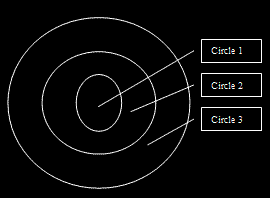
Imagine 3 circles (as in the diagram shown above):
- The smallest circle represents everything that we know at the present time.
- The middle circle represents everything that we have questions about but do not know the answer to yet.
- The largest circle represents all the things that we are not yet even aware of. These are the things we are really totally ignorant about.
We all know to search for answers to our questions. Most people spend their time finding answers to the questions in the middle circle. But how can we succeed if we don’t even know what it is that we don’t know? Finding the answers, the solutions, the guidance, and your own path to achieve what you want will be so much harder if you don’t know what the right questions are (the things in the largest circle).
 Become A Better Guitarist Faster
Become a better guitarist fast with this free musical goals mini course.
 Achieve Your Guitar Playing Goals
Find out how to reach your musical
goals faster and more effectively.
 Identify Your Guitar Playing Goals
Learn how to identify your goals
for guitar to achieve them faster.
Think back to when you were a beginning guitar player and had no clue what was involved in becoming a great musician. You probably knew there would be a lot to learn, but didn’t know, at that time, how much there is to be learned. In other words, you didn’t know what you didn’t know. As time went by, you gained more experience and now understand more about music than you did before. And this is good, very good. But if you are like most people, you also realized that music is an even bigger and deeper topic than you originally thought. The more one learns, the easier it becomes to see how much more there is to know. I remember entering college as a music student thinking that I knew a lot about music and was only there to fill in some gaps in my knowledge – it wasn’t an arrogant mindset, just an ignorant one. I found myself in awe of the abyss of musical knowledge that I didn’t even know existed up until that point.
This became clearly evident to me in a “physics of sound / music perception” class I was in at Roosevelt University. The professor designed the entire semester for this class without any real plan. He said something like, “this is a class where you basically learn whatever you want on the topics of the physics of sound and music perception”. He called it “student initiated learning”. What this meant was, every day in class we were to ask him any question we could think of on the topic we were studying. In the beginning, it seemed very strange and I didn’t like the class format because I didn’t really need him to answer my questions (I could study on my own, use the text book, run experiments, use musical resources, etc.). I felt that the class was essentially a waste of time (and a lot of money). What I wanted from the professor was for him to make me aware of all the things in my biggest circle. I wanted him to expand my awareness of all the things I was ignorant about. I told him, “I can research my existing questions myself, what I want from you is to help me develop new questions that are beyond my current level of understanding. I don’t know what I don’t know. Teach me what’s beyond the text book”.
Imagine you are seeking solutions to an important problem or challenge in your life (such as becoming the musician you want to be, or making a serious career as a professional musician perhaps). You go to a huge library searching for solutions. Lets assume that somewhere in that library is a book (or set of books) that contains the answers you need. Now imagine that for some strange reason you don’t want to ask the librarian to help you locate the book(s) that have the solutions/answers you seek. How easy will it be to “get lucky” and stumble upon the right resource you need?
It seems obvious that the fastest way to acquire the knowledge is to go straight to the librarian and tell him/her exactly what you are looking for, or look it up on the library’s data base. It’s not very effective to read every book in the library to find the specific answers you are searching for. Yet, this is exactly what some people try to do in order to reach their musical goals. Other people look at the massive size of the information out there and become intimidated by it. These people give up on their goals because it seems to “unrealistic” or “impossible”.
- The number one reason why guitar players fail an attempt to become a great musician is because they never REALLY commit themselves to it.
- The number one reason why guitar players fail an attempt to become a professional musician is because they never REALLY commit themselves to that either.
Some guitar players spend years chasing things that don’t matter and ignoring the things that do matter either because of ignorance or unwillingness to commit to finding a better way. (I can relate. I used to be exactly like this.) Those that have the greatest chances of finding the solutions to their problems or challenges are the people who seek first to discover what it is that he/she does not know. To have the right answers, you need the possess the right questions. Many of those answers may lie beyond what you are even aware exists right now (as represented in the largest circle described above).
To Begin At The End You Must:
- Be specific about what the end actually is (this article may help you)
- Build your plans from the top down (not the bottom up).
- If you don’t know how to build from the top down, find someone who does know.
Every person, situation and goal is different. Outlining a complete hypothetical plan that is specific and detailed would be overly cumbersome in this format. The purpose of this article is to shed light onto the principal of beginning at the end, not to engross you into a plan that may not be relevant to you, your goals and your present circumstances.
Maximize your guitar playing progress and become a better guitar player much faster.
