The Biggest Secrets And Myths Behind Building Guitar Speed
BY AT LEAST 100%
EMAIL TO GET ACCESS
By submitting your info, you agree to send it to Tom Hess Music Corporation who will process and use it according to their privacy policy.
If you have practiced for years and still can’t play guitar fast the way you want, you have probably started to wonder if you simply don’t have the talent for it.
Here's the good news: the reason your guitar speed is stuck almost certainly has nothing to do with talent.
But it DOES have to do with some of the myths you probably believe about building guitar speed … things that are commonly taught and that make playing guitar fast way harder than it needs to be.
I’m going to expose two of these myths, why they fail you, and what actually builds the kind of fast, clean playing you hear from the players you admire.
BY AT LEAST 100%
EMAIL TO GET ACCESS
By submitting your info, you agree to send it to Tom Hess Music Corporation who will process and use it according to their privacy policy.
Before I do, let me tell you about a guitar student of mine, named Chris from Virginia.
Today, at 59 years old - 17 months after he started taking lessons with me, Chris rips through 16th-note runs at 162 beats per minute without breaking a sweat.
But when he first came to me, things looked very different.
He has been playing since he was 26, had a good ear, knew the fretboard, understood a good amount of music theory, and had played in bands for years.
But the big thorn in his side was his lack of speed.
On a good day he could just barely push to 110 beats per minute. On a bad day he couldn’t even get there, and his hands would get out of sync the moment he tried.
When we started, Chris told me this: “I feel like I'm doing everything right, but dammit - I've been stuck at the same speed for years. I hear guys like Eric Johnson, Gary Moore and EVH just rip through this stuff, and no matter how hard I push, my hands won't go any faster. I should've cracked this by now.”
I'm telling you about Chris, because what was actually holding him back is the same thing holding back most players who feel stuck below their speed goal.
Let's start with the first belief - the one almost every guitar player follows and never thinks to question. You probably do too.
Myth 1: Alternate Picking Is 'The' Premier Way To Play Guitar Fast
Walk into almost any guitar lesson, open almost any method book, and you’ll hear the same instruction about your guitar picking: alternate pick everything. Down, up, down, up, no matter what.
Chris believed this. He believed it because every teacher he ever followed told him to, and because the players he looked up to seemed to do it.
So that’s what he practiced ... for decades.
Why does that belief keep you slow?
When you alternate pick and you change strings, the strict down-up rule often forces your pick to jump over a string, stop, reverse direction, and come back the other way to reach the next note.
Picture moving from the D string up to the G string, where the rule says the next note has to be an upstroke even though that string is sitting right below your pick. To obey the rule, your hand has to jump over the string, stop hard, turn around, and build the speed back up to pick the G string.
That braking and reversing at high speed is where your hands get sloppy, where tension builds, and where your top speed hits a wall.
Sure, plenty of guitar players have learned to play fast anyway … but that doesn't fix the problem that's built into alternate picking.
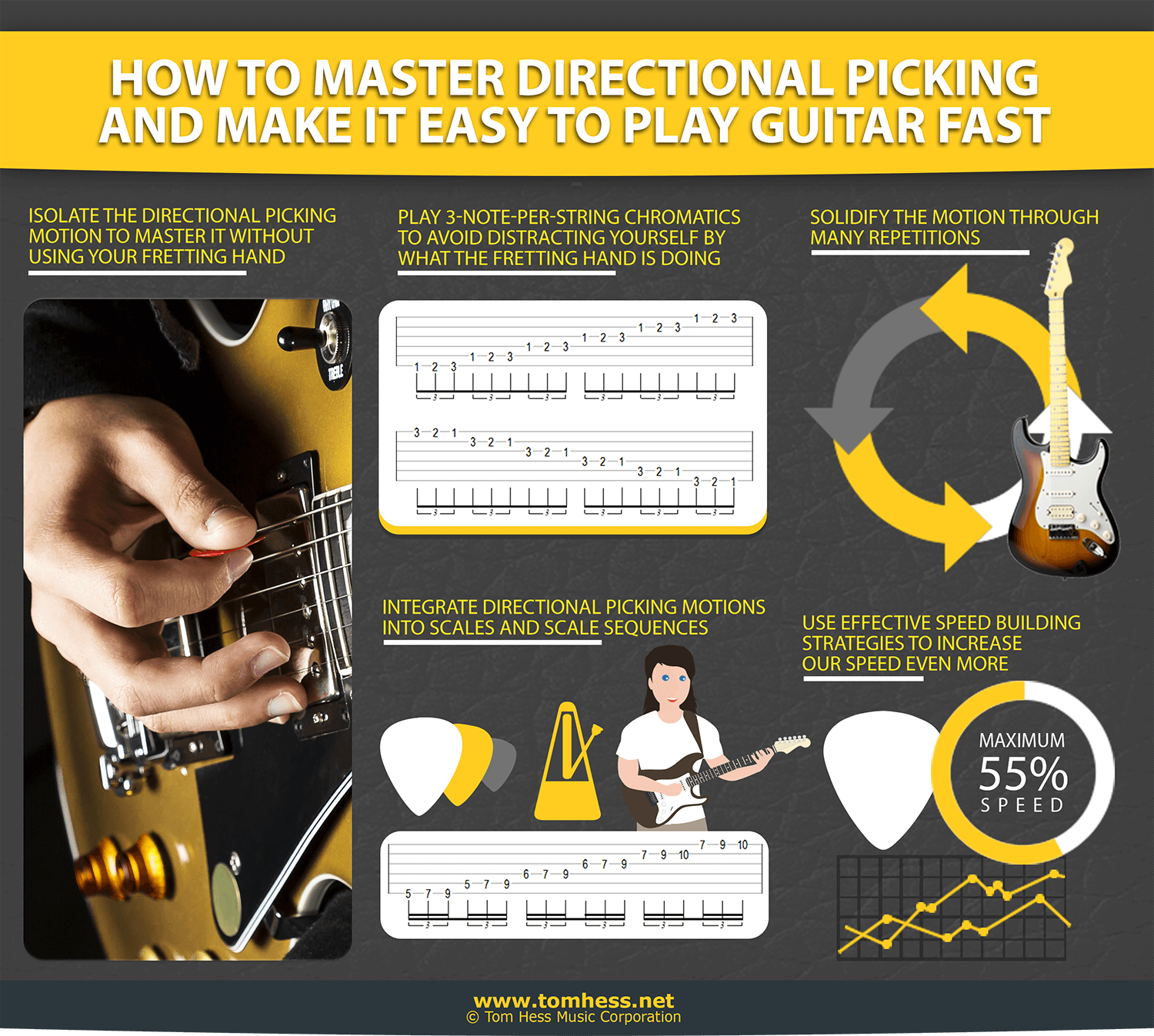
There's a better way to pick, and it's called directional picking.
The principle is simple: you move your pick the shortest possible distance to the next note, whether the note before it was a downstroke or an upstroke. This eliminates the unnecessary jumps over strings and allows the pick to travel directly where it needs to go next.
Watch this video to see a guitar lick where this mechanic allows you to achieve great speed with very little effort:
In that 👆 video, strict alternate picking would force your hand to jump over a string and reverse its movement … while directional picking lets the pick flow straight into the next note with a small sweeping motion.
Directional picking beats alternate picking for guitar speed for a few specific reasons:
It’s more efficient. Because your pick always takes the shortest path during string changes, it spends more time down between the strings and less time flying around in the air. Less wasted motion means more speed with less effort.
Plus, every time the pick leaves the space between the strings, the risk of a mistake goes up. Alternate picking pulls the pick out of that space far more often, and at high speed that's exactly where errors creep in.
It is easier on your hands. All that braking and reversing takes real force, and force means tension in your wrist. Tension is the enemy of both speed and endurance … and it's another reason why guitar players tend to have a much harder time building speed with alternate picking than directional picking.
And it works with sweep picking instead of against it. Sweeping follows the same idea as directional picking ... move to the next note the shortest way possible. Alternate picking fights that idea. Directional picking helps you master sweep picking more quickly even while you're not specifically focused on sweep picking.
The first thing I did with Chris was get him off alternate picking and onto directional picking.
That alone changed what was possible for his hands.
But it was only half of what was keeping him stuck. The second half was a belief that ran even deeper than the first one - and it was the one that had him convinced the problem was his talent.
Myth 2: You Build Speed By Starting Slow And Gradually Speeding Up A Few Beats Per Minute At A Time.
Chris did exactly this 👆 for years.
When that didn’t work, he did the thing most dedicated players do. He assumed he wasn’t doing enough of it, so he pushed his practice up to a full two hours a day.
 How To Increase Speed On Guitar
Discover the most effective ways
to increase speed in your playing.
 14 Day Guitar Speed Mini Course
Discover the most effective ways
to quickly build your guitar speed.
 Strengthen Your Guitar
Discover how to play with cleaner,
more accurate guitar technique.
He still hit the same wall.
The belief fails because it comes from a much bigger mistake: the idea that speed is one single skill.
It isn’t.
Speed is a result. It comes out of many separate skills all working together ... the basic motions of each hand, the two hands staying in sync, playing the same thing consistently instead of getting it right once in ten tries, keeping excess muscle tension under control, clean articulation, and your mind keeping up at faster tempos.
Each one of those is its own skill. And each one needs its own kind of practice.
“Start slow and gradually speed up” doesn’t develop most of these skills.
In fact, for several of them, it actually does harm. Let me show you what I mean.
First, a lot of mistakes only show up at high speeds. If you spend almost all your practice down at slow tempos, you never get to see, hear, or fix the mistakes that only appear when you play fast.
You need the ability to spot a mistake at high speed and fix it without slowing back down.
This was one of the big aha-moments for Chris as I showed him how to break through his speed plateau.
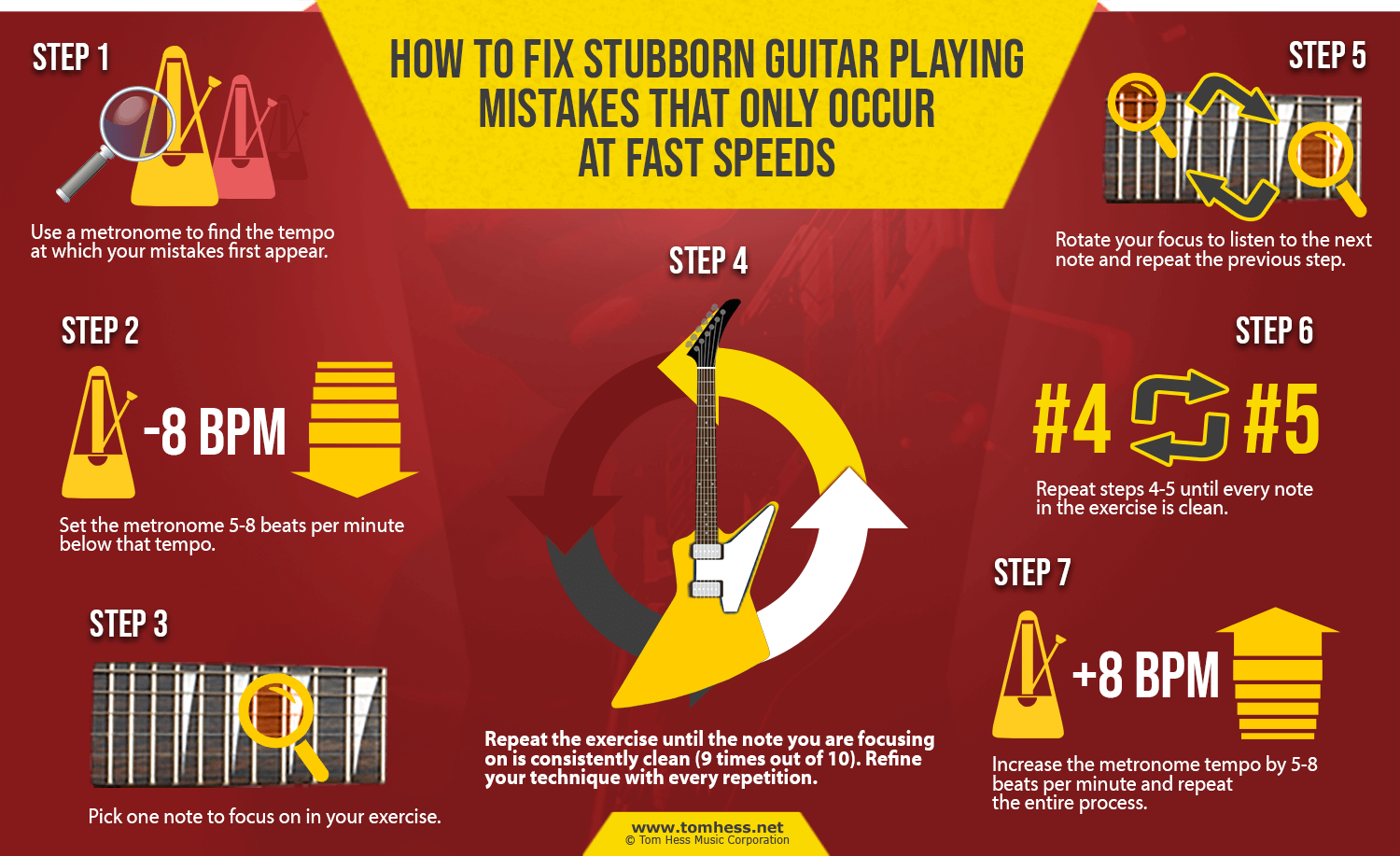
Second, you only have so much focus. You have the most of it at the very start of a session, and your focus drains as the session goes on.
When you spend most of your time starting slowly and gradually increasing the metronome tempo, you only reach your top speeds after you've already burned through most of that focus.
That is one reason practicing more didn’t make Chris faster. When he stretched his practice to two hours a day, he was attacking his hardest playing with the least focus left in the tank.
I showed him how to spot and fix his mistakes while his focus was still at full strength.
Watch one way to make this happen when you're learning to play guitar fast:
Third, when you speed up gradually, mistakes show up just as gradually - a little extra tension here, a little sloppiness there, too small for you to notice.
By the time the problem grows big enough that you can’t ignore it, it's deeply set in and very hard to undo. You need a way to make those mistakes obvious early, at the tempos where they're still easy to fix.
Fourth, “start slow” never tells you how slow. Slower than your top speed isn't the same as slow enough.
A tempo that feels slow to you can still be far too fast to do the real work, and you would never know it. (It can also mean you're playing so slowly that no mistakes show up at all ... so you spend the time feeling productive while fixing nothing.)
This clip shows exactly what I mean:
Fifth, many players use completely different motions when they play slowly than they do when they play fast.
This is exactly why your playing may feel good when practicing something at a slow speed, but it breaks down as you go faster than a certain tempo. The motions you practiced were never the motions you need to play at your goal speed.
Notice what all five of those 👆 issues have in common.
Every single one is a practice method problem that feels like a 'lack of talent' problem when the only way you know how to practice is 'start slow and gradually get faster'.
And the harder you push it, the more convinced you get that you were born without the gift.
The method built that conclusion for you, one stuck practice session at a time.
So Which Of These Have You Been Living By?
If you have been alternate picking everything and building speed by inching a metronome upward …
And you're now realizing that your practice method has been capping your speed, not your ability - that's actually very good news. Your talent was NEVER the problem ... your method was. And you can absolutely change your method starting today.
The hard part is knowing which of the skills that make speed possible are your weak links, and which one to fix first. There is a free guide that helps you start sorting that out.
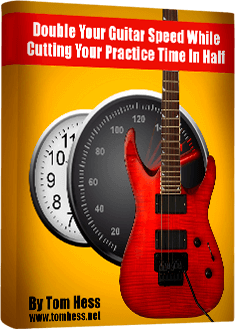
It is called Double Your Guitar Speed. It walks through how improving just five areas of your guitar technique by only 15 percent each can double how fast you play.
It also shows why roughly 75 percent of most players’ guitar practice time isn’t directly making them better, and how to spend your practice time so it actually moves you forward.
What Changed For Chris
So what happened once Chris stopped basing his practicing on both of those myths?
When he first came to me, he was operating on both without ever having questioned them.
Once he switched to directional picking and stopped fighting his own hands on every string change, his playing got cleaner almost right away.
Then I looked at his actual playing and found which of the skills underneath speed were his real weak links. For Chris, the biggest one was that he couldn’t catch his own mistakes at fast tempos. He could only feel them after his hands had already got hopelessly out of sync.
So we trained that one specific skill, with his focus fresh, at the tempos where the problems actually showed up.
He didn’t get faster by practicing more. For a while he actually practiced less. He got faster by practicing the right skills, in the right order, in the ways each one needed.
About five months in, he was already past the speed wall that had stopped him for over thirty years. Today he plays those 16th-note runs at 162 bpm clean and steady ... and he isn’t wondering whether he has the talent anymore.
Where This Leaves You
You know why working harder at the old method only digs the hole deeper. The one thing an article can never do is the part that actually matters most: look at your exact playing and know which of the skills behind speed is your real weak link, and which one to fix first.
That is exactly what I do in my Breakthrough Guitar Lessons. I find what is actually holding your guitar speed back, and build you a plan made for YOU - then adjust it as you go, giving you all the feedback, support and coaching you need to reach your goals.
It's the part YOU can't get from any article, or from a teacher who watches you play but doesn't know what he's looking for. It takes someone who can pinpoint your real weak link and knows exactly how to fix it.
A year from now, you could still be where Chris was for thirty years. Still alternate picking everything and nudging your metronome up a few beats at a time, convinced you just lack the talent.
Or you could be where Chris is now - hearing your own hands tear through a fast lick clean and steady, no hesitation, no tightening up, and finally feeling like the speed is yours.
What separates those two futures has nothing to do with how you were born and everything to do with how you practice.
Start Breakthrough Guitar Lessons today and let’s find out what is really holding your guitar speed back (it is almost never what you think it is) ... so you can finally play guitar fast the way you've wanted to all along.